
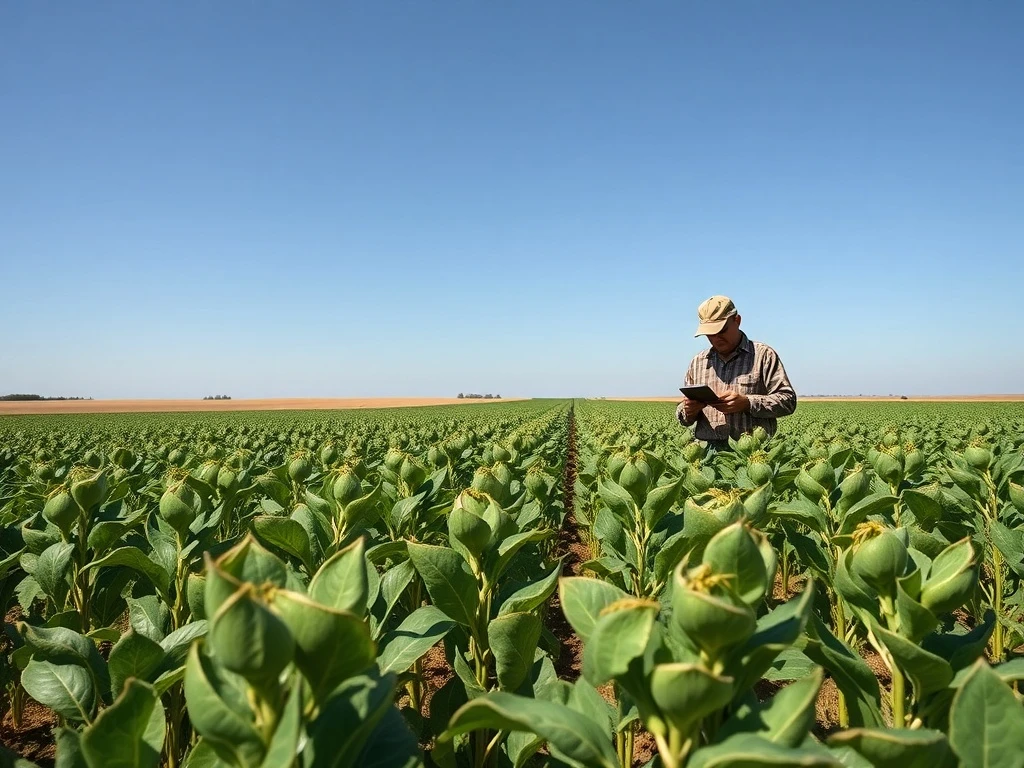
CHICAGO, March 9, 2026 — Soybean futures faced significant selling pressure during Monday’s trading session, declining 5 to 7 cents per bushel by midday. The March 2026 contract traded at $11.79½, down 5½ cents from Friday’s close, while the national average cash price dropped 6¼ cents to $11.20½. This decline represents a dramatic reversal from overnight trading, with prices falling more than 35 cents from their peak. The downward movement follows concerning export inspection data and comes ahead of Tuesday’s critical World Agricultural Supply and Demand Estimates (WASDE) report from the U.S. Department of Agriculture.
Soybean Market Sees Broad-Based Declines
The soybean complex experienced uniform weakness across related markets. Soymeal futures fell $3.00 to $3.70 per ton, while soyoil futures dropped 17 to 34 points. Interestingly, crude oil showed only modest gains of $3.97 at midday, despite being nearly $25 above overnight lows. Market analysts immediately pointed to fundamental data as the primary driver. According to Barchart’s Austin Schroeder, open interest increased by 16,951 contracts on Friday, suggesting new short positions entered the market ahead of the weekly data releases. The USDA’s Export Inspections report revealed that soybean shipments totaled 879,190 metric tons (32.3 million bushels) for the week ending March 5. This represented a concerning 24.3% decline from the previous week, though it remained 2.5% above the same period last year.
China maintained its position as the top destination, receiving 411,462 metric tons. Other significant shipments included 161,746 metric tons to Egypt and 118,747 metric tons to Indonesia. However, the cumulative marketing year total of 27.09 million metric tons (995.3 million bushels) shows a substantial 29.6% decrease compared to the previous year. This persistent year-over-year deficit continues to weigh on market sentiment, particularly as South American harvest progress accelerates.
Managed Money Positions and Harvest Progress
Commitments of Traders data from the Commodity Futures Trading Commission revealed nuanced positioning changes. Managed money traders added just 14,700 contracts to their net long position in soybean futures and options during the week ending March 3. Consequently, their total net long reached 198,902 contracts by Tuesday. Meanwhile, speculators demonstrated more aggressive positioning in soybean products. Their net long in soymeal surged by 30,392 contracts to 62,087, while the soyoil net long increased by 12,197 contracts to 75,509—the largest position since November 2022.
- Harvest Acceleration: Brazil’s soybean harvest reached 51% completion as of Thursday, according to agricultural consultancy AgRural. This progress, while substantial, still trails last year’s pace of 61% for the same date.
- Stock Projections: Analysts anticipate Tuesday’s WASDE report will trim U.S. soybean ending stocks by approximately 6 million bushels to 344 million bushels.
- Cash Market Pressure: The cmdtyView national average cash bean price decline of 6¼ cents reflects immediate physical market reactions to futures weakness.
Expert Analysis on Market Dynamics
Dr. Sarah Chen, agricultural economist at the University of Illinois, provided context for the day’s movements. “Today’s price action reflects the market’s sensitivity to weekly export data,” Chen explained. “The 24% week-over-week decline in inspections, particularly during a period when U.S. beans should be competitively priced against South American supplies, signals potential demand softness.” Chen referenced USDA’s Foreign Agricultural Service data showing increased Chinese purchases from Brazil in recent weeks. Meanwhile, Michael O’Connor, risk management specialist at ProFarmer, noted the technical damage. “The failure to hold overnight highs and subsequent breakdown through key support levels triggered algorithmic selling,” O’Connor stated. “The market now looks to tomorrow’s WASDE for direction, with particular focus on South American production adjustments.”
Historical Context and Seasonal Patterns
Monday’s decline continues a pattern of March volatility observed in recent years. Historically, soybean markets experience increased uncertainty during this period as traders balance Northern Hemisphere planting intentions against Southern Hemisphere harvest results. The current price level, while down significantly from overnight highs, remains within the trading range established since January. However, the magnitude of the intraday reversal—exceeding 35 cents—represents one of the most dramatic single-session swings of 2026.
| Contract | Price (March 9 Midday) | Daily Change |
|---|---|---|
| Mar 26 Soybeans | $11.79½ | -5½¢ |
| Nearby Cash | $11.20½ | -6¼¢ |
| May 26 Soybeans | $11.94¾ | -6¢ |
| Jul 26 Soybeans | $12.08 | -5¢ |
Forward-Looking Market Implications
Tuesday’s WASDE report now takes center stage for market direction. Analysts will scrutinize several key elements: U.S. ending stock adjustments, Brazilian and Argentine production estimates, and global demand projections. Any significant deviation from expectations could trigger substantial volatility. Additionally, the pace of the Brazilian harvest will increasingly influence U.S. export competitiveness through the spring months. Weather conditions in both South America (affecting harvest completion) and the U.S. Midwest (affecting planting intentions) will become increasingly important price drivers as March progresses.
Industry and Trader Reactions
Initial reactions from the agricultural community reflected cautious concern. “The cash market followed futures lower almost immediately,” reported Iowa grain merchandiser David Miller. “Basis levels held relatively steady, but the flat price decline means producers who haven’t priced recent rallies are seeing opportunity cost.” Meanwhile, futures traders noted increased volume in options markets, particularly in out-of-the-money puts, suggesting some participants are hedging against further declines. The relative strength in soymeal versus soyoil also sparked discussion about crush margins and processor profitability heading into the spring.
Conclusion
Soybean markets entered the week under clear pressure, with fundamental export data triggering a broad-based decline across the complex. The 5-7 cent drop in futures, coupled with a 24% weekly decrease in export inspections, highlights ongoing demand concerns as South American supplies reach the global market. Managed money maintains substantial long positions, creating potential for further volatility depending on Tuesday’s WASDE revelations. Market participants should monitor three key developments: the final Brazilian harvest pace, U.S. planting intention reports at month’s end, and any shifts in Chinese buying patterns between hemispheric sources. While today’s decline represents a significant intraday reversal, the soybean market remains within its established 2026 range, awaiting clearer fundamental direction from upcoming USDA data.
Frequently Asked Questions
Q1: Why did soybean prices drop on March 9, 2026?
Soybean futures declined 5-7 cents due to disappointing export inspection data showing a 24.3% weekly decrease in shipments, combined with ongoing pressure from advancing Brazilian harvest progress.
Q2: What is the significance of Tuesday’s WASDE report for soybean markets?
The March 10 WASDE report will provide updated U.S. and global supply-demand estimates, with analysts expecting a 6 million bushel reduction in U.S. ending stocks to 344 million bushels.
Q3: How does Brazil’s harvest progress affect U.S. soybean prices?
With Brazil’s harvest at 51% completion as of March 5 (versus 61% last year), increasing South American supplies create competitive pressure on U.S. export prospects, particularly to key markets like China.
Q4: What were the price changes across different soybean contracts?
The March 2026 contract fell 5½ cents to $11.79½, May dropped 6 cents to $11.94¾, July declined 5 cents to $12.08, and the national cash average decreased 6¼ cents to $11.20½.
Q5: How are managed money traders positioned in soybean markets?
CFTC data shows managed money held a net long of 198,902 contracts in soybean futures and options as of March 3, having added just 14,700 contracts during the previous week.
Q6: What should farmers and traders watch in the coming weeks?
Key factors include the final Brazilian harvest results, the March 31 USDA Planting Intentions report, weekly export sales data, and weather conditions affecting early U.S. planting operations.



