
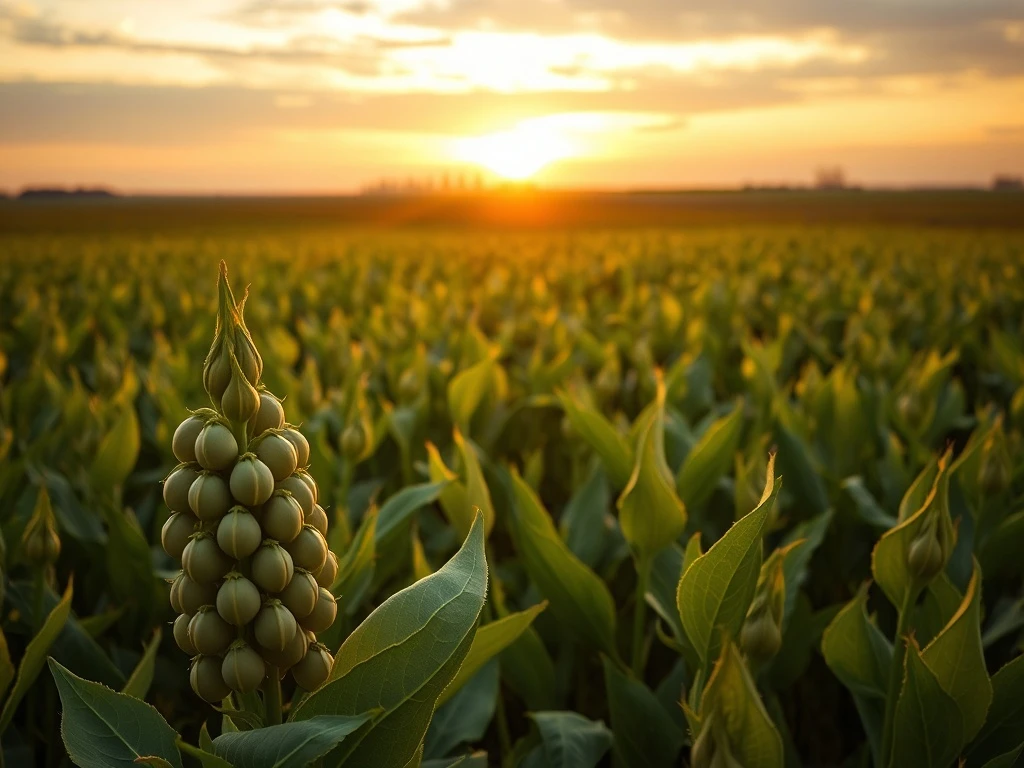
CHICAGO, March 10, 2026 — Soybean futures closed with solid gains across the board on Tuesday, March 10, 2026, as traders digested a monthly USDA World Agricultural Supply and Demand Estimates (WASDE) report that showed remarkably few adjustments to the global balance sheet. The soybeans pop higher materialized as May 2026 contracts gained 5.5 cents to settle at $12.01 3/4 per bushel, while the nearby March contract added 6.75 cents to reach $11.87 1/4. The cmdtyView national average cash price followed suit, rising 5 3/4 cents to $11.27 1/4. The modest price advance occurred against a complex backdrop of steady USDA projections, escalating Middle East tensions affecting crude oil, and anticipation of key diplomatic meetings concerning U.S.-China trade.
USDA WASDE Report Details: A Story of Remarkable Stability
The U.S. Department of Agriculture’s monthly update, released midday Tuesday, presented a market picture of unusual equilibrium. Analysts at Barchart, who have provided commodity data since 1995, noted the report’s primary takeaway was stability. The USDA made only minor tweaks to the U.S. soybean balance sheet, increasing both the import and crush categories by 5 million bushels each, resulting in a net ending stocks figure unchanged at 350 million bushels. “The market was braced for potential surprises, especially from South America,” said a senior grain analyst from a Chicago-based trading firm who requested anonymity due to company policy. “Instead, the USDA essentially confirmed the current supply narrative, which gave bulls enough confidence to push prices off session lows.”
Globally, changes were equally subtle. The USDA left its estimate for Brazil’s massive soybean crop untouched at 180 million metric tons (MMT). It did trim the forecast for Argentina’s production by 0.5 MMT to 48 MMT, a minor adjustment that reflects ongoing regional yield checks. The only other notable revision was a 0.18 MMT increase to old-crop global carryover, partially offset by a 0.2 MMT reduction to 2025/26 ending stocks, now pegged at 125.31 MMT. This data arrives as China’s General Administration of Customs reported soybean imports for January and February totaled 12.55 MMT, a 7.8% decline from the same period last year, keeping traders attentive to demand signals from the world’s largest buyer.
Geopolitical Crosscurrents and Product Market Divergence
While soybeans found footing, the trading session revealed stark divergences within the broader oilseed complex and energy markets, directly impacting processor margins. Soymeal futures posted gains of $0.80 to $1.10 per ton, finding support in robust domestic feed demand. Conversely, soyoil futures struggled, trading steady to 51 points lower, pressured by a historic sell-off in the crude oil market. Front-month crude oil futures plummeted $8.38 per barrel during the session after the U.S. Navy initiated escorted passages for commercial vessels through the Strait of Hormuz, easing immediate supply fears.
However, prices rebounded sharply—$8 off the daily low—on unconfirmed intelligence reports, cited by several maritime security consultancies, suggesting Iranian forces were placing mines in the strategic waterway. “The whipsaw in crude creates a confusing backdrop for vegetable oils,” explained Dr. Michael Lang, an agricultural economist at the University of Illinois. “Soyoil competes with petroleum for biofuel feedstock. Today’s volatility in energy makes the biodiesel profit margin calculation a moving target, which explains soyoil’s lagging performance compared to beans and meal.”
- Crude Oil Volatility: The $8.38 drop and subsequent $8 rebound created uncertainty for biofuel-linked commodities like soyoil.
- Meal Strength: Consistent livestock production and export demand provided a firm floor for soymeal prices.
- Processor Squeeze: The divergence put pressure on the “crush spread,” the profit margin for processing soybeans into oil and meal.
Expert Analysis: Reading Between the WASDE Lines
Market experts emphasize that the lack of change in the USDA report is itself a significant data point. “In a year with a record Brazilian harvest and a recovering Argentine crop, the fact that the USDA didn’t feel the need to increase South American supply estimates further is mildly supportive,” stated Karen Braun, a global agricultural columnist for Reuters. She points to the recent CONAB (Brazil’s crop agency) reports which have also stabilized, suggesting the peak of harvest pressure may be passing. Furthermore, the USDA’s decision to raise the U.S. crush forecast signals confidence in domestic biofuel and feed demand, a positive fundamental often overlooked in favor of export news.
Historical Context and Forward Price Projections
To understand the significance of Tuesday’s price move, it’s useful to compare current soybean price levels and USDA stock-to-use ratios against recent years. The market is currently trading in the upper third of its five-year price range, supported by consistent demand but capped by the enormous South American supply. The U.S. stock-to-use ratio of approximately 7.9% remains tight by historical standards, though less so than during the supply crises of the early 2020s.
| Contract | March 10, 2026 Close | Net Change (cents/bu) | Price vs. 5-Yr Avg |
|---|---|---|---|
| Mar 26 Soybeans | $11.87 1/4 | +6 3/4 | +12% |
| May 26 Soybeans | $12.01 3/4 | +5 1/2 | +11% |
| Jul 26 Soybeans | $12.15 | +6 | +10% |
| Nov 26 Soybeans (New Crop) | $11.92* | +4* | +8%* |
*Estimated based on futures curve. Source: CME Group data via Barchart.
The Diplomatic Calendar: A Key Variable for Spring Demand
Looking ahead, traders are focusing less on immediate supply reports and more on the potential for demand shifts, particularly from China. Market optimism was subtly bolstered by the upcoming meeting between U.S. Secretary of Commerce, Elizabeth Bessent, and her Chinese counterparts scheduled for this weekend in Paris. This talkshop precedes a more consequential meeting between former President Donald Trump and Chinese President Xi Jinping later this month. “Any signal of trade thaw, however faint, gets priced into the soybean market instantly,” noted a veteran grain broker on the Chicago trading floor. “We’re heading into the period where U.S. old-crop supplies are the dominant source for the global market until the Brazilian harvest is fully exported. Any import acceleration from China would tighten an already snug balance sheet.”
Farmer and Commercial Trader Sentiment
Initial reactions from the farm gate were cautiously optimistic. “A steady report without bearish surprises is a win this time of year,” said Mark Mueller, a soybean producer from Iowa, reached by phone. “It doesn’t change my marketing plan dramatically, but it tells me the floor might be a little firmer than we thought.” Commercial elevators reported steady selling from farmers holding remaining 2025 crop, but no rush to the exits, suggesting many are waiting for a potential spring rally driven by planting delays or weather scares in the Northern Hemisphere.
Conclusion
The soybeans pop higher on Tuesday ultimately reflects a market finding equilibrium after assessing new information. The USDA’s March WASDE report provided no major shocks, allowing underlying factors—steady demand, geopolitical risk premiums, and diplomatic hopes—to support prices. The stability in USDA numbers, particularly the lack of increases to South American production, prevented a bearish outcome. Moving forward, attention will pivot from static supply reports to dynamic demand signals and Northern Hemisphere planting weather. The upcoming high-level U.S.-China meetings now represent the next major catalyst for the soybean complex, with the market poised to react to any hint of changing trade winds. For now, the modest gains signal a market in balance, waiting for its next fundamental driver.
Frequently Asked Questions
Q1: Why did soybean prices rise after a USDA report with few changes?
In commodity markets, the absence of bearish news can be interpreted as bullish. Traders had feared the USDA might increase South American production estimates, which it did not. The stability confirmed existing supply expectations, allowing other supportive factors like steady demand and geopolitical events to influence prices.
Q2: How does crude oil volatility affect soybean prices?
Crude oil impacts soybeans primarily through the soyoil component. Soyoil is a major feedstock for biodiesel. Sharp drops in crude oil make biodiesel less economically competitive, depressing soyoil prices and potentially weighing on the overall soybean crush margin, though this relationship was overshadowed by other factors on Tuesday.
Q3: What is the significance of the upcoming U.S.-China meetings for soybean farmers?
China is the world’s largest soybean importer. High-level diplomatic meetings can influence trade policy and purchasing behavior. Any sign of improved relations or reduced trade tensions could lead to increased Chinese buying of U.S. soybeans, providing direct price support for American farmers.
Q4: What are “ending stocks” and why is the 350 million bushel figure important?
Ending stocks represent the amount of a commodity expected to be left over at the end of a marketing year. The USDA’s projection of 350 million bushels for U.S. soybeans is considered a relatively tight supply level historically. This tightness provides a fundamental price floor, as markets grow nervous when available supplies shrink.
Q5: How does the Brazilian soybean crop affect prices in Chicago?
Brazil is the world’s largest soybean producer and exporter. A large Brazilian harvest, like the current estimated record of 180 MMT, creates global supply competition for U.S. beans, typically limiting price rallies. The fact that the USDA did not increase this estimate further removed a potential source of selling pressure.
Q6: What should a grain farmer watch for in the coming weeks?
Farmers should monitor: 1) Progress and final size of the South American harvest, 2) Weekly U.S. export sales reports for demand strength, 3) Weather forecasts for the U.S. Midwest as planting season approaches, and 4) Any concrete outcomes from the U.S.-China diplomatic meetings that could affect trade flows.



