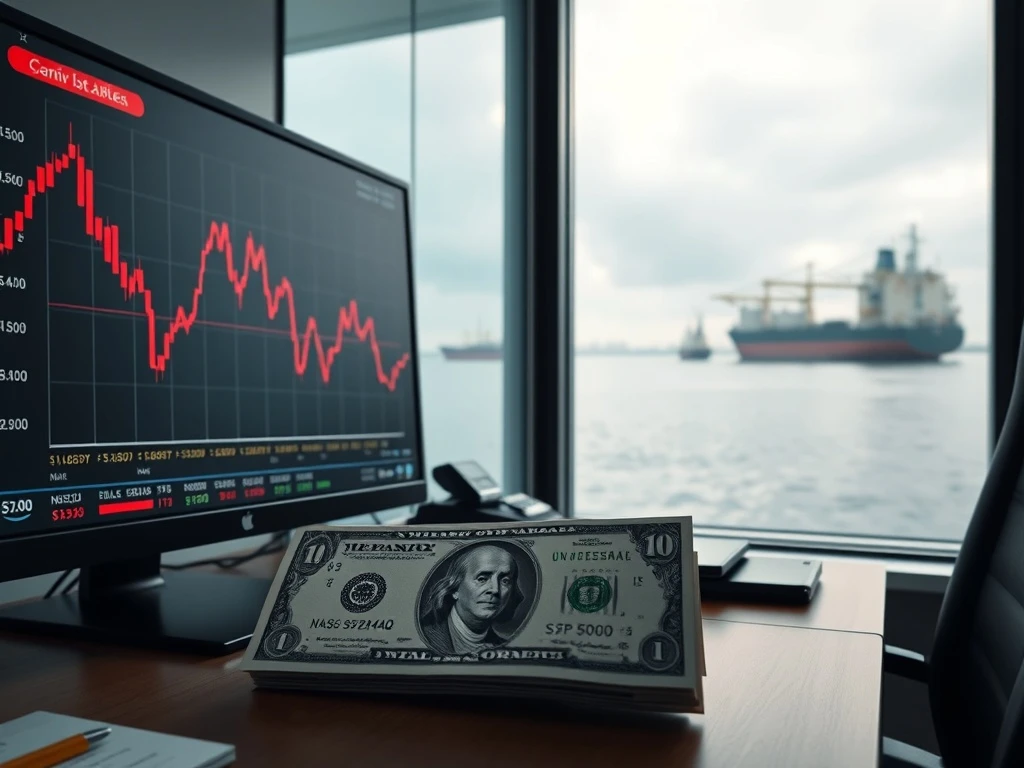
NEW YORK, March 11, 2026 — U.S. equity markets closed with modest losses Tuesday as a sharp rise in Treasury note yields and persistent geopolitical uncertainty overshadowed positive economic data. The S&P 500 Index ($SPX) fell 0.21%, while the Dow Jones Industrial Average ($DOWI) slipped 0.07%. The tech-heavy Nasdaq 100 Index ($IUXX) declined 0.04%, demonstrating relative resilience. The primary catalyst was a jump of more than +5 basis points in the benchmark 10-year Treasury yield, which climbed to 4.154%, pressuring equity valuations. Concurrently, investor anxiety remained elevated despite a 12% plunge in oil prices, as conflicting reports emerged about U.S. military activity near the Strait of Hormuz and Iran appointed a new hardline supreme leader.
Geopolitical Turbulence Drives Market Volatility
The trading session was dominated by crosscurrents from the ongoing conflict in Iran. Initially, oil prices cratered by 12% following President Trump’s assertion that the war would end “very soon” and discussions among G-7 nations about a coordinated release of strategic oil stockpiles. However, markets whipsawed after U.S. Energy Secretary Chris Wright posted on social media that the U.S. Navy had escorted a tanker through the critical Strait of Hormuz, a claim later retracted by White House Press Secretary Karoline Leavitt. This sequence, confirmed by officials at the Pentagon, created confusion and limited the equity market’s downside. “The market is trading on headlines and denial-of-headlines,” noted a veteran strategist at Barchart, who requested anonymity due to firm policy. “The yield move reflects a reassessment of duration risk when geopolitical safe-haven flows are interrupted by official communications.”
Furthermore, the fundamental landscape in Iran shifted over the weekend. Iran’s Assembly of Experts formally appointed Mojtaba Khamenei, son of the late Ayatollah, as the new Supreme Leader. Analysts at the Center for Strategic and International Studies (CSIS) immediately flagged his deep ties to the Islamic Revolutionary Guard Corps (IRGC), suggesting a continuation rather than a cessation of hostilities. President Trump later told reporters he was “not happy” with the selection, injecting further uncertainty into diplomatic channels.
Sector Performance Reveals a Split Market
The day’s price action highlighted a stark divergence between sectors. Technology stocks, particularly the so-called “Magnificent Seven,” provided crucial support. Nvidia (NVDA) and Meta Platforms (META) gained over 1%, while chipmakers like Micron Technology (MU) surged more than 3%. This strength helped cushion the Nasdaq’s fall. Conversely, energy stocks were hammered by the oil price collapse. Occidental Petroleum (OXY) fell over 3%, with Devon Energy (DVN) and ConocoPhillips (COP) down more than 2%. This sector rotation indicates investors are parsing the Iran situation for its inflationary implications versus its direct impact on corporate earnings.
- Tech Resilience: Semiconductor and mega-cap software stocks rose, betting on contained inflation and steady demand.
- Energy Collapse: Exploration and production companies sold off sharply, reflecting a brutal repricing of near-term crude forecasts.
- Defensive Mix: Consumer staples and utilities saw muted flows, suggesting the pullback was not seen as a broad risk-off event.
Federal Reserve and Economic Data Provide a Floor
Despite the geopolitical noise, underlying economic fundamentals offered support. The U.S. existing home sales report for February surprised to the upside, rising 1.7% month-over-month to a 4.09 million annual rate against expectations of a decline. This data point, sourced from the National Association of Realtors, suggested resilience in a high-rate environment. Moreover, the dramatic drop in oil prices was viewed as dovish for Federal Reserve policy, easing near-term inflationary pressures. According to CME FedWatch Tool data analyzed at market close, the probability of a rate cut at the March 17-18 FOMC meeting remained at 0%, but expectations for a cut in the second quarter slightly increased. “The market is telling a story of delayed, not derailed, growth,” said a fixed-income analyst citing the yield curve’s movement.
Global Context and Treasury Market Mechanics
Overseas markets rallied, taking their cue from Monday’s late recovery on Wall Street. Japan’s Nikkei 225 soared 2.88%, recouping part of its steep Monday loss, while the Euro Stoxx 50 gained 2.67%. This global risk-on sentiment, however, conflicted with the safe-haven bid typically associated with rising Middle East tensions, creating a complex backdrop for U.S. Treasuries. The 10-year yield’s rise was attributed to specific technical factors: soft demand at a 3-year note auction and the aforementioned retraction of the Navy escort story, which dashed hopes for a quick reopening of the Strait of Hormuz. Additionally, the 10-year breakeven inflation expectation rate edged up 1.8 basis points to 2.347%, signaling that long-term inflation concerns persist despite the day’s oil selloff.
| Index/Asset | Performance (March 11) | Key Driver |
|---|---|---|
| S&P 500 (SPY) | -0.21% | Rising yields, Iran uncertainty |
| Nasdaq 100 (QQQ) | -0.04% | Tech strength vs. yield pressure |
| WTI Crude Oil | -12.0% | G-7 stockpile talk, Trump comments |
| 10-Year Treasury Yield | +5.8 bps to 4.154% | Auction demand, safe-haven flow reversal |
| U.S. Dollar Index (DXY) | +0.3% | Moderate safe-haven bid |
Corporate Spotlight and Earnings Tailwind
Individual corporate stories added color to the session. Hewlett-Packard Enterprise (HPE) fell 3.4% after reporting revenue that slightly missed expectations. In contrast, AT&T (T) gained 0.5% following its announcement of a massive $250 billion, five-year infrastructure investment plan. Notably, the earnings season provided a fundamental tailwind. With over 95% of S&P 500 companies having reported for Q4 2025, the results have been robust. According to Bloomberg Intelligence, 74% of companies have beaten expectations, with aggregate earnings growth projected at +8.4% year-over-year—the tenth consecutive quarter of growth. Excluding the Magnificent Seven, growth still stands at a healthy +4.6%.
Looking Ahead: Key Catalysts for the Rest of the Week
Market participants are now looking to a series of high-impact events. The U.S. Treasury will auction 10-year notes on Wednesday and 30-year bonds on Thursday, testing market appetite amid the volatile backdrop. The Federal Reserve’s quiet period ahead of its March meeting begins, shifting focus to economic data. Most critically, any tangible developments regarding G-7 oil stockpile releases or military de-escalation in the Strait of Hormuz will likely dictate short-term direction. “We’re in a holding pattern between technicals and headlines,” the Barchart strategist concluded. “The path of least resistance remains lower for yields and higher for stocks, but only if the geopolitical fog clears.”
Conclusion
Tuesday’s market action underscored a fragile equilibrium. While rising Treasury yields and Iran-driven uncertainty applied downward pressure, strong corporate earnings, resilient economic data, and a crash in oil prices provided a firm floor. The result was a modest, orderly decline in major indices. The critical takeaway is the market’s nuanced interpretation of events: the Iran conflict is seen more as a supply shock to be managed rather than a systemic risk, and the economy appears strong enough to withstand marginally higher financing costs. Investors should monitor the 10-year yield’s hold above 4.15% and official statements from the G-7 regarding energy market interventions. The next significant move in stocks will likely depend on which narrative—geopolitical fear or economic resilience—gains the upper hand in the coming sessions.
Frequently Asked Questions
Q1: Why did stock markets fall on March 11, 2026?
Markets declined primarily due to a sharp rise of over 5 basis points in the 10-year Treasury yield, which increases borrowing costs and pressures equity valuations. Ongoing uncertainty surrounding the Iran conflict and conflicting reports about U.S. military activity in the Strait of Hormuz also contributed to investor caution.
Q2: How did the Iran war news specifically affect oil prices and energy stocks?
Oil prices plunged 12% on headlines about a potential imminent end to the conflict and G-7 discussions about releasing strategic oil stockpiles. This crash directly caused steep losses in energy equities, with companies like Occidental Petroleum (OXY) falling over 3%.
Q3: What is the Federal Reserve’s likely response to this market movement?
The dramatic drop in oil prices is seen as disinflationary, which could allow the Fed to maintain a patient stance. As of March 11, market pricing indicated a 0% chance of a rate cut at the imminent March meeting, but expectations for easing later in 2026 were reinforced.
Q4: Did all sectors of the stock market decline equally?
No. The market exhibited clear rotation. Technology and semiconductor stocks, like Nvidia and Micron, performed well. The sell-off was concentrated in energy and some industrial sectors, while consumer staples were relatively stable.
Q5: What are the key events to watch that could move markets next?
Critical upcoming catalysts include U.S. Treasury auctions of 10-year and 30-year debt, any official announcement from the G-7 on coordinated oil stockpile releases, and concrete developments regarding maritime security in the Strait of Hormuz.
Q6: How does the strong Q4 2025 earnings season factor into the market outlook?
The robust earnings provide a fundamental cushion. With over 95% of S&P 500 companies reporting and 74% beating expectations, corporate profitability remains strong. This underlying strength helps explain why the market’s pullback was modest despite the negative headlines.