
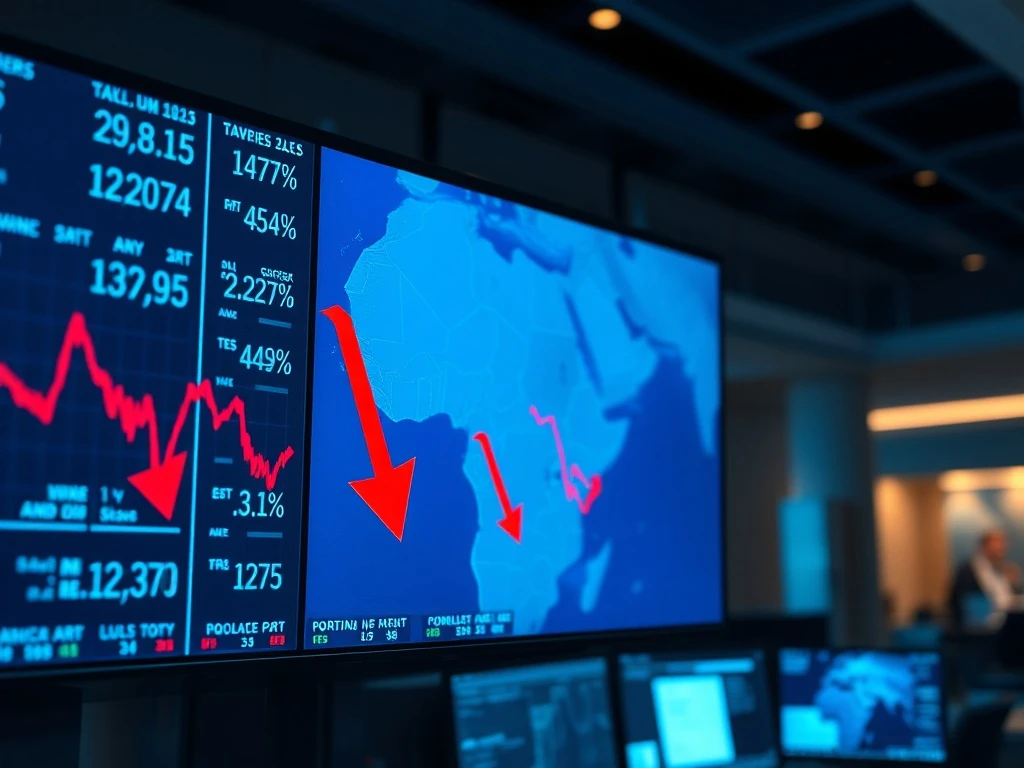
NEW YORK, March 8, 2026 — U.S. equity markets suffered a severe sell-off Friday, posting their worst single-day decline in months as a toxic combination of surging oil prices, a shockingly weak jobs report, and escalating Middle East conflict shattered investor confidence. The S&P 500 Index ($SPX) closed down 1.33%, the Dow Jones Industrial Average ($DOWI) fell 0.95% to a 3.5-month low, and the technology-heavy Nasdaq 100 Index ($IUXX) plummeted 1.51%. The simultaneous pressures of persistent inflation concerns and sudden labor market weakness created a perfect storm, triggering a broad-based retreat across major sectors and raising urgent questions about the Federal Reserve’s policy path.
Market Rout Driven by Geopolitical and Economic Shock
The trading session turned decisively negative following two critical developments. First, Qatar’s Energy Minister warned in the Financial Times that the ongoing war in the Middle East could “bring down the economies of the world.” He predicted Gulf energy exporters would shut production within weeks if the conflict persists, potentially driving crude oil to $150 a barrel. Second, the U.S. Labor Department released data showing employers unexpectedly cut 92,000 jobs in February—the largest decline in four months—while the unemployment rate ticked up to 4.4%. “The market is getting hit from both sides,” said a veteran floor trader at the New York Stock Exchange, who requested anonymity due to firm policy. “You have an external supply shock threatening to re-ignite inflation, and now domestic data suggesting the economic engine might be sputtering. It’s a worst-case scenario for equities.”
The geopolitical situation intensified midday after remarks from President Trump, who stated the U.S. would not negotiate with Iran except on terms of “unconditional surrender,” fueling fears of a prolonged and expanding regional war. This sent a fresh wave of risk aversion through the market. Consequently, March E-mini S&P 500 futures (ESH26) fell 1.39%, and March E-mini Nasdaq 100 futures (NQH26) dropped 1.58%, indicating continued pressure.
Energy Crisis Deepens as Strait of Hormuz Remains Closed
The core inflationary threat stems from a severe disruption in global energy markets, now entering its second week. The strategic Strait of Hormuz, a chokepoint for roughly 20% of the world’s oil, remains closed due to the conflict. Iran’s Islamic Revolutionary Guard Corps has warned ships they “could be at risk from missiles or rogue drones.” This closure has halted most exports from the Persian Gulf, forcing producers to stockpile crude in rapidly filling storage tanks. The physical market impact was stark: WTI crude (CLJ26) surged over 12% Friday to a 2.5-year high.
- Infrastructure Attacks: An intercepted Iranian drone caused a major fire at the Fujairah oil-trading hub in the UAE. Separately, Qatar shut its massive Ras Laffan LNG plant after a drone attack, removing 20% of global LNG supply.
- Global Ripple Effects: European natural gas prices hit a 3-year high. China ordered its largest refiner to suspend diesel and gasoline exports, tightening global fuel supplies further.
- Risk Premium: Analysts at Goldman Sachs estimate the real-time risk premium for crude oil at $18 per barrel, reflecting the impact of a six-week halt in Strait of Hormuz traffic.
Federal Reserve Officials Attempt to Calm Inflation Fears
In response to the market turmoil, several Federal Reserve officials provided public commentary, aiming to separate temporary energy shocks from core inflation trends. Fed Governor Christopher Waller stated, “The Iran war is unlikely to cause sustained inflation. That’s one reason the Fed doesn’t look at energy prices but looks at core prices, excluding energy, as core is a better predictor of future inflation.” His remarks helped U.S. Treasury notes recover from early losses. Meanwhile, Cleveland Fed President Beth Hammack and Boston Fed President Susan Collins both emphasized a patient, hold-steady approach, citing an “uncertain inflation picture” and the need for more evidence of cooling prices. The market-implied probability of a rate cut at the March 17-18 FOMC meeting remained near zero, at just 5%.
Sector Carnage: Tech, Airlines, and Crypto-Related Stocks Hit Hard
The sell-off was notably broad. The so-called Magnificent Seven technology stocks, which have driven market gains for years, were a significant drag. Meta Platforms (META), Tesla (TSLA), Amazon.com (AMZN), and Nvidia (NVDA) all fell more than 2%. Semiconductor and AI-infrastructure stocks were battered, with Lam Research (LRCX) down over 7% and Micron Technology (MU), KLA Corp (KLAC), and Applied Materials (AMAT) all dropping more than 6%.
The surge in oil prices crushed airline stocks on rising jet fuel cost fears. American Airlines (AAL) and Southwest Airlines (LUV) plunged over 5%. Cryptocurrency-exposed equities like Riot Platforms (RIOT) and Galaxy Digital (GLXY) fell more than 9%, mirroring a sharp drop in Bitcoin. In contrast, defense stocks rallied on speculation of increased military funding, with AeroVironment (AVAV) up over 3% and Lockheed Martin (LMT) gaining more than 2%.
| Sector | Key Driver | Representative Move |
|---|---|---|
| Technology/Semiconductors | Broad risk-off sentiment, valuation concerns | Lam Research (LRCX): -7% |
| Airlines | Jet fuel costs from soaring oil prices | American Airlines (AAL): -5% |
| Cryptocurrency Equities | Sharp decline in Bitcoin price | Riot Platforms (RIOT): -9% |
| Defense & Aerospace | Geopolitical conflict, budget expectations | AeroVironment (AVAV): +3% |
Looking Ahead: Earnings Strength vs. Macroeconomic Headwinds
The fundamental backdrop presents a stark contrast. While macroeconomic fears dominate, the underlying corporate earnings picture remains robust. The Q4 2025 earnings season is nearly complete, with over 95% of S&P 500 companies having reported. According to Bloomberg Intelligence, 74% have beaten expectations, and S&P 500 earnings growth is estimated at +8.4% year-over-year—the tenth consecutive quarter of growth. Excluding the Magnificent Seven, growth is still a healthy +4.6%. “The corporate sector is fundamentally healthy,” noted a lead strategist from a major asset manager. “But in the short term, markets are voting on macro fears—oil, war, and Fed policy—not on earnings beats.”
Global Markets and Interest Rate Reaction
Overseas markets offered little solace. The Euro Stoxx 50 tumbled 1.09% to a 3-month low, pressured by revised-lower Eurozone GDP data. In contrast, Asian markets were mixed, with Japan’s Nikkei 225 rising 0.62%. In bond markets, the U.S. 10-year Treasury yield initially spiked to a 3-week high of 4.175% on inflation fears but retreated to 4.131% after the weak jobs data bolstered hopes for eventual Fed easing. European bond yields, however, continued to climb.
Conclusion
Friday’s stock market retreat underscores a fragile equilibrium where strong corporate earnings are being overwhelmed by acute macroeconomic risks. The twin shocks of geopolitical energy disruption and unexpected labor market softness have forced a rapid reassessment of the economic outlook. While Federal Reserve commentary suggests a focus on core inflation and a patient stance, the immediate pressure from soaring commodity prices is undeniable. Investors now face a volatile landscape where the trajectory of the Middle East conflict will be as critical to watch as any economic data point. The market’s next move likely hinges on whether the energy shock proves transient or begins to embed itself in broader price expectations, potentially delaying the monetary policy pivot that equities have been anticipating.
Frequently Asked Questions
Q1: What caused the stock market to drop so sharply on March 8, 2026?
The decline was triggered by two main factors: escalating war in the Middle East threatening to send oil prices to $150/barrel, and a surprisingly weak U.S. jobs report showing a loss of 92,000 positions in February. These events sparked renewed inflation fears and concerns about economic strength.
Q2: How did the closure of the Strait of Hormuz affect markets?
The closure of this critical oil chokepoint, which handles 20% of global supply, halted energy exports from the Persian Gulf. This directly caused WTI crude oil prices to surge over 12% to a 2.5-year high, raising fears of persistent inflation and hurting sectors like airlines.
Q3: What did Federal Reserve officials say about the situation?
Fed Governor Christopher Waller stated the Iran war is “unlikely to cause sustained inflation,” emphasizing the Fed focuses on core prices (excluding energy). Other Fed presidents indicated policy should remain on hold, signaling no imminent interest rate cuts despite market turmoil.
Q4: Which stock sectors were hit the hardest, and which gained?
Technology giants, semiconductor stocks, airlines, and crypto-related equities saw severe declines. In contrast, defense and aerospace stocks like Lockheed Martin rallied on expectations of increased military spending due to the ongoing conflict.
Q5: Was the weak jobs report a sign of a broader economic slowdown?
The unexpected loss of 92,000 jobs and a rise in the unemployment rate to 4.4% raised immediate concerns. However, analysts caution it’s a single data point, and other factors like strong corporate earnings suggest underlying economic resilience.
Q6: What should investors watch next?
Key indicators include the duration of the Strait of Hormuz closure, upcoming U.S. inflation (CPI) data, any shift in Federal Reserve rhetoric, and corporate guidance in the next earnings season for signs of demand destruction from higher prices.



