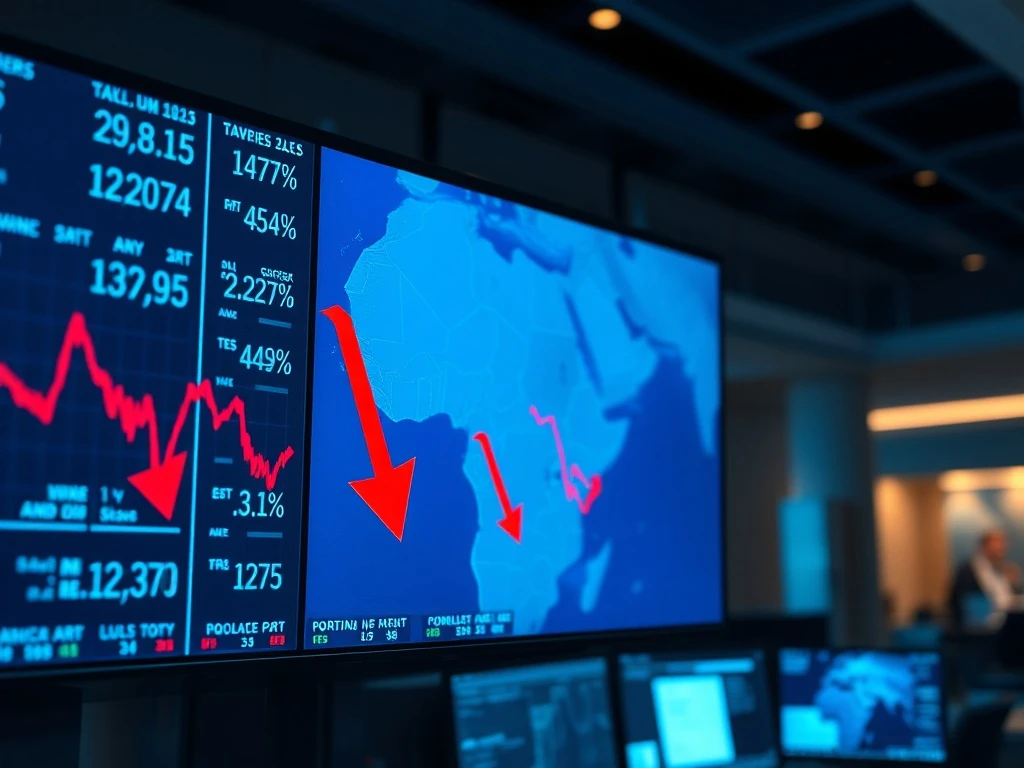
NEW YORK, March 8, 2026 — U.S. stock markets suffered their sharpest single-day decline in three months Friday as twin shocks rattled investor confidence. The S&P 500 Index plunged 1.33% while the Nasdaq 100 dropped 1.51%, dragging major indexes to multi-month lows. This dramatic stocks retreat followed unexpectedly weak U.S. employment data and escalating Middle East tensions that sent crude oil prices soaring above 12%. Trading floors from Wall Street to Chicago witnessed accelerated selling throughout the afternoon session, with the Dow Jones Industrial Average closing at its lowest level since late November 2025.
Market Plunge Triggered by Dual Economic Shocks
The trading day began with ominous signals from the Middle East. Qatar’s Energy Minister warned the Financial Times that prolonged conflict could “bring down the economies of the world.” His prediction that Gulf producers might halt energy exports within weeks sent immediate shockwaves through global markets. Meanwhile, the 8:30 AM ET release of February employment data delivered a second blow. The U.S. economy unexpectedly lost 92,000 jobs last month—the largest decline in four months—while the unemployment rate ticked up to 4.4%. Economists had projected a gain of 55,000 positions.
Market analysts immediately connected these developments. “Today’s perfect storm combines geopolitical risk with fundamental economic weakness,” noted Maria Chen, senior strategist at Global Markets Advisory. “The jobs report suggests underlying softness the Fed must consider, while oil above $150 threatens to reignite the inflation battle they just won.” Trading volume surged to 150% of the 30-day average as institutional investors repositioned portfolios. The VIX volatility index, Wall Street’s fear gauge, jumped 18% to its highest level since January.
Geopolitical Crisis Fuels Inflation Concerns
The closure of the Strait of Hormuz represents the most significant energy supply disruption since the 1970s oil crises. This critical waterway normally handles 20% of global oil shipments and one-third of fertilizer trade. Iranian Revolutionary Guard warnings about missile risks to shipping have effectively blockaded the Persian Gulf. Consequently, WTI crude futures surged to $157.42 per barrel—a 2.5-year high—while European natural gas prices hit three-year peaks after Qatar shut its massive Ras Laffan LNG facility following drone attacks.
- Energy Supply Shock: Goldman Sachs estimates an $18 per barrel risk premium currently priced into oil markets, corresponding to a six-week Strait of Hormuz closure
- Infrastructure Damage: Fujairah, the UAE’s major oil-trading hub, suffered a major fire from intercepted Iranian drones, further straining storage capacity
- Global Ripple Effects: China ordered its largest refiner to suspend diesel and gasoline exports, tightening global fuel supplies amid already strained markets
Federal Reserve Officials Signal Cautious Stance
Despite market turmoil, Federal Reserve officials maintained their measured tone in Friday remarks. Fed Governor Christopher Waller emphasized distinction between temporary and sustained inflation pressures. “The Iran conflict is unlikely to cause sustained inflation,” Waller stated during a Washington economic forum. “That’s precisely why we focus on core prices excluding energy—core provides better predictive power for future inflation trends.” His comments followed similar cautious notes from regional Fed presidents.
Cleveland Fed President Beth Hammack outlined her base case scenario: “I believe policy should remain on hold for quite some time as we gather evidence of declining inflation and further labor market stabilization.” Boston Fed President Susan Collins echoed this patience, citing “continued upside risks” to inflation alongside a “relatively stable labor market” that argues for maintaining “mildly restrictive” rates. Markets currently price just a 5% chance of a rate cut at the March 17-18 FOMC meeting, according to CME FedWatch data.
Sector Analysis Reveals Divergent Impacts
Friday’s trading revealed stark sector divergences that illustrate the crisis’s uneven effects. Technology and travel-related stocks bore the brunt of selling pressure, while defense and select industrial names found buyers. The so-called “Magnificent Seven” technology stocks collectively lost over $400 billion in market value, with Meta Platforms, Tesla, Amazon, and Nvidia all declining more than 2%. Semiconductor and AI-infrastructure stocks faced particularly heavy selling as investors questioned growth assumptions amid economic uncertainty.
| Sector | Key Movers | Primary Driver |
|---|---|---|
| Technology | META -2.8%, NVDA -2.3% | Growth concerns, valuation pressure |
| Airlines | AAL -5.4%, LUV -5.1% | Jet fuel costs, demand uncertainty |
| Defense | LMT +2.4%, NOC +2.2% | Geopolitical tension, budget expectations |
| Energy | Mixed performance | Offsetting price gains vs. export constraints |
Forward Outlook: Navigating Dual Uncertainties
Market participants now face competing narratives about what comes next. The traditional playbook suggests weak employment data might prompt Fed accommodation, but surging energy prices complicate that calculus. “We’re in uncharted territory where textbook monetary policy responses don’t apply cleanly,” observed David Park, chief investment officer at Horizon Capital. “The Fed must weigh genuine economic softness against imported inflation from a supply shock they cannot control.”
Next week brings critical data including CPI inflation readings and retail sales figures that will further clarify the economic picture. Meanwhile, diplomatic efforts continue behind the scenes to reopen the Strait of Hormuz, though President Trump’s statement ruling out negotiations with Iran except for “unconditional surrender” suggests prolonged tensions. Energy analysts warn that every week of closure removes approximately 15 million barrels per day from global markets, creating inventory draws that will pressure prices for months even after shipping resumes.
Corporate Earnings Provide Silver Lining
Amid the market turmoil, corporate earnings continue to show resilience. With over 95% of S&P 500 companies having reported fourth-quarter results, 74% have exceeded expectations. According to Bloomberg Intelligence analysis, S&P 500 earnings grew 8.4% year-over-year in Q4—the tenth consecutive quarter of growth. Excluding the seven technology megacaps, earnings still increased 4.6%. This fundamental strength provides some buffer against geopolitical and macroeconomic headwinds, though forward guidance has become increasingly cautious.
Conclusion
Friday’s market decline represents more than routine volatility—it signals investor recognition of simultaneous challenges on multiple fronts. The unexpected weakness in the U.S. job market contradicts narratives of economic invulnerability, while Middle East conflict has reintroduced 1970s-style energy insecurity. For investors, the path forward requires monitoring both geopolitical developments and economic data with equal intensity. The Federal Reserve’s delicate balancing act between fighting inflation and supporting growth just became considerably more complex. As markets enter the weekend, the only certainty is that Monday’s opening bell will find traders scrutinizing every headline from the Persian Gulf and every data point from Washington.
Frequently Asked Questions
Q1: What caused the stock market decline on March 8, 2026?
The decline resulted from two simultaneous shocks: unexpectedly weak U.S. employment data showing a loss of 92,000 jobs, and escalating Middle East conflict that sent oil prices soaring over 12% and raised inflation concerns.
Q2: How did major stock indexes perform?
The S&P 500 fell 1.33%, the Nasdaq 100 dropped 1.51%, and the Dow Jones Industrial Average declined 0.95% to a 3.5-month low. March E-mini S&P futures fell 1.39%.
Q3: What is the Strait of Hormuz closure’s impact on oil markets?
The closure has halted 20% of global oil shipments, pushing WTI crude to $157.42 per barrel—a 2.5-year high. Goldman Sachs estimates an $18 per barrel risk premium corresponding to a six-week closure.
Q4: How did Federal Reserve officials respond to the market turmoil?
Fed officials maintained a cautious stance, with Governor Christopher Waller stating the Iran conflict is “unlikely to cause sustained inflation” and several regional presidents suggesting rates should remain on hold.
Q5: Which stock sectors were most affected?
Technology stocks, particularly semiconductor and AI-infrastructure companies, and airline stocks suffered heaviest losses. Defense stocks gained on expectations of increased military spending.
Q6: What should investors watch next week?
Critical data includes CPI inflation readings and retail sales figures, along with any developments regarding Strait of Hormuz shipping and diplomatic efforts to de-escalate Middle East tensions.