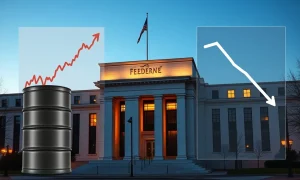
NEW YORK, March 9, 2026 — U.S. stock markets suffered their sharpest decline in months Friday as renewed inflation fears collided with unexpectedly weak employment data, sending major indexes to multi-month lows. The S&P 500 Index closed down 1.33%, the Dow Jones Industrial Average fell 0.95% to a 3.5-month low, and the Nasdaq 100 Index dropped 1.51% as escalating Middle East tensions pushed crude oil prices above $150 per barrel. Meanwhile, the U.S. Labor Department reported employers cut 92,000 jobs in February—the largest decline in four months—contradicting expectations of 55,000 new positions and raising fresh concerns about economic stability.
Middle East Conflict Sparks Energy Crisis and Inflation Fears
The seventh day of intensified conflict between Iran and allied forces sent shockwaves through global energy markets Friday. Qatar’s energy minister warned the Financial Times that prolonged conflict could “bring down the economies of the world,” predicting Gulf energy exporters would shut production within weeks if hostilities continue. This warning materialized immediately as WTI crude surged over 12% to a 2.5-year high, while European natural gas prices hit a 3-year peak after Qatar shut its Ras Laffan plant—the world’s largest LNG export facility—following an Iranian drone attack.
The strategic Strait of Hormuz remained closed for the third consecutive day, halting approximately 20% of global oil shipments. Iran’s Islamic Revolutionary Guard Corps warned vessels they “could be at risk from missiles or rogue drones” if attempting passage. Storage facilities across the region reached capacity as exports stalled, including at Fujairah—the UAE’s major oil-trading hub—where damage from an intercepted drone caused a major fire Tuesday. China compounded supply concerns by ordering its largest refiner to suspend diesel and gasoline exports, tightening global fuel inventories further.
Weak Labor Market Data Contradicts Economic Optimism
Friday’s employment report delivered a sobering counterpoint to recent economic optimism. The unexpected loss of 92,000 jobs marked the first negative reading in ten months, while the unemployment rate ticked up to 4.4%. Average hourly earnings rose 0.4% monthly and 3.8% annually—slightly above expectations—creating a stagflationary signal that troubled investors. “The data presents a worst-of-both-worlds scenario,” noted market analyst Rich Asplund in his Barchart briefing. “Weakening employment combined with persistent wage growth complicates the Federal Reserve’s inflation fight.”
- Employment Contraction: February’s 92,000 job losses contrasted sharply with January’s revised gain of 78,000
- Wage Pressure: 3.8% annual wage growth exceeds the Fed’s comfort zone despite cooling hiring
- Consumer Weakness: January retail sales fell 0.2% while consumer credit growth slowed to $8.05 billion
Federal Reserve Officials Signal Cautious Stance
Federal Reserve governors emphasized patience despite market turbulence. “The Iran war is unlikely to cause sustained inflation,” stated Fed Governor Christopher Waller. “That’s one reason the Fed doesn’t look at energy prices but looks at core prices, excluding energy, as core is a better predictor of future inflation.” Cleveland Fed President Beth Hammack added, “Under my base case, I think policy should be on hold for quite some time as we see evidence that inflation is coming down and the labor market stabilizes further.” Markets currently price just a 5% chance of a rate cut at the March 17-18 meeting, reflecting the Fed’s data-dependent approach.
Sector Performance Reveals Broader Market Stress
The selloff extended beyond energy-sensitive sectors, indicating systemic concerns. Technology leaders dubbed the “Magnificent Seven”—including Meta Platforms, Tesla, Amazon, and Nvidia—all closed down over 2%, dragging the Nasdaq significantly. Chipmakers suffered particularly severe losses, with Lam Research dropping over 7% and Micron Technology, KLA Corp, and Applied Materials all falling more than 6%. Airline stocks tumbled as jet fuel costs spiked, with American Airlines and Southwest Airlines both declining over 5%.
| Sector | Key Movers | Performance |
|---|---|---|
| Technology | META, TSLA, AMZN, NVDA | Down 2%+ |
| Semiconductors | LRCX, MU, KLAC, AMAT | Down 6-7% |
| Airlines | AAL, LUV, DAL, UAL | Down 3-5% |
| Defense | LMT, RTX, NOC, LHX | Up 2%+ |
Global Markets and Treasury Reactions
International markets displayed mixed responses to the dual crises. The Euro Stoxx 50 tumbled 1.09% to a 3-month low, while Japan’s Nikkei 225 gained 0.62% and China’s Shanghai Composite rose 0.38%. European government bond yields climbed, with the 10-year German bund reaching a 1-month high of 2.880%. In the U.S., Treasury notes initially fell then recovered as investors sought safety, with the 10-year yield settling at 4.131%. “The flight to quality is selective,” observed a London-based fixed income strategist. “Investors are distinguishing between geopolitical risk and fundamental economic deterioration.”
Corporate Earnings Provide Limited Buffer
Fourth-quarter earnings season concluded with generally positive results, offering little protection against macro concerns. Over 95% of S&P 500 companies reported, with 74% beating expectations. Bloomberg Intelligence estimates S&P earnings grew 8.4% year-over-year—the tenth consecutive quarter of growth. However, excluding the Magnificent Seven, growth moderated to 4.6%. Notable movers included Marvell Technology, which surged over 18% after forecasting accelerating revenue growth, and Boeing, which gained 4% on reports of potential Chinese orders for 500 737 Max jets.
Forward Outlook: Monitoring Multiple Flashpoints
Market participants now monitor three critical developments: Middle East ceasefire prospects, March 15-16 OPEC+ emergency meetings, and the Fed’s March 17-18 policy decision. Goldman Sachs estimates the current risk premium for crude at $18 per barrel, corresponding to a six-week Strait of Hormuz closure. Energy analysts warn sustained prices above $150 could shave 0.5-0.7% from global GDP growth. “The situation remains fluid,” cautioned a Gulf-based energy consultant. “Every hour of closure increases logistical challenges and inventory pressures across the supply chain.”
Conclusion
Friday’s market retreat reflects converging pressures from geopolitical conflict, energy inflation, and economic uncertainty. The simultaneous surge in oil prices and deterioration in labor market data presents policymakers with complex trade-offs. While corporate earnings remain resilient, investor focus has shifted decisively to macro risks. Markets will likely remain volatile until clarity emerges on Middle East diplomacy and the Federal Reserve’s assessment of whether recent data represents a temporary deviation or sustained trend. The coming week’s policy meetings and conflict developments will determine whether this retreat becomes a correction or finds stabilization.
Frequently Asked Questions
Q1: Why did stock markets fall so sharply on March 9, 2026?
Markets declined due to escalating Middle East conflict pushing oil prices over 12% higher combined with unexpectedly weak U.S. employment data showing 92,000 job losses in February.
Q2: How did the Middle East situation affect energy markets?
The closure of the Strait of Hormuz halted 20% of global oil shipments, while attacks on Qatari LNG facilities and UAE storage terminals created supply shortages that pushed crude to 2.5-year highs.
Q3: What was surprising about the February jobs report?
Economists expected 55,000 job gains but instead saw 92,000 losses—the first negative reading in ten months—while wages grew 3.8% annually, creating stagflation concerns.
Q4: How did the Federal Reserve respond to these developments?
Fed officials emphasized watching core inflation (excluding energy) and maintaining current interest rates until clearer evidence emerges of both cooling inflation and labor market stabilization.
Q5: Which stock sectors were most affected?
Technology stocks fell over 2%, semiconductors dropped 6-7%, and airlines declined 3-5% due to higher fuel costs, while defense stocks gained 2%+ on increased conflict spending expectations.
Q6: What should investors watch next?
Key developments include Middle East ceasefire negotiations, OPEC+ emergency meetings March 15-16, the Federal Reserve’s March 17-18 policy decision, and whether March employment data confirms or contradicts February’s weakness.