
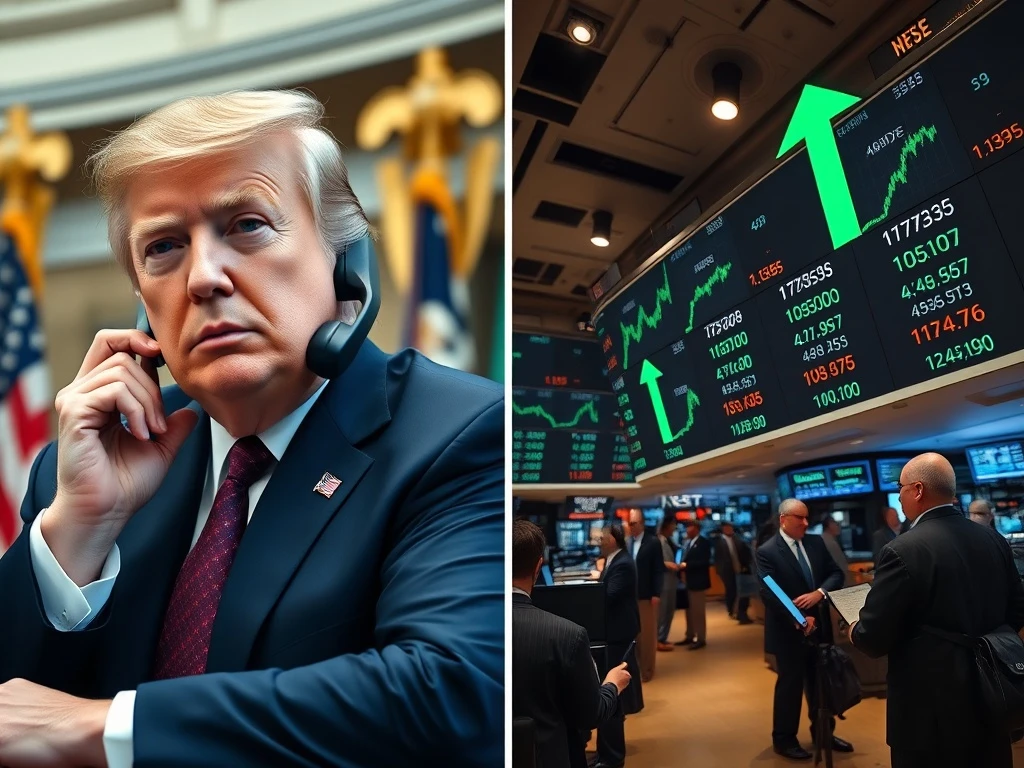
U.S. equity markets staged a dramatic intraday reversal to close sharply higher on Monday, March 10, 2026, after President Donald Trump indicated the military conflict with Iran was nearing its end. The S&P 500 Index ($SPX) closed up 0.71% at 5,842.11, erasing morning losses sparked by an oil price spike above $100 per barrel. The Dow Jones Industrial Average ($DOWI) gained 0.39%, and the technology-heavy Nasdaq 100 Index ($IUXX) jumped 1.13%. The rally, centered in New York trading, was directly triggered by President Trump’s comments to CBS News, where he stated the operation was “very far” ahead of schedule and the war was “very complete, pretty much.” This geopolitical development provided immediate relief to investors fearing a prolonged conflict and sustained energy price shock.
Market Reverses Course on Presidential Comments
Trading on Monday followed a distinct two-act structure defined by geopolitical headlines. The session opened under significant pressure. Brent crude oil futures had surged past the psychologically critical $100 per barrel mark in overnight trading. This spike followed weekend reports that Israeli airstrikes had hit 30 Iranian fuel depots. Concurrently, Saudi Arabia announced production cuts as its domestic storage neared capacity, tightening global supply further. The March E-mini S&P 500 futures (ESH26) traded down nearly 0.8% in pre-market action, reflecting classic risk-off sentiment.
The momentum shifted decisively after 11:00 AM Eastern Time. In a phone interview, President Trump provided the market its catalyst. “I think the war is very complete, pretty much,” he told CBS, adding the military timeline was “very far” ahead of its original 4-5 week projection. Analysts at Barchart noted the comments prompted immediate algorithmic buying, particularly in rate-sensitive technology shares and beaten-down consumer discretionary stocks. “The market was pricing in a worst-case scenario of a months-long regional war,” said market strategist Rich Asplund in his closing note. “Trump’s comments, while informal, were interpreted as a clear signal of de-escalation, allowing traders to cover shorts and re-risk.”
Sector Impacts: Airlines Soar, Defense Stocks Retreat
The shifting geopolitical winds created stark winners and losers across equity sectors. The prospect of a shorter conflict and lower jet fuel costs triggered a powerful rally in airline stocks, which had been under severe pressure. United Airlines Holdings (UAL), Delta Air Lines (DAL), and American Airlines Group (AAL) all closed with gains exceeding 2% as traders covered bearish bets. Conversely, major defense contractors, which often see elevated volatility during geopolitical tensions, sold off on the potential for reduced military expenditure urgency. Northrop Grumman (NOC) and Lockheed Martin (LMT) both fell more than 1%.
- Technology Leadership: The “Magnificent Seven” megacap tech stocks all closed higher, led by Nvidia (NVDA) and Alphabet (GOOGL), which gained over 2%. The sector benefits from lower discount rates when geopolitical risk premiums recede.
- Energy Sector Choppiness: Oil-related stocks closed mixed after crude’s intraday rollercoaster. While Exxon (XOM) and Chevron (CVX) ended slightly down, refiners like Valero Energy (VLO) fell over 3%, likely on narrowing crack spreads.
- Notable Movers: Hims & Hers Health (HIMS) skyrocketed 40.79% on a partnership with Novo Nordisk. Live Nation Entertainment (LYV) rallied over 6% on news of a potential antitrust settlement.
Expert Analysis on the Market’s Reaction
Financial experts emphasized the market’s hypersensitivity to geopolitical rhetoric. Dr. Elena Torres, Director of Geopolitical Strategy at the Center for Economic and Policy Research, noted, “Market movements today are less about the factual military situation and more about perceived political will. Trump’s statement, regardless of its precision, signals an intent to wind down operations, which is what capital markets needed to hear.” She cautioned, however, that the fundamental situation in Iran remains volatile, citing the weekend appointment of hardliner Mojtaba Khamenei as the new Supreme Leader. “The new leadership has deep ties to the IRGC, making a swift political surrender unlikely. Markets may be getting ahead of themselves,” Torres added. This perspective underscores the critical distinction between market sentiment and ground reality—a nuance often lost in rapid trading.
Broader Economic Context and Earnings Backdrop
Monday’s rally occurred against a mixed domestic economic landscape. Recent data has shown cracks: February non-farm payrolls unexpectedly fell by 92,000, and January retail sales declined 0.2% month-over-month. These figures had heightened concerns about U.S. economic resilience. However, the nearly complete Q4 2025 earnings season has provided a solid fundamental floor for equities. According to Bloomberg Intelligence, with over 95% of S&P 500 companies reported, 74% have exceeded earnings expectations. Aggregate S&P 500 earnings are on track for 8.4% year-over-year growth—the tenth consecutive quarter of expansion.
| Index | Close | Change | Key Driver |
|---|---|---|---|
| S&P 500 ($SPX) | 5,842.11 | +0.71% | Geopolitical De-escalation Hopes |
| Nasdaq 100 ($IUXX) | 16,245.50 | +1.13% | Lower Rate Expectations, Tech Rally |
| Dow Jones ($DOWI) | 38,450.67 | +0.39% | Industrial & Financial Recovery |
This earnings strength, particularly when excluding the Magnificent Seven (where growth was still a robust 4.6%), suggests corporate America is weathering macroeconomic crosscurrents. The Federal Reserve’s posture remains a key watchpoint. Interest rate markets, as of Monday’s close, were discounting only a 4% chance of a 25-basis-point rate cut at the upcoming March 17-18 FOMC meeting. The 10-year Treasury yield settled at 4.105%, down 3.3 basis points on the day, as the early inflation scare from oil faded.
Global Market Reaction and Path Forward
International markets did not share Wall Street’s late-day optimism, as they closed before President Trump’s comments circulated fully. The Euro Stoxx 50 fell 0.61%, and Japan’s Nikkei 225 plunged 5.2%, reflecting the initial shock of the oil price surge and its implications for import-dependent economies. This divergence sets up potential catch-up trades in Asian and European markets in the coming session. The immediate path for U.S. stocks now hinges on two evolving narratives: the actual military and diplomatic progression in the Middle East, and the durability of the domestic economic soft patch.
Stakeholder Reactions and Political Response
Reactions from Capitol Hill were mixed. Senate Majority Leader voiced cautious optimism but stressed the need for a “durable diplomatic framework, not just a military pause.” Defense industry lobbyists, while publicly supporting administration policy, privately expressed concern over the potential for reduced emergency supplemental spending. Meanwhile, airline and transportation industry groups hailed the development, with the Airlines for America association stating, “Stability in energy markets is crucial for operational planning and consumer affordability.” The contrasting responses highlight how a single geopolitical statement ripples through different economic constituencies with varying effects.
Conclusion
The March 10, 2026, trading session demonstrated the stock market’s acute sensitivity to geopolitical communication. The stocks’ close higher was a direct function of de-escalatory rhetoric from the White House, overpowering earlier fears fueled by a spike in oil prices. Key takeaways include the powerful rally in travel-related stocks, the ongoing resilience of corporate earnings, and the market’s continued focus on Federal Reserve policy amidst mixed economic data. Investors should monitor for concrete diplomatic or military actions confirming the conflict’s wind-down, as markets have now priced in a favorable outcome. The next major test will be whether the positive momentum holds against the backdrop of upcoming economic releases and the Fed’s March meeting, proving this was more than a one-day headline-driven rally.
Frequently Asked Questions
Q1: Why did the stock market rally on March 10, 2026?
The market rallied after President Trump stated in an interview that the military conflict with Iran was “pretty much” complete and ahead of schedule. This reduced the perceived risk of a prolonged war and a sustained oil price shock, leading investors to buy stocks, particularly in technology and airlines.
Q2: What was the initial cause of the stock market’s decline earlier in the day?
Stocks opened lower after the price of Brent crude oil surged above $100 per barrel. This spike followed reports of Israeli airstrikes on Iranian fuel depots and production cuts from Saudi Arabia, raising fears of higher inflation and slower economic growth.
Q3: Which stock sectors benefited most from the news?
Airline stocks (like United, Delta, American) and major technology companies (the “Magnificent Seven”) saw the most significant gains. Airlines benefit from lower fuel cost expectations, while tech stocks are sensitive to lower interest rates that often accompany reduced geopolitical risk.
Q4: How did the bond market react to the day’s events?
The 10-year U.S. Treasury yield fell to 4.105%, down 3.3 basis points. Bond prices rose (yields fell) as the early inflationary scare from oil receded, reducing pressure on the Federal Reserve to maintain a hawkish policy stance.
Q5: What are the main risks that could reverse this market optimism?
The primary risk is that the military or political situation in Iran does not de-escalate as quickly as markets now expect. The appointment of a hardline new Supreme Leader in Iran suggests diplomatic challenges ahead. Additionally, weak U.S. economic data remains a concern.
Q6: How did international stock markets perform?
Major international indexes like the Euro Stoxx 50 and Japan’s Nikkei 225 closed lower, as their trading sessions ended before President Trump’s comments circulated. This creates potential for volatility as global markets react to the new information.



