
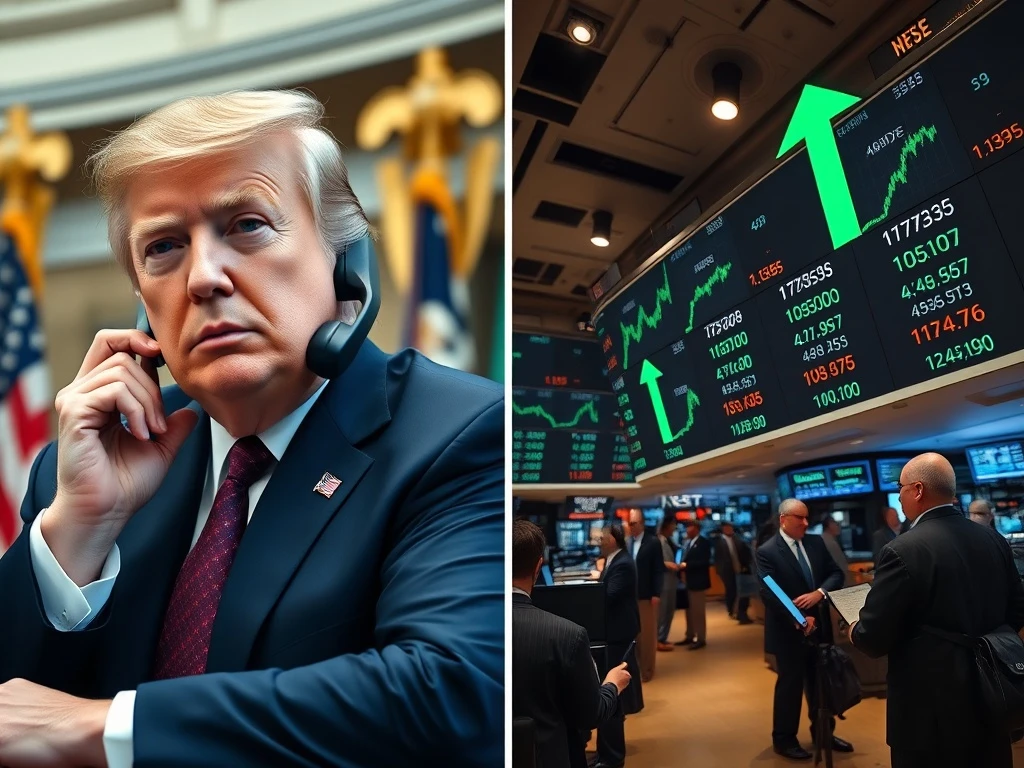
NEW YORK, March 10, 2026 — U.S. equity markets staged a dramatic intraday reversal to close sharply higher Monday, propelled by comments from President Donald Trump that suggested a swift conclusion to military operations against Iran. The S&P 500 Index ($SPX) closed up +0.71%, erasing morning losses sparked by a geopolitical shock that briefly sent crude oil prices soaring above $100 per barrel. The tech-heavy Nasdaq 100 Index ($IUXX) led the gains, rising +1.13%, while the Dow Jones Industrial Average ($DOWI) advanced +0.39%. The market’s powerful rebound, turning fear into optimism within hours, underscores the intense sensitivity of global finance to Middle East tensions and presidential rhetoric.
Market Reverses Course on Presidential Comments
Trading began under a cloud of significant risk aversion. Over the weekend, Israeli airstrikes hit 30 Iranian fuel depots, a major escalation that triggered an immediate spike in global oil benchmarks. Brent crude futures surged past the psychologically critical $100 level in overnight trading, raising alarms about inflationary pressures and potential disruptions to global economic growth. “The initial reaction was pure risk-off,” noted Michael Hartnett, Chief Investment Strategist at Bank of America Global Research, in a morning client note. “A sustained oil price at that level would force a recalibration of growth and Fed policy expectations.”
The sentiment shift arrived just before midday. In a phone interview with CBS News, President Trump addressed the conflict, stating, “I think the war is very complete, pretty much” and noting the operation was “very far” ahead of its original 4-5 week timeframe. While not declaring a formal ceasefire, the implication of a nearing end was enough to catalyze a broad-based rally. The comments directly countered the morning’s narrative, allowing investors to look past the immediate crisis toward a potential stabilization of the region.
Sector Impacts: Winners, Losers, and the Oil Rollercoaster
The day’s trading created clear sectoral winners and losers, painting a precise picture of market expectations. The most dramatic moves occurred in industries directly tied to energy prices and geopolitical risk.
- Technology & Travel Rebound: The so-called Magnificent Seven megacap stocks, led by Nvidia (NVDA) and Alphabet (GOOGL) with gains exceeding 2%, powered the Nasdaq higher. Simultaneously, airline stocks like United Airlines (UAL) and Delta Air Lines (DAL) soared more than +2% on short-covering, as investors bet on lower future fuel costs and renewed passenger demand.
- Energy & Defense Retreat: Conversely, oil producers and defense contractors lost ground. Valero Energy (VLO) fell over -3%, while defense giants Northrop Grumman (NOC) and Lockheed Martin (LMT) dropped more than -1%, reflecting the market’s assessment of reduced near-term demand for their products.
- Commodity Whiplash: Oil prices themselves mirrored the equity reversal. After the early spike, Brent crude settled nearly flat on the day after G7 finance ministers pledged coordinated releases from strategic petroleum reserves. The 10-year breakeven inflation rate, a market gauge of inflation expectations, fell -1.4 basis points to 2.338%, signaling eased price fears.
Expert Analysis: Parsing the Geopolitical and Market Signals
Market strategists emphasized the complexity of interpreting the day’s events. “This is a classic ‘fade the geopolitics’ move, but with a Trump twist,” said Lori Calvasina, Head of U.S. Equity Strategy at RBC Capital Markets. “The market is trading on the perception of de-escalation, not necessarily the reality on the ground. The key will be whether oil stays below $95.” The geopolitical reality remains fraught. Over the weekend, Iran’s Assembly of Experts appointed hardliner Mojtaba Khamenei, son of the late Ayatollah, as the new Supreme Leader—a move President Trump later said he was “not happy” with. Analysts at the geopolitical risk firm Stratfor noted the appointment “cements the IRGC’s influence and suggests a prolonged strategic confrontation, even if active warfare diminishes.”
Economic Backdrop: Earnings Strength Meets Macro Worries
Monday’s geopolitical drama unfolded against a mixed domestic economic picture. On one hand, the Q4 2025 earnings season has provided a sturdy foundation for equities. With over 95% of S&P 500 companies having reported, the results have been robust: 74% have beaten expectations, and overall earnings growth is tracking toward +8.4% year-over-year, according to Bloomberg Intelligence. This marks a tenth consecutive quarter of growth.
Conversely, recent macroeconomic data has softened. Last Friday’s reports showed a surprising loss of -92,000 jobs in February and a -0.2% month-over-month decline in January retail sales. These figures have kept the Federal Reserve in a cautious hold pattern. As of Monday’s close, interest rate futures markets priced only a 4% chance of a rate cut at the upcoming March 17-18 FOMC meeting. “The market is in a tug-of-war between stellar corporate profits and emerging cracks in the consumer story,” explained David Kostin, Goldman Sachs’ Chief U.S. Equity Strategist.
| Index | Close | Daily Change |
|---|---|---|
| S&P 500 ($SPX) | 5,842.15 | +0.71% |
| Nasdaq 100 ($IUXX) | 18,203.67 | +1.13% |
| Dow Jones Industrial ($DOWI) | 39,120.88 | +0.39% |
What Happens Next: Monitoring Key Catalysts
The path forward for markets hinges on several verifiable near-term catalysts. First, traders will scrutinize any official statements from the Pentagon or State Department regarding troop movements or ceasefire negotiations to validate the President’s comments. Second, weekly U.S. oil inventory data on Wednesday will be critical for confirming whether the oil price pullback has fundamental support. Finally, the February Consumer Price Index (CPI) report, due next week, will test whether the oil spike translated into broader inflationary pressure or was merely a fleeting event.
Global Reaction and Market Ripple Effects
International markets did not share in Wall Street’s late-day optimism, having closed before President Trump’s remarks. European and Asian bourses finished deeply in the red, bearing the full brunt of the morning’s oil shock. Japan’s Nikkei 225 plunged -5.2%, its worst day in over a year, reflecting its economy’s acute sensitivity to energy import costs. The stark divergence sets up potential catch-up rallies in overseas markets during Tuesday’s session, depending on the overnight development of the narrative.
Conclusion
March 10, 2026, demonstrated the powerful and immediate influence of geopolitical language on modern financial markets. The stocks close higher narrative ultimately prevailed, but only after a volatile journey that reflected deep underlying tensions. While corporate earnings remain a pillar of strength, the day proved that investor sentiment remains tethered to oil prices and White House statements. The key takeaway is that perceived de-escalation can be as potent as actual de-escalation in driving capital flows. Investors should now monitor for concrete diplomatic or military steps that either confirm or contradict the market’s hopeful interpretation, with energy prices serving as the most immediate barometer of ongoing risk.
Frequently Asked Questions
Q1: What exactly did President Trump say that caused the stock market to rally?
In a midday interview with CBS News on March 10, President Trump stated, “I think the war is very complete, pretty much” and that the military operation was “very far” ahead of schedule. Markets interpreted this as a signal that the conflict with Iran could end sooner than feared, reducing geopolitical risk.
Q2: Why did oil prices spike above $100 per barrel initially?
The spike was triggered by a major weekend escalation: Israeli airstrikes bombed 30 Iranian fuel depots. This raised immediate concerns about oil supply disruptions from the region, compounded by reports that Saudi Arabia was cutting production as its storage neared capacity.
Q3: How did different stock sectors react to the news?
Technology stocks and airlines rallied sharply on hopes for lower oil costs and reduced economic uncertainty. Oil company stocks and major defense contractors like Lockheed Martin fell, as investors priced in lower crude prices and potentially reduced military demand.
Q4: What is the current state of the U.S. economy outside of this geopolitical event?
The backdrop is mixed. Corporate earnings for Q4 2025 have been very strong, with most companies beating expectations. However, recent jobs and retail sales data have been weak, causing some concern about consumer strength and keeping the Federal Reserve from cutting interest rates.
Q5: Did international stock markets also rally?
No. Major markets in Europe and Asia closed sharply lower because their trading sessions ended before President Trump’s comments. They only experienced the negative impact of the morning’s oil price surge, highlighting the timing-dependent nature of the day’s events.
Q6: What should investors watch for in the coming days?
Key indicators include official statements from the U.S. or Iranian governments regarding ceasefire terms, weekly U.S. oil inventory data, and the upcoming Consumer Price Index (CPI) report to see if the oil spike affected broader inflation.



