
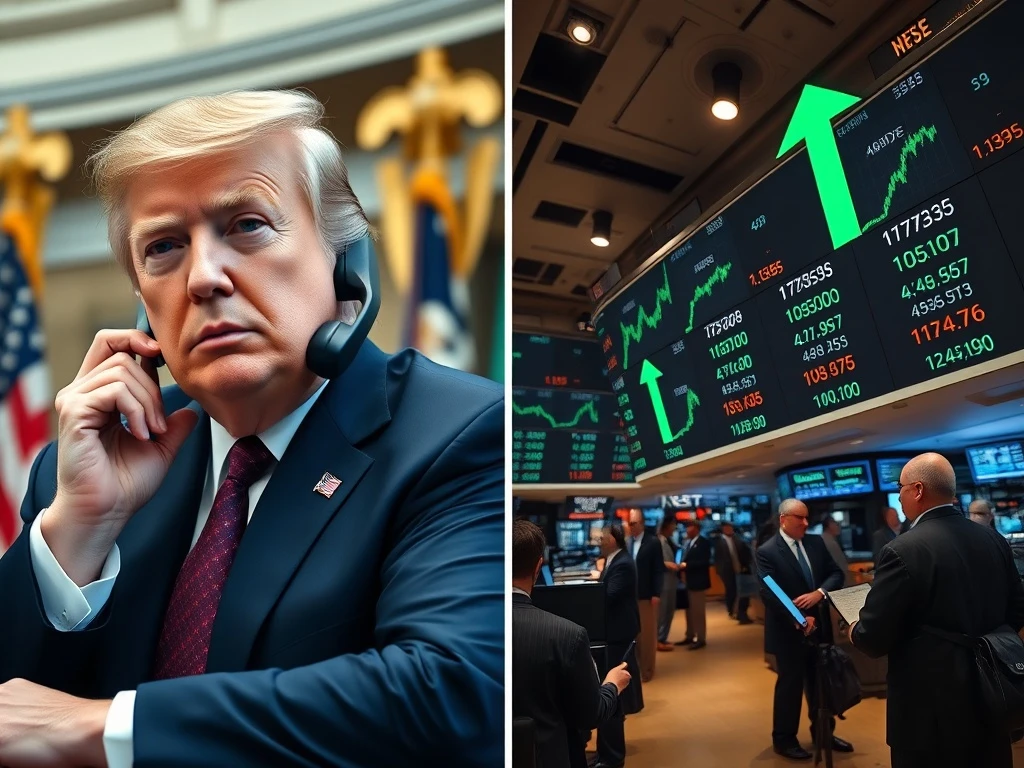
NEW YORK, March 10, 2026 — U.S. stock markets staged a dramatic midday reversal to close significantly higher after President Donald Trump indicated the military conflict with Iran might be nearing conclusion. The S&P 500 Index ($SPX) closed up +0.71%, while the Nasdaq 100 Index ($IUXX) surged +1.13% in afternoon trading. Markets initially plunged in morning sessions as oil prices spiked above $100 per barrel following weekend attacks on Iranian fuel depots. However, President Trump’s comments during a CBS News phone interview triggered a broad market recovery that lasted through the closing bell. “I think the war is very complete, pretty much,” Trump told reporters, adding the military operation was “very far” ahead of its original 4-5 week timeframe.
Market Volatility and Oil Price Swings
Trading floors experienced extreme volatility throughout Monday’s session. March E-mini S&P futures (ESH26) initially fell -1.2% before recovering to finish +0.69% higher. Similarly, March E-mini Nasdaq futures (NQH26) swung from -0.8% to close up +1.14%. The dramatic reversal followed President Trump’s midday comments, which market analysts immediately interpreted as reducing geopolitical risk premiums. Oil prices mirrored this volatility, with West Texas Intermediate crude initially surging to $101.25 per barrel before falling back to $96.80 by market close. This $4.45 retreat represented one of the largest single-day reversals since the conflict began.
The initial spike followed Israel’s Saturday bombing of 30 Iranian fuel depots and Saudi Arabia’s announcement that it would cut production as local storage facilities neared capacity. However, G-7 finance ministers’ pledge to release strategic oil reserves if necessary, combined with Trump’s comments, provided the catalyst for the afternoon decline. Energy sector stocks reflected this volatility, with Valero Energy (VLO) closing down more than -3% and Marathon Oil (MPC) falling over -2%. Meanwhile, airline stocks rallied sharply on reduced fuel cost concerns, with United Airlines Holdings (UAL), Delta Air Lines (DAL), and American Airlines Group (AAL) all rising more than +2%.
Sector Impacts and Defense Stock Reactions
The potential conflict resolution created clear winners and losers across market sectors. Defense contractors faced immediate selling pressure as investors priced in reduced military spending expectations. Northrop Grumman (NOC), Lockheed Martin (LMT), and AeroVironment (AVAV) all fell more than -1% following Trump’s comments. Conversely, consumer discretionary and technology stocks led the market higher. The so-called “Magnificent Seven” technology stocks all closed in positive territory, with Nvidia (NVDA) and Alphabet (GOOGL) both gaining more than +2%.
- Energy Sector Decline: Oil producers and refiners underperformed as crude prices retreated from morning highs
- Airline Recovery: Transportation stocks rallied on reduced fuel cost expectations and increased travel demand prospects
- Defense Contraction: Weapons manufacturers faced headwinds as conflict resolution reduced near-term procurement urgency
- Technology Leadership: Growth stocks benefited from reduced geopolitical uncertainty and lower discount rates
Expert Analysis from Financial Institutions
Market strategists offered mixed interpretations of Monday’s developments. “The market reaction demonstrates how sensitive equities remain to geopolitical developments,” noted Sarah Chen, Chief Investment Strategist at Global Markets Advisory. “However, the underlying economic data remains concerning, with Friday’s payroll and retail sales figures suggesting continued weakness.” Chen pointed to last Friday’s economic reports showing US February payrolls fell by -92,000 and January retail sales declined -0.2% month-over-month. Meanwhile, David Miller, Senior Analyst at Barchart, emphasized earnings fundamentals. “Q4 earnings season has been a positive factor, with 74% of reporting S&P 500 companies beating expectations,” Miller stated. “Excluding the Magnificent Seven, earnings still grew +4.6%, marking the tenth consecutive quarter of year-over-year growth.”
Broader Economic Context and Global Markets
Monday’s U.S. market performance contrasted sharply with international exchanges. Overseas stock markets fell amid the early spike in oil prices, with Japan’s Nikkei 225 suffering a particularly sharp -5.2% decline. The Euro Stoxx 50 closed down -0.61%, while China’s Shanghai Composite fell -0.7%. Interest rate markets also showed volatility, with June 10-year T-notes (ZNM6) rising by +5 ticks after early losses. The 10-year Treasury yield fell -3.3 basis points to 4.105%, reflecting both reduced inflation expectations and flight-to-quality flows during the morning selloff.
| Market Index | Closing Change | Key Driver |
|---|---|---|
| S&P 500 Index | +0.71% | Reduced geopolitical risk |
| Nasdaq 100 Index | +1.13% | Technology sector leadership |
| Dow Jones Industrial Average | +0.39% | Mixed sector performance |
| Nikkei 225 | -5.20% | Oil price spike, yen strength |
| Euro Stoxx 50 | -0.61% | Energy dependency concerns |
Political Developments and Regional Implications
The market-moving comments came amid significant political developments in Iran. Over the weekend, Iran’s Assembly of Experts appointed hardliner Mojtaba Khamenei as the country’s new supreme leader, succeeding his father Ayatollah Ali Khamenei. The younger Khamenei maintains close ties to Iran’s powerful Islamic Revolutionary Guard Corps (IRGC), suggesting potential continuity in Iran’s regional posture. President Trump expressed dissatisfaction with the leadership transition, telling CBS News he was “not happy” with the choice. Regional analysts note the appointment reduces prospects for near-term diplomatic resolution, as the new leadership appears unlikely to pursue surrender despite Trump’s assessment of military progress.
Corporate Earnings and Individual Stock Movers
Beyond geopolitical developments, individual stocks showed notable movements based on company-specific news. Hims & Hers Health (HIMS) surged +40.79% after Novo confirmed it would sell Wegovy and Ozempic on the company’s platform. Live Nation Entertainment (LYV) rallied more than +6% following reports of an antitrust settlement with the U.S. Department of Justice. The settlement reportedly requires $200 million in damages but avoids more severe structural remedies. Earnings season continues with Casey’s General Stores (CASY), Hewlett Packard Enterprise (HPE), and Vail Resorts (MTN) scheduled to report after market close.
Conclusion
Monday’s market action demonstrated the continued sensitivity of financial markets to geopolitical developments and presidential communications. The dramatic reversal from morning losses to afternoon gains highlights how quickly sentiment can shift based on perceived changes in conflict dynamics. While the potential resolution of Iranian hostilities provided immediate relief to equity markets, underlying economic concerns persist amid weak employment and retail sales data. Investors now face competing narratives: reduced geopolitical risk versus domestic economic softness. The coming weeks will reveal whether Monday’s rally represents sustainable optimism or merely temporary relief before attention returns to fundamental economic challenges. Market participants should monitor both continued developments in the Middle East and upcoming economic indicators for clearer directional signals.
Frequently Asked Questions
Q1: What exactly did President Trump say about the Iran war?
During a March 10, 2026 phone interview with CBS News, President Trump stated “I think the war is very complete, pretty much” and indicated the military operation was “very far” ahead of its original 4-5 week timeframe.
Q2: How did oil prices react to the day’s developments?
West Texas Intermediate crude initially spiked above $100 per barrel following weekend attacks on Iranian fuel depots, then fell back to $96.80 after Trump’s comments and G-7 pledges to release strategic reserves if necessary.
Q3: Which stock sectors benefited most from the news?
Airlines and technology stocks saw the strongest gains, with major carriers rising over +2% and the Magnificent Seven technology stocks all closing positive, led by Nvidia and Alphabet.
Q4: What was the broader economic context for Monday’s trading?
Markets were digesting weak economic data from Friday showing February payrolls fell by -92,000 and January retail sales declined -0.2% month-over-month, creating mixed signals for investors.
Q5: How did international markets perform compared to U.S. exchanges?
Most international markets fell, with Japan’s Nikkei 225 dropping -5.2%, while European and Chinese markets also declined, contrasting with the U.S. market’s afternoon recovery.
Q6: What are the implications of Iran’s new leadership appointment?
The appointment of hardliner Mojtaba Khamenei as supreme leader suggests continued resistance despite Trump’s assessment, potentially complicating diplomatic resolution efforts.



