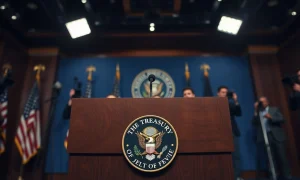
The US Treasury Department has called a meeting of key financial regulators to examine potential risks building in the private credit market. According to sources familiar with the matter, the discussions will involve both American and international insurance supervisors. This move signals growing official concern over a financial sector that has ballooned to an estimated $2.1 trillion in assets.
A Rapidly Growing Market Draws Scrutiny
Private credit, where non-bank lenders provide loans directly to companies, has exploded in size since the 2008 financial crisis. It filled a void left by traditional banks facing stricter regulations. The market’s sheer scale now makes it a focal point for those monitoring financial stability.
Also read: Hegseth Broker Sought Defense Fund Before Iran Strike
Data from Preqin shows private credit assets under management have more than doubled since 2020. This growth has been fueled by institutional investors, like pension funds and insurers, chasing higher yields. The Treasury’s action suggests this hunt for return may be concentrating risk in parts of the financial system less visible to standard oversight.
Why Insurance Watchdogs Are Key
The inclusion of insurance regulators is a critical detail. Insurers are major allocators to private credit funds, seeking the asset class’s attractive income streams to match their long-term liabilities. A sharp downturn in these loans could directly impact insurer balance sheets.
Also read: KPMG Cuts Nearly 600 UK Jobs Amid Slowdown
Industry watchers note that insurance capital is often channeled through reinsurers and offshore vehicles, adding layers of complexity. “The concern is about interconnectedness,” one analyst said, referencing common institutional attribution. “If a wave of corporate defaults hits private credit portfolios, the pain could ripple back to insurers and then into the broader market.”
This could signal a shift in regulatory focus. For years, attention was fixed on banks. Now, the so-called “shadow banking” sector is under the microscope.
Pressure Points and Potential Triggers
Regulators are likely examining several specific vulnerabilities. Loan covenants in private credit deals have weakened significantly, offering lenders less protection. Much of the lending is to mid-sized companies with higher debt loads. A prolonged economic slowdown would test these borrowers severely.
Another issue is liquidity, or the lack thereof. Private credit loans are not traded on public exchanges. If investors rush to exit, there may be no clear market price or ready buyer. This illiquidity can amplify losses during stress.
The Treasury’s Financial Stability Oversight Council (FSOC) has mentioned private credit in recent reports. But convening a dedicated meeting is a more direct step. It implies the topic has moved up the priority list.
International Coordination
Inviting international insurance supervisors points to the global nature of the risk. Major European and Asian insurers are also large investors in US private credit. A problem in America would not be contained by borders.
Coordinating with bodies like the International Association of Insurance Supervisors (IAIS) allows for a more complete picture. It helps prevent regulatory arbitrage, where risk simply shifts to the jurisdiction with the loosest rules.
What this means for investors is closer scrutiny ahead. Funds may face more questions from their institutional clients about risk management and stress testing. New regulatory guidance for insurers on their private credit exposures is a possible outcome.
What Happens Next
The meeting is a fact-finding and coordination exercise, not a rule-making session. Its immediate impact will be limited. However, it lays the groundwork for potential policy actions later this year.
Observers will watch for any public statement from the Treasury or FSOC following the talks. A stern warning about underwriting standards would be a clear signal to the industry. For now, the market continues to operate, but with a new, powerful audience watching its every move.
For more information on the private credit market’s growth, see data from Preqin. The Financial Stability Oversight Council’s latest annual report can be found on the US Treasury website.

This article was produced with AI assistance and reviewed by our editorial team for accuracy and quality.