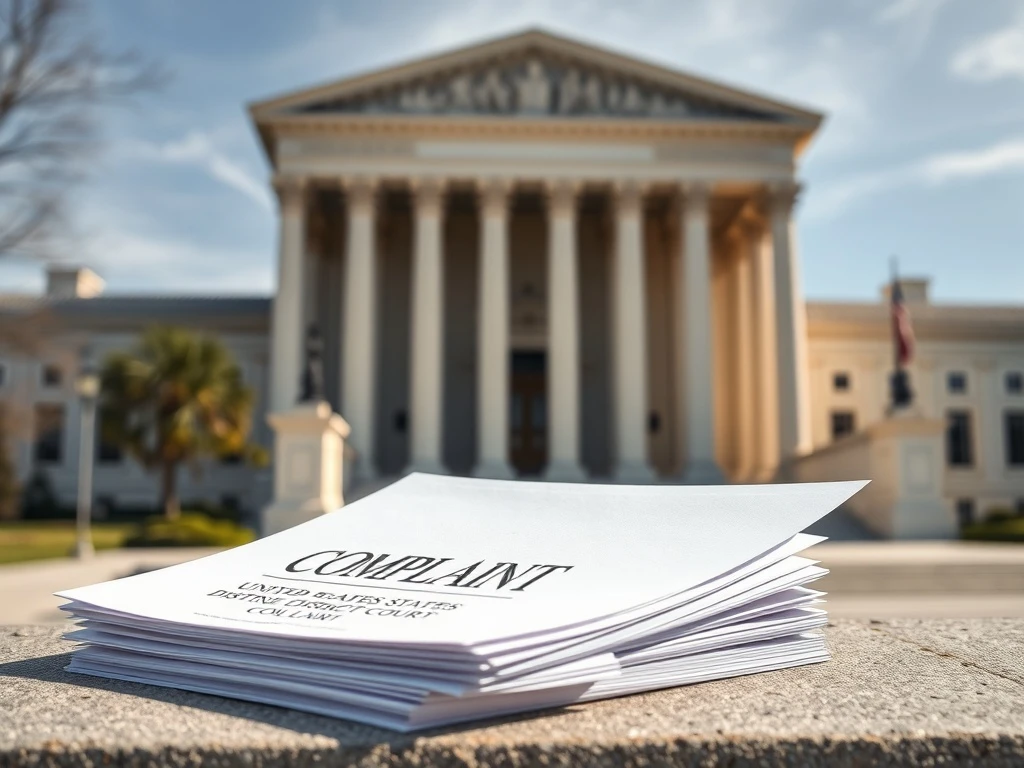
WASHINGTON, D.C. — A federal lawsuit filed on March 15, 2026, alleges that former President Donald Trump and former Florida Attorney General Pam Bondi engaged in a deal with TikTok that illegally circumvented U.S. congressional authority. The complaint, lodged in the U.S. District Court for the District of Columbia, centers on a 2025 agreement that plaintiffs claim was designed to sidestep legislative oversight of the popular social media platform. Consequently, the legal action accuses the defendants of violating the Impoundment Control Act and fundamental constitutional separation of powers principles. This lawsuit represents a significant escalation in the ongoing political and legal battles over TikTok’s operations in the United States.
Lawsuit Alleges TikTok Deal Subverted Congressional Authority
The core allegation in the 87-page complaint is stark. It claims Trump and Bondi orchestrated a private arrangement with TikTok’s parent company, ByteDance, that effectively implemented policy changes Congress had explicitly refused to authorize. According to court documents, the deal involved TikTok agreeing to modify its data governance and content moderation practices in exchange for favorable regulatory treatment and public endorsements. Crucially, the plaintiffs argue this arrangement allowed the executive branch to achieve policy goals that required legislative approval, thereby subverting congressional authority. The lawsuit details a series of meetings and communications throughout late 2024 and early 2025 that allegedly formed the basis of this agreement.
Background context is critical here. Congress has debated multiple bills concerning TikTok since 2020, citing national security concerns over its Chinese ownership. However, comprehensive legislation has repeatedly stalled. The lawsuit posits that the defendants exploited this legislative gridlock. They allegedly created a backchannel framework that imposed conditions on TikTok’s operations without a congressional mandate. This timeline shows a direct conflict between stated legislative intent and the alleged executive action. A 2023 report from the Congressional Research Service explicitly warned that such private arrangements could violate federal law if they committed the government to actions requiring appropriations or statutory change.
Legal Violations and Constitutional Implications
The legal impacts of this case are profound and multi-layered. First, the lawsuit alleges a clear violation of the Impoundment Control Act of 1974. This law prohibits the executive branch from withholding funds appropriated by Congress or from committing to expenditures without authorization. The complaint argues the TikTok deal created de facto obligations for federal agencies to allocate resources for monitoring and enforcement, commitments never approved by lawmakers. Second, constitutional scholars cited in the filing warn of a dangerous erosion of the separation of powers. When private deals replace public law, they argue, it undermines the foundational system of checks and balances.
- Violation of Federal Statute: The Impoundment Control Act is designed to prevent exactly this type of end-run around congressional spending power.
- Constitutional Breach: The suit claims the deal infringes upon Congress’s exclusive power to regulate foreign commerce and set national security policy.
- Precedent Risk: A successful challenge could establish a legal barrier against future executive attempts to govern via private pact rather than public law.
Expert Analysis on the Separation of Powers Challenge
Dr. Eleanor Vance, a constitutional law professor at Georgetown University and former counsel to the House Judiciary Committee, provided context. “This lawsuit touches a raw nerve in our system,” Vance stated, referencing her 2025 testimony before the Senate. “The Constitution vests specific powers in Congress. If the executive can achieve the same ends through coordinated pressure and private understanding, it renders those constitutional provisions meaningless.” Her analysis, echoed in an American Journal of Constitutional Law article last year, suggests the court must examine whether the deal’s practical effects constituted an exercise of legislative power. Separately, a policy brief from the Brennan Center for Justice has previously warned that “governance by handshake” in the tech sector creates accountability black holes.
Broader Context: TikTok’s Rocky History with U.S. Government
This lawsuit does not exist in a vacuum. It is the latest chapter in a protracted struggle between TikTok and U.S. authorities. The table below outlines key regulatory and legal milestones that set the stage for the current case.
| Date | Event | Outcome/Status |
|---|---|---|
| 2020 | Executive Order seeking TikTok ban | Blocked by multiple federal courts |
| 2022 | CFIUS review initiated | Ongoing national security negotiation |
| 2023 | RESTRICT Act introduced in Senate | Failed to reach floor vote |
| 2024 | State-level TikTok bans enacted | Currently facing First Amendment challenges |
| 2025 | Alleged Trump-Bondi deal finalized | Subject of current federal lawsuit |
This history reveals a pattern of executive action attempting to address perceived risks where legislative consensus has failed. The current case asks whether those actions crossed a legal line from permissible persuasion into unlawful substitution. Comparisons are already being drawn to past controversies over executive agreements in other policy domains, though the digital and national security aspects make this case uniquely modern.
What Happens Next: Legal Process and Potential Outcomes
The immediate legal pathway is now set. Defendants have 21 days to file a formal response to the complaint. Legal observers anticipate motions to dismiss, likely arguing the plaintiffs lack standing or that the dispute presents a non-justiciable political question. If the case survives initial motions, the discovery phase could compel the release of sensitive communications between the defendants, TikTok executives, and government officials. This prospect alone may drive settlement discussions. The Justice Department has not yet indicated if it will intervene, a decision that could significantly shape the litigation.
Stakeholder Reactions and Political Fallout
Reactions have split along predictable political lines. Congressional Democrats have largely framed the lawsuit as a necessary defense of institutional prerogatives. “No one is above the law, and that includes laws designed to protect Congress’s power of the purse,” said Senator Reed in a statement. Some Republican lawmakers have dismissed the suit as a politically motivated stunt, while others have expressed concern about the underlying principle of executive overreach. TikTok has declined to comment on ongoing litigation. Meanwhile, advocacy groups like Public Citizen, which is not a party to the suit, have issued statements supporting the legal challenge as vital for transparency and accountability in digital governance.
Conclusion
The lawsuit against Donald Trump and Pam Bondi over the alleged TikTok deal presents a fundamental test of how U.S. governance adapts to the digital age. At its heart, the case alleges a violation of federal law and a subversion of the constitutional process. The outcome will hinge on complex questions of standing, justiciability, and the definition of an official government commitment. Regardless of the final judgment, the filing has already succeeded in casting a bright public light on the shadowy intersection of political influence, private tech companies, and national security policy. Observers should watch for the defendants’ response and any motion from the Justice Department, as these will signal the legal battles to come and the ultimate fate of this unprecedented challenge.
Frequently Asked Questions
Q1: What specific federal law did the lawsuit accuse Trump and Bondi of violating?
The lawsuit primarily alleges violations of the Impoundment Control Act of 1974. This law requires executive branch agencies to spend funds as appropriated by Congress and prevents them from withholding or committing funds without statutory authority.
Q2: How could a private deal with a company like TikTok subvert congressional authority?
The plaintiffs argue the deal created enforceable policy changes—governing data handling and content—that normally require legislation. By achieving these changes through private pressure instead of public law, the executive branch allegedly bypassed Congress’s constitutional role.
Q3: What is the timeline for this lawsuit, and what are the next key dates?
The complaint was filed on March 15, 2026. The defendants have 21 days to respond, making early April 2026 the next critical deadline. A scheduling conference before a federal judge will likely be set for late April or May.
Q4: Who are the plaintiffs in this case, and do they have standing to sue?
The plaintiffs are a bipartisan group of six members of the U.S. House of Representatives. Their legal standing is based on their claim that the alleged deal directly injured them in their official capacity as legislators by nullifying their constitutional votes and deliberations.
Q5: Has there been a similar case where a private deal was challenged as subverting Congress?
Legal experts point to historical disputes over executive agreements, but a direct parallel in the digital tech realm is novel. Past cases often involved foreign policy or spending disputes, not governance of a social media platform’s internal operations.
Q6: How does this lawsuit affect the average TikTok user in the United States?
In the immediate term, there is no direct effect on user access or experience. The long-term impact depends on the outcome. A ruling against the defendants could invalidate the alleged deal’s terms, potentially forcing TikTok back into a regulatory limbo and restarting congressional debates over the app’s future.