
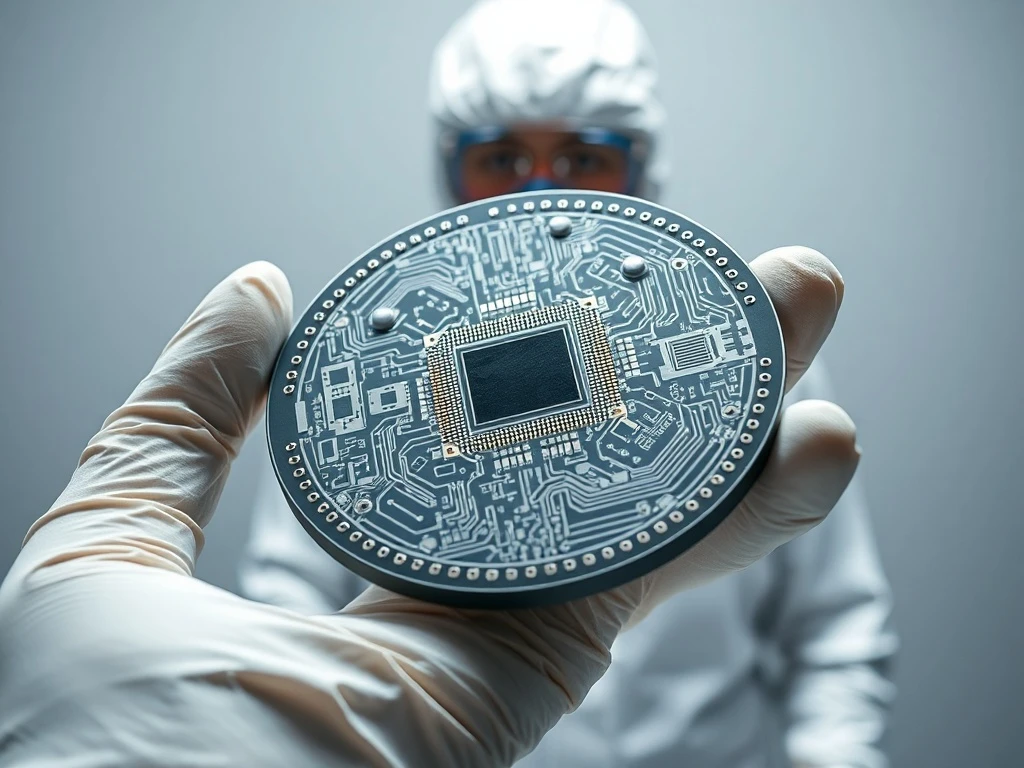
TAIPEI, Taiwan — March 11, 2026: Taiwan Semiconductor Manufacturing Company (TSM) shares have delivered a stunning 33.8% return over the past six months, dramatically outperforming a volatile broader market. This surge places the world’s leading chip foundry at a critical juncture for investors. The rally, powered by unprecedented demand for artificial intelligence processors, raises a pivotal question analyzed by Zacks Investment Research: Is TSM stock still a buy after such a powerful run? The answer hinges on three converging factors: unrelenting AI demand, massive capital investment, and a valuation that remains reasonable despite the gains.
TSM’s Meteoric Rise and Market Outperformance
From September 2025 through March 2026, TSM stock climbed 34%, a performance that crushed the Zacks Computer and Technology sector’s 3.4% gain. Furthermore, it outpaced major semiconductor peers. For instance, shares of Advanced Micro Devices (AMD) rose 28.6%, while NVIDIA (NVDA) gained 4%. Broadcom (AVGO) actually declined 4.8% in the same period. This divergence signals a specific and powerful investor thesis. “The market is rewarding TSMC’s irreplaceable role in the AI supply chain,” notes Anirudha Bhagat, the analyst behind the Zacks report. “Even with persistent geopolitical concerns regarding Taiwan, confidence in the company’s execution and long-term growth trajectory is overriding near-term risks.” The momentum is undeniably grounded in spectacular financial results.
In its 2025 fiscal year, TSMC’s revenue skyrocketed 35.9% year-over-year to $122.42 billion. Earnings per share exploded by 51.3% to $10.65. This growth engine is its advanced manufacturing. The company’s cutting-edge 3-nanometer and 5-nanometer chip nodes now constitute over 60% of total wafer sales. Consequently, gross margins expanded by 380 basis points to 59.9%, demonstrating significant pricing power and cost efficiency. The company’s guidance for 2026 suggests this is not a peak. Management forecasts approximately 30% revenue growth this year, with the Zacks Consensus Estimate landing at $158.2 billion.
The AI Boom: TSMC’s Central and Expanding Role
The single largest driver of TSMC’s success is the artificial intelligence revolution. The company manufactures the most advanced chips for all leading AI hardware firms, including NVIDIA, AMD, and Broadcom. These companies rely on TSMC’s fabrication plants, or “fabs,” to produce their graphics processing units (GPUs) and AI accelerators. As a result, AI-related sales have transformed TSMC’s revenue mix. In 2025, high-performance computing (HPC), which encompasses AI, accounted for 58% of total revenue, up sharply from 51% in 2024.
TSMC’s leadership expects this transformation to accelerate. Company forecasts project AI-related revenues to grow at a compound annual rate exceeding 50% from 2024 through 2029. To meet this staggering demand, TSMC is embarking on the industry’s most aggressive capital expenditure plan. The company has earmarked $52 to $56 billion for capital investments in 2026, a massive increase from the $40.9 billion spent in 2025. “This spending is overwhelmingly focused on next-generation process technology,” explains a semiconductor industry analyst at TechInsights, a firm tracking global chip capacity. “It’s a clear bid to maintain a multi-year lead over rivals like Samsung and Intel. For investors, it translates to sustained revenue growth visibility.”
- Supply Chain Anchor: TSMC is the indispensable manufacturer for the entire AI chip ecosystem.
- Revenue Transformation: AI/HPC is now the dominant, high-margin revenue segment.
- Capacity Race: Record capital spending secures future market share and technological leadership.
Valuation Analysis: Is TSM Stock Still Reasonably Priced?
Despite the powerful rally, a valuation analysis suggests TSM stock is not excessively priced. The stock trades at a forward price-to-earnings (P/E) ratio of 23.46. This sits below the sector average of 24.60. When compared to its primary customers, TSMC’s valuation appears disciplined. For example, Broadcom trades at a forward P/E of 29.15, and AMD trades at 28.02. NVIDIA, at 22.98, is slightly lower. This comparative discount, coupled with TSMC’s superior growth profile, forms a core part of the investment thesis. “You’re paying for a global monopoly in advanced logic manufacturing at a price that doesn’t bake in all the future AI growth,” argues Bhagat in the Zacks analysis. The firm currently assigns TSM a Zacks Rank #1 (Strong Buy).
Geopolitical Context and Manufacturing Moats
Any analysis of TSMC must acknowledge the unique geopolitical context of its operations. The company’s most advanced fabs are located in Taiwan, a fact that introduces a persistent risk premium into the stock price. However, TSMC’s strategic response has been a rapid and costly globalization of its manufacturing footprint. The company is building major new facilities in Arizona, Japan, and Germany. This diversification is designed to mitigate client concerns and supply chain fragility. “The Arizona fab, once operational, will serve as a crucial node for U.S. tech and defense clients,” observes a report from the Center for Strategic and International Studies (CSIS). “It doesn’t replace Taiwan’s capacity but provides a vital contingency.” TSMC’s technological moat—the years of R&D and executional expertise required to manufacture at the 3nm node and beyond—remains its ultimate defense.
| Semiconductor Stock | 6-Month Return (to Mar 2026) | Forward P/E Ratio | Primary Catalyst |
|---|---|---|---|
| Taiwan Semiconductor (TSM) | +33.8% | 23.46 | AI Foundry Demand |
| Advanced Micro Devices (AMD) | +28.6% | 28.02 | AI GPU & CPU Design |
| NVIDIA (NVDA) | +4.0% | 22.98 | AI Software & Hardware |
| Broadcom (AVGO) | -4.8% | 29.15 | AI Networking & Custom Chips |
The 2026 Outlook: Growth Amidst Scrutiny
Looking ahead, TSMC’s path in 2026 is defined by execution. The company must successfully ramp its new global fabs while maintaining its blistering pace of innovation in Taiwan. The primary challenge is operational, not demand-based. “The question for 2026 isn’t ‘if’ there’s demand, but ‘can’ TSMC build enough capacity fast enough,” states the TechInsights analyst. Any delays in its 2nm process technology rollout or its international expansion could temporarily pressure the stock. Conversely, smoother-than-expected execution could lead to further earnings upside. Investors will closely monitor quarterly capacity utilization rates, capex spending efficiency, and gross margin guidance.
Investor Sentiment and Market Positioning
Current investor sentiment reflects a calculated bet on TSMC’s execution. While some funds have expressed concerns over Taiwan’s geopolitical status, many large institutional investors view the company as a non-negotiable holding for exposure to secular tech trends. “In our client portfolios, TSMC is treated as a core infrastructure holding for the digital age, similar to how energy pipelines were viewed in prior eras,” shares a managing director at a global asset management firm. This shift in perception—from a cyclical chip stock to a growth infrastructure play—partly explains the multiple expansion the stock has enjoyed. The market is increasingly pricing TSMC for durability, not just the current cycle.
Conclusion
TSM stock presents a compelling, though nuanced, case for investors in March 2026. The 34% surge is backed by fundamental strength: record financials driven by AI, a defensible technological moat, and aggressive capacity expansion. Crucially, the valuation remains reasonable relative to both the sector and its growth profile. The primary risks are well-known—geopolitical tensions and execution complexity—and are arguably priced in. For investors seeking a direct, foundational stake in the AI revolution with clear visibility into multi-year growth, Taiwan Semiconductor retains a strong buy thesis. The coming quarters will be critical, but the company’s position at the center of the world’s most important technological shift appears more secure than ever.
Frequently Asked Questions
Q1: Why did TSM stock jump 34% in six months?
The surge is primarily driven by explosive demand for AI chips, which TSMC manufactures for companies like NVIDIA and AMD. Record 2025 financial results, with revenue up 35.9% and EPS up 51.3%, confirmed this growth trajectory to investors.
Q2: Is TSM stock overvalued after such a big run?
Analysis suggests it is not overvalued. With a forward P/E of 23.46, TSM trades below the sector average (24.60) and below peers like AMD (28.02) and Broadcom (29.15), despite its central role in the higher-growth AI supply chain.
Q3: What are the biggest risks to investing in TSMC?
The two primary risks are geopolitical tensions related to Taiwan, where its most advanced fabs are located, and execution risk as the company spends over $50 billion in 2026 to build new plants in the U.S., Japan, and Germany.
Q4: How does TSMC’s growth compare to other chip stocks like NVIDIA?
TSMC’s growth is more foundational and less volatile. While NVIDIA designs and sells AI chips and software, TSMC manufactures almost all of them. This gives TSMC more consistent, high-volume revenue from multiple clients, not just one product cycle.
Q5: What should investors watch for in TSMC’s upcoming earnings reports?
Key metrics include updates on 2nm process technology development, capacity utilization rates for its advanced nodes, progress on international fab construction, and any changes to its massive $52-56 billion 2026 capital expenditure budget.
Q6: Does TSMC pay a dividend, and is it a factor for investors?
Yes, TSMC pays a dividend, but it is a minor factor in the investment thesis. The current yield is low (around 1-2%). The stock is primarily owned for capital appreciation driven by growth, not for income.



