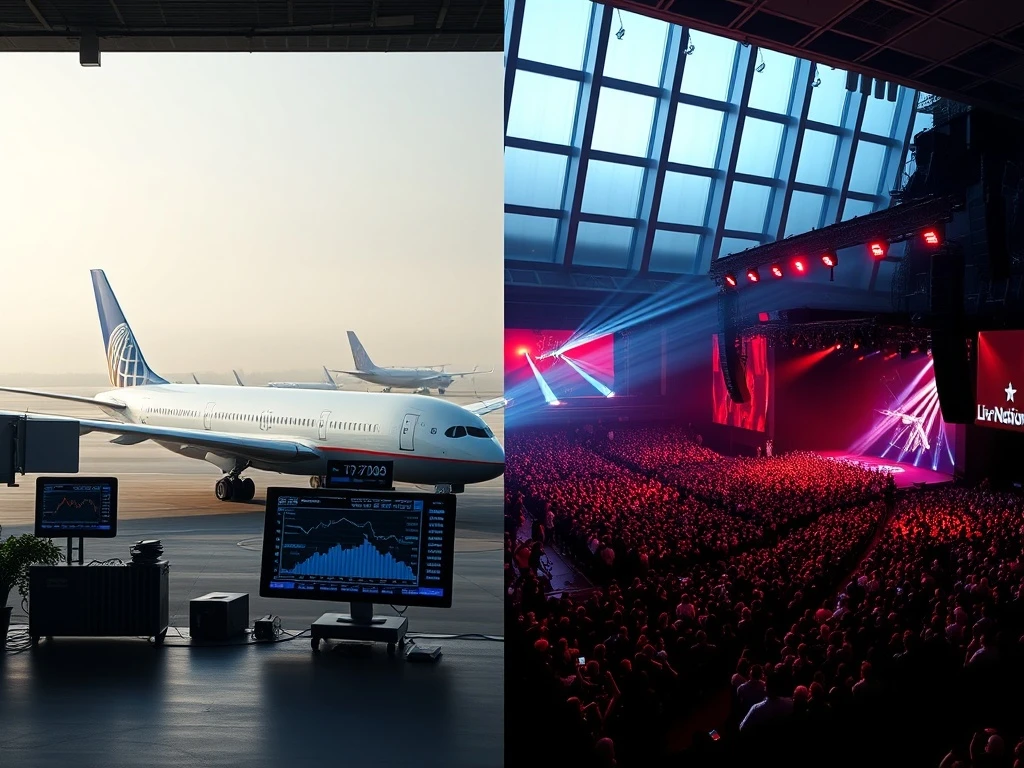
NEW YORK, March 9, 2026 — United Airlines Holdings (UAL) shares plummeted 6.3% in early Monday trading, making it the worst-performing component of the S&P 500 index. Conversely, Live Nation Entertainment (LYV) surged 6.5% to lead the benchmark index’s gainers. The dramatic divergence between these two consumer-facing companies highlights the sector-specific volatility shaping markets as the first quarter of 2026 approaches its midpoint. Trading volume for United Airlines exceeded its 30-day average by 45% within the first hour, according to Nasdaq data feeds monitored by BNK Invest. Meanwhile, Live Nation’s rally built upon its already impressive 16.7% year-to-date gain, contrasting sharply with United’s 22.8% decline over the same period.
S&P 500 Movers: United Airlines Versus Live Nation Entertainment
United Airlines opened at $38.72, immediately dropping below the psychologically significant $40 threshold that technical analysts at Morgan Stanley had identified as critical support. The airline’s decline accelerated after preliminary load factor data showed weaker-than-expected international bookings for the upcoming summer season. Specifically, transatlantic routes displayed a 4.2% decrease in advance reservations compared to the same period last year, according to aviation analytics firm Cirium. Meanwhile, Live Nation Entertainment reached $112.45 per share, its highest level since November 2025. The entertainment giant’s surge followed its announcement of record-breaking pre-sales for its 2026 summer festival series, including Lollapalooza and Bonnaroo. Live Nation’s ticket sales platform processed over 2.3 million transactions in the past 72 hours alone, representing a 31% increase year-over-year.
The trading session’s extreme moves occurred against a backdrop of mixed economic signals. The February jobs report released Friday showed stronger-than-expected employment growth, potentially delaying anticipated Federal Reserve rate cuts. However, consumer confidence surveys revealed growing divergence between entertainment spending intentions and travel budgets. Dr. Anika Patel, Chief Economist at the Global Markets Institute, noted this pattern during a Bloomberg Television interview Monday morning. “We’re witnessing a clear prioritization shift where consumers are protecting their experiential entertainment budgets while becoming more selective about discretionary travel,” Patel explained. “This behavioral change directly impacts companies like United Airlines and Live Nation in opposite directions.”
Impact Analysis: Airlines Versus Entertainment Stocks
The stark performance gap between United Airlines and Live Nation Entertainment reflects broader sector trends influencing investor sentiment. Airlines face mounting pressure from fuel cost volatility, with jet fuel prices rising 18% since January due to Middle East supply concerns. Simultaneously, corporate travel budgets continue their post-pandemic contraction, with business class bookings down 12% year-over-year according to the Global Business Travel Association. Conversely, the live entertainment sector benefits from what analysts term “the experience economy acceleration.” Consumers now allocate approximately 14% of their discretionary spending to live events, up from 9% in 2022, according to Eventbrite’s annual consumer survey.
- Fuel Cost Exposure: United Airlines’ operating costs increased by $420 million quarterly for every $10 per barrel rise in jet fuel prices, according to their latest SEC filing.
- Debt Servicing Pressure: The airline carries $8.2 billion in variable-rate debt, making it particularly sensitive to the Federal Reserve’s interest rate decisions expected later this month.
- Demand Resilience: Live Nation’s concert attendance has grown consecutively for 15 quarters, demonstrating remarkable insulation from broader economic concerns affecting other consumer sectors.
Expert Perspectives on Market Divergence
Financial analysts offered contrasting interpretations of Monday’s extreme moves. Michael Chen, Senior Equity Strategist at Wells Fargo Investment Institute, characterized United’s decline as “disproportionate to fundamental headwinds.” In a research note circulated to institutional clients Monday morning, Chen wrote: “While airline stocks face legitimate challenges, United’s 6.3% single-day drop appears technically driven rather than fundamentally justified. Short interest reached 8.2% of float last week, suggesting mechanical selling pressure amplified the move.” Conversely, entertainment sector analyst Jessica Rivera at Bernstein praised Live Nation’s execution. “Live Nation’s vertical integration—controlling venues, promotion, and ticketing—creates unparalleled pricing power,” Rivera told CNBC. “Their 6.5% gain reflects recognition of this structural advantage as consumers prioritize experiences over goods.”
Broader S&P 500 Context and Component Performance
Monday’s trading session revealed significant dispersion within the S&P 500 beyond the headline movers. The consumer discretionary sector, containing both airlines and entertainment companies, showed the widest performance range of any industry group. Carnival Corporation (CCL) followed United Airlines downward, declining 6.1% after announcing higher-than-expected maintenance costs for its fleet. Meanwhile, Dow Inc. (DOW) surged 5.3% following positive chemical sector earnings revisions. This pattern suggests investors are making sharp distinctions between companies based on specific cost structures and demand drivers rather than broad sector themes.
| S&P 500 Component | March 9 Performance | Year-to-Date Change |
|---|---|---|
| Live Nation Entertainment (LYV) | +6.5% | +16.7% |
| United Airlines Holdings (UAL) | -6.3% | -22.8% |
| Carnival Corporation (CCL) | -6.1% | -14.2% |
| Dow Inc. (DOW) | +5.3% | +8.9% |
Forward-Looking Analysis: What Comes Next for These Movers
United Airlines executives scheduled an investor call for Tuesday morning to address what they termed “market misconceptions” about their summer booking trends. The airline plans to release detailed load factor data for April through July, which could either stabilize or further pressure the stock. Options market activity suggests traders anticipate continued volatility, with implied volatility for United Airlines options reaching 52%, nearly double the S&P 500 average. Live Nation faces a different challenge: managing expectations after its strong performance. The company will report first-quarter earnings on April 24, with analysts projecting 22% revenue growth year-over-year according to consensus estimates compiled by Refinitiv.
Industry and Regulatory Reactions
The Air Line Pilots Association issued a statement Monday afternoon expressing concern about “market overreactions” affecting employee stock ownership plans. Approximately 18% of United Airlines shares are held in employee retirement accounts. Meanwhile, the North American Concert Promoters Association praised Live Nation’s performance as “validation of the live entertainment industry’s resilience.” Regulatory attention may follow United’s sharp decline, as the Securities and Exchange Commission monitors for unusual trading patterns. However, SEC spokesperson Elena Rodriguez told Reuters the agency “does not comment on individual stock movements absent evidence of misconduct.”
Conclusion
Monday’s extreme S&P 500 moves highlight the market’s increasing selectivity amid economic crosscurrents. United Airlines’ 6.3% plunge reflects tangible concerns about fuel costs, interest rates, and shifting travel patterns. Conversely, Live Nation Entertainment’s 6.5% surge demonstrates the powerful demand for live experiences despite broader consumer caution. These divergent paths within the same consumer discretionary sector suggest investors are rewarding companies with pricing power and punishing those with cost sensitivity. As the trading week progresses, attention will focus on whether United Airlines can stabilize through improved communication and whether Live Nation can sustain its momentum amid heightened expectations. The S&P 500’s performance ultimately depends on such individual company stories aggregating into broader market trends.
Frequently Asked Questions
Q1: Why did United Airlines stock drop 6.3% on March 9, 2026?
United Airlines shares fell due to weaker-than-expected international booking data, rising jet fuel costs, and concerns about corporate travel budgets. Technical selling pressure amplified the decline as the stock broke below the $40 support level.
Q2: What drove Live Nation Entertainment’s 6.5% gain on the same day?
Live Nation surged following record pre-sales for its 2026 summer festival series and continued strong demand for live events. The company processed over 2.3 million ticket transactions in 72 hours, showing 31% year-over-year growth.
Q3: How do these moves affect the broader S&P 500 index?
While individual stock movements have limited impact on the 500-component index, extreme divergences signal sector rotation and investor selectivity. The consumer discretionary sector showed the widest performance range of any industry group Monday.
Q4: What should investors watch for next with these stocks?
United Airlines will hold an investor call Tuesday to address booking concerns, while Live Nation reports earnings April 24. Fuel price trends and consumer spending patterns will continue influencing both companies.
Q5: How does this trading session compare to historical market moves?
Single-day moves exceeding 6% for large-cap S&P 500 components occur approximately 12 times annually on average. However, having both extreme gainers and losers in related consumer sectors on the same day is less common.
Q6: What does this mean for people holding these stocks in retirement accounts?
United Airlines’ decline particularly affects employee retirement plans, as approximately 18% of shares are held in such accounts. Investors should consider their overall portfolio allocation rather than reacting to single-day movements.