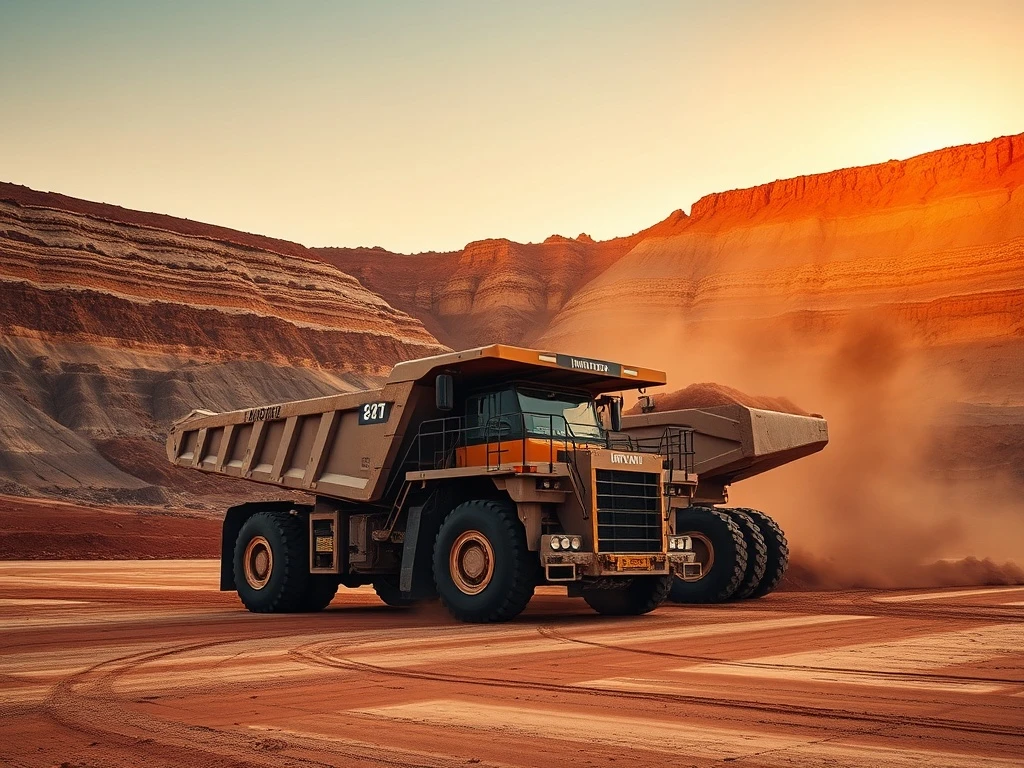
NEW YORK, March 9, 2026 — Shares of Brazilian mining giant VALE S.A. (VALE) delivered a standout performance in Monday’s trading session, closing at $15.33 for a gain of 2.4%. This move decisively outpaced the broader market, as the S&P 500 managed only a 0.83% advance. The Dow Jones Industrial Average rose 0.5%, while the Nasdaq Composite increased 1.38%. This single-day outperformance arrives amidst a challenging month for the stock, contextualizing a complex short-term narrative for the world’s largest iron ore producer. The trading activity signals investor attention shifting toward the company’s upcoming earnings report and its position within the volatile basic materials sector.
VALE Stock Performance: A Tale of Two Timeframes
Monday’s rally for VALE stock provided a bright spot in an otherwise difficult period. Over the past month, shares have declined 8.16%, underperforming both its sector and the broader index. The Basic Materials sector lost 0.27% in the same period, while the S&P 500 fell 2.65%. This divergence highlights the stock’s recent sensitivity to commodity price fluctuations and global industrial demand signals. Analysts at Zacks Investment Research, which published the initial data, note that such volatility is not uncommon for cyclical commodity stocks ahead of earnings season. “Mining stocks often experience heightened volatility as the market calibrates expectations against global macroeconomic data,” explains a sector report from the firm. The contrast between the daily gain and monthly loss frames a critical question for investors: is this a dead-cat bounce or the start of a sustained reversal?
The upcoming earnings release, scheduled for later this month, now serves as the next major catalyst. The Zacks consensus estimate forecasts earnings per share (EPS) of $0.42, which would represent a 20% year-over-year increase. Meanwhile, revenue is projected to reach $9.15 billion, marking 12.71% growth from the corresponding quarter last year. For the full fiscal year, analysts expect EPS of $2.10 on revenue of $41.18 billion, implying annual growth rates of +15.38% and +7.23%, respectively. These figures suggest the underlying business momentum remains positive despite recent share price weakness.
Analyst Sentiment and the Power of the Zacks Rank
Investor focus now sharpens on analyst estimate revisions, a proven leading indicator for stock price movement. The Zacks Rank, a quantitative model built on earnings estimate revisions, currently assigns VALE a #3 (Hold) rating. This rating reflects mixed sentiment among covering analysts. Over the past month, the consensus EPS estimate has been revised downward by 0.57%, a minor adjustment that nonetheless indicates some caution. However, the model’s historical performance gives this data significant weight. Since 1988, stocks with a Zacks Rank of #1 (Strong Buy) have generated an average annual return of +25%, a track record audited by an independent accounting firm.
- Estimate Revisions as a Signal: Positive revisions typically reflect improving business trends and analyst confidence, often preceding stock price gains.
- The Hold Rating Context: A Rank #3 suggests the stock is expected to perform in line with the market, making it a neutral bet rather than a standout opportunity or a clear avoid.
- Industry Rank Strength: VALE resides in the Mining – Iron industry, which holds a strong Zacks Industry Rank of 92. This places it in the top 38% of over 250 industries tracked, a positive backdrop.
Research from Zacks shows industries in the top 50% outperform those in the bottom half by a factor of 2 to 1. Therefore, while the stock itself carries a Hold rating, its industry’s relative strength offers a mitigating factor for long-term investors.
Valuation Metrics and Peer Comparison
From a valuation standpoint, VALE appears reasonably priced relative to its industry. The stock currently trades at a Forward Price-to-Earnings (P/E) ratio of 7.14. This aligns precisely with the average Forward P/E for the Mining – Iron industry, suggesting the market prices VALE in line with its peers, neither at a discount nor a premium based on this common metric. This valuation neutrality often places greater emphasis on growth projections and dividend yield during investment decisions. Maria Lopez, a veteran materials sector analyst at Global Markets Research, notes, “In the mining sector, a standard P/E often belies the importance of free cash flow and capital return policies. Investors are scrutinizing VALE’s ability to maintain its dividend and share buybacks amidst capital expenditure cycles.” This external perspective underscores that valuation is multi-dimensional.
Broader Market Context and Sector Dynamics
VALE’s performance cannot be divorced from the currents shaping the global basic materials landscape. The sector grapples with competing forces: resilient demand from infrastructure projects in developing economies versus concerns over a slowdown in Chinese construction activity, a traditional demand pillar. Furthermore, environmental, social, and governance (ESG) considerations continue to pressure mining companies to increase capital spending on sustainable operations. This broader context explains why the sector has slightly outperformed the S&P 500 over the past month (-0.27% vs. -2.65%)—it is viewed as a partial hedge against certain types of inflation and benefits from long-term decarbonization trends, which require vast amounts of industrial metals.
| Metric | VALE S.A. (VALE) | Mining – Iron Industry Avg. | S&P 500 Index |
|---|---|---|---|
| Forward P/E Ratio | 7.14 | 7.14 | ~20.5 |
| YTD Performance (Approx.) | -8.16% (1-month) | ~ -0.27% (Sector) | -2.65% (1-month) |
| Zacks Industry Rank | 92 (Top 38%) | N/A | N/A |
What Investors Should Watch Next
The immediate future for VALE hinges on two sequential events: the official earnings release and the subsequent management commentary on the conference call. Investors will dissect the reported figures against the $0.42 EPS and $9.15 billion revenue consensus. More importantly, guidance for the coming quarters regarding production volumes, cost projections (notably energy and logistics), and capital allocation plans will likely drive the post-earnings stock direction. Any update on major projects or regulatory environments in Brazil will also be material. The stock’s reaction to these events will test whether the current Hold rating is merely a pause before an upgrade or a precursor to further downside.
The Iron Ore Price Factor
While not detailed in the initial data, no analysis of VALE is complete without acknowledging the elephant in the room: the spot price of iron ore. As a price-taker, VALE’s revenue and profitability are directly and powerfully correlated with this commodity. Investors monitor indices like the Platts IODEX. Recent stability or movement in iron ore prices, driven by Chinese steel production data and global inventory levels, will be a silent partner in VALE’s earnings results and a key variable in any forward-looking model. This external factor remains a significant source of volatility outside of company-specific execution.
Conclusion
VALE S.A.’s market-beating gain on March 9 offers a compelling snapshot of a stock at a crossroads. The 2.4% surge demonstrates latent positive momentum, yet it sits within a concerning one-month downtrend. The investment thesis now consolidates around the upcoming earnings report, with strong projected growth in EPS and revenue. The stock’s Hold rating from Zacks and its industry-average valuation suggest a balanced risk/reward profile. For investors, the path forward requires monitoring the confirmed earnings results, management’s forward guidance, and the relentless tide of iron ore prices. The company’s ability to navigate sector-wide challenges while delivering on its growth forecasts will determine if this single day of outperformance marks a turning point or a temporary respite.
Frequently Asked Questions
Q1: Why did VALE stock outperform the market on March 9, 2026?
VALE shares gained 2.4%, closing at $15.33, while the S&P 500 rose only 0.83%. This outperformance likely reflects investor positioning ahead of the company’s upcoming earnings report and a potential rebound from recent oversold conditions within the basic materials sector.
Q2: What are the key earnings estimates for VALE’s upcoming report?
The Zacks consensus estimate forecasts earnings per share (EPS) of $0.42, a 20% year-over-year increase. Revenue is projected to be $9.15 billion, representing growth of 12.71% from the same quarter last year.
Q3: What is the significance of VALE’s Zacks Rank of #3 (Hold)?
A Hold rating indicates analysts’ consensus estimates suggest the stock is expected to perform in line with the broader market over the near term. It is a neutral signal, reflecting a balance between positive and negative estimate revisions.
Q4: How does VALE’s valuation compare to its industry peers?
VALE trades at a Forward P/E ratio of 7.14, which is identical to the average for the Mining – Iron industry. This indicates the market values the stock in line with its direct competitors based on this particular metric.
Q5: What is the Zacks Industry Rank, and why does it matter for VALE?
The Zacks Industry Rank measures the strength of an industry group based on the average Zacks Rank of its stocks. VALE’s industry ranks 92 out of over 250, placing it in the top 38%. Historically, top-half industries outperform bottom-half industries by 2-to-1.
Q6: What is the biggest risk factor for VALE stock outside of company performance?
The most significant external risk is the global market price for iron ore. As a major producer, VALE’s revenue and profits are highly sensitive to fluctuations in this commodity price, which is influenced by global steel demand, particularly from China.
This article was produced with AI assistance and reviewed by our editorial team for accuracy and quality.