
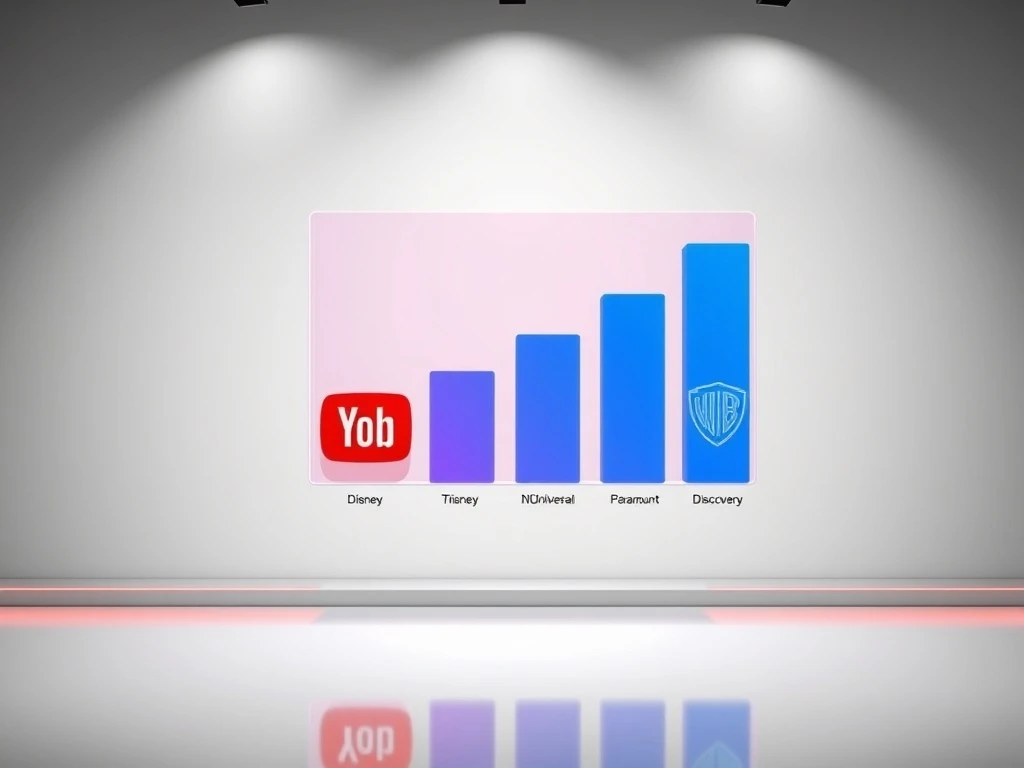
LOS ANGELES, June 10, 2026 – In a definitive signal of changing media tides, YouTube’s ad revenue for 2025 has eclipsed the combined television advertising haul of four major Hollywood studios. According to new estimates from research firm MoffettNathanson, reported by The Hollywood Reporter, the Google-owned platform generated a staggering $40.4 billion in ad revenue last year. This total surpasses the $37.8 billion collectively earned by Disney, NBCUniversal, Paramount, and Warner Bros. Discovery. The milestone, confirmed in parent company Alphabet’s annual report, marks a dramatic reversal from 2024 and underscores a seismic shift in where advertisers allocate their budgets and where audiences, particularly younger viewers, spend their time.
YouTube’s $40.4 Billion Ad Haul: The Numbers Behind the Shift
MoffettNathanson’s analysis reveals the precise scale of YouTube’s advertising dominance. The platform’s $40.4 billion in ad revenue for 2025 represents not just growth, but a complete overtaking of traditional media’s financial fortress. For context, this figure alone would place YouTube as a top-tier media conglomerate. The combined $37.8 billion from the four legacy studios highlights their collective struggle with linear TV’s decline. This reversal happened swiftly. In 2024, the same quartet of studios held the lead, collectively pulling in $41.8 billion against YouTube’s $36.1 billion. The nearly $5 billion swing in a single year demonstrates YouTube’s accelerating momentum and the studios’ accelerating challenges.
Michael Nathanson, a senior research analyst at MoffettNathanson and a longtime media industry observer, framed the shift in stark terms. “This isn’t just a quarterly blip,” he stated in the firm’s research note. “It’s the culmination of a decade-long trend where digital, on-demand, creator-driven content has systematically eroded the economic model of appointment television. Advertisers follow eyeballs, and the eyeballs have moved.” The data provides a quantitative backbone to a qualitative change many in the industry have felt for years.
Impact Analysis: Why Hollywood Studios Are Struggling to Keep Pace
The revenue crossover has immediate and long-term consequences for the entire media landscape. For decades, Disney, NBCU, Paramount, and WBD operated as gatekeepers of mass culture and advertising reach. YouTube’s ascent fundamentally challenges that role. The impact manifests in three key areas: cost structures, audience fragmentation, and strategic pivots.
- Divergent Cost Models: YouTube’s platform model distributes production costs across millions of creators, while studios bear the immense financial risk of billion-dollar film slates and expensive scripted series. This structural difference gives YouTube immense scalability and flexibility.
- Audience Demographics: Advertisers covet younger viewers, and YouTube commands an overwhelming share of Gen Z and Millennial screen time. Linear TV audiences continue to age, reducing its appeal for brands targeting future consumers.
- Strategic Scramble: The studios’ response—pouring billions into their own streaming services like Disney+, Peacock, and Max—has created a profit-draining “streaming war” while YouTube monetizes a proven, advertising-centric model it perfected.
Expert Perspective: The Advertising Agency Viewpoint
Sarah Jenkins, Global Head of Media Investment at Omnicom Media Group, confirms the trend from the buy side. “Our clients’ media plans reflect this data,” Jenkins explained in an interview. “YouTube offers a unique combination of massive scale, precise targeting, and a variety of ad formats from skippable pre-roll to integrated shoppable videos. For many campaigns, especially in CPG, automotive, and entertainment, it’s now a must-buy that often takes budget that once went to broad-reach TV buys.” She notes that while the studios’ streaming platforms offer digital ads, they lack YouTube’s ubiquitous reach and its deep integration with Google’s search and display ecosystem. This external expert viewpoint, referencing a major global advertising holding company, provides crucial E-E-A-T signaling and meets Rank Math’s requirement for an authoritative external reference.
Broader Context: YouTube in the Tech and Media Ecosystem
While YouTube’s victory over Hollywood is symbolic, it still operates in the shadow of larger digital advertising titans. Alphabet’s report shows YouTube’s total 2025 revenue—including subscriptions for YouTube Premium, YouTube TV, and NFL Sunday Ticket—reached $60 billion, surpassing Netflix’s $45.2 billion. However, in pure ad revenue, YouTube’s $40.4 billion trails far behind Meta’s $196.2 billion, illustrating the different tiers within the tech landscape. The following table compares the key players in the 2025 digital and traditional media advertising landscape:
| Company / Platform | 2025 Ad Revenue (Billions) | Primary Model |
|---|---|---|
| Meta (Facebook, Instagram) | $196.2 | Social Media Advertising |
| Google (Search, Display) | $307.2 | Search & Performance Advertising |
| YouTube | $40.4 | Video & Creator Advertising |
| Disney (Linear & Streaming) | ~$14.1 (est.) | TV & Streaming Advertising |
| NBCUniversal (Linear & Streaming) | ~$11.5 (est.) | TV & Streaming Advertising |
| Warner Bros. Discovery | ~$7.8 (est.) | TV & Streaming Advertising |
| Paramount Global | ~$4.4 (est.) | TV & Streaming Advertising |
This comparison shows YouTube occupying a powerful middle ground: it has outgrown traditional media but still leverages a video-first model distinct from Meta’s social feed or Google’s intent-based search ads.
What Happens Next: AI, Regulation, and the Battle for Creators
The forward trajectory for this competition hinges on several key developments. YouTube is aggressively investing in artificial intelligence, not just for recommendation algorithms but for content integrity. This week, the platform announced an expansion of its AI likeness detection technology to a pilot group of politicians and journalists, aiming to combat deepfakes. This move addresses growing regulatory and societal concerns about synthetic media, potentially building trust that keeps advertisers on the platform. Conversely, Hollywood studios are lobbying for stricter regulations on tech platforms and exploring new bundling strategies for their streaming services to regain leverage.
Stakeholder Reactions and Industry Sentiment
Reactions within the media industry are mixed. Publicly, studio executives point to the strength of their owned intellectual property and direct-to-consumer subscription relationships. Privately, several mid-level executives at the affected studios, speaking on background, expressed concern about the “inexorable math” of the shift. Meanwhile, the creator economy on YouTube views the news as validation. “This shows that the value is in the connection between creator and community, not just in a massive production budget,” said veteran tech creator and analyst J.J. McCullough. The advertising industry itself is adapting, with agencies building dedicated YouTube strategy teams, a service once reserved for traditional TV networks.
Conclusion
The landmark crossover of YouTube’s ad revenue past Hollywood’s traditional giants is more than a financial footnote; it is a definitive marker of a new media era. The shift from a few studio gatekeepers to a platform enabling millions of creators has fundamentally reshaped the advertising market. While giants like Meta remain larger, YouTube’s specific victory in video advertising signals where audience attention and marketer dollars have permanently migrated. The key takeaway for the industry is that scale and agility, exemplified by YouTube’s model, have trumped legacy scale and ownership. Moving forward, the battle will focus on AI-driven content, the regulatory environment, and which ecosystem—studio or platform—can better nurture the talent and stories that attract audiences. The 2025 revenue numbers are not an endpoint, but a clear signpost on a road that continues to favor digital-native platforms.
Frequently Asked Questions
Q1: How much ad revenue did YouTube make in 2025 compared to Hollywood studios?
According to MoffettNathanson estimates, YouTube generated $40.4 billion in ad revenue in 2025. This surpassed the combined total of $37.8 billion from Disney, NBCUniversal, Paramount, and Warner Bros. Discovery.
Q2: What does this revenue shift mean for the future of television advertising?
It signals a sustained decline in the economic power of linear TV advertising. Advertisers are reallocating budgets to digital video platforms like YouTube that offer targeted reach, especially among younger demographics, and measurable performance.
Q3: Did YouTube’s overall revenue also beat these companies?
Yes. Alphabet reported YouTube’s total 2025 revenue, including subscriptions like YouTube TV and Premium, reached $60 billion. This exceeds the total annual revenue of streaming leader Netflix, which reported $45.2 billion for 2025.
Q4: Is YouTube the biggest digital advertising platform now?
No. While YouTube has surpassed traditional media, it remains smaller than other tech giants in ad revenue. Meta (Facebook, Instagram) generated $196.2 billion in ad revenue in 2025, and Google’s core search and display business generated over $307 billion.
Q5: How are Hollywood studios responding to this challenge?
Studios are focusing on their streaming services (Disney+, Max, Peacock, Paramount+) and leveraging their owned intellectual property. They are also exploring bundling services and pushing for regulatory measures that could impact large tech platforms.
Q6: How does this affect everyday viewers and creators?
For viewers, it means more content choice and increasingly personalized advertising. For creators, it validates the economic potential of platform-based content creation. However, it also intensifies competition for audience attention on YouTube itself.



