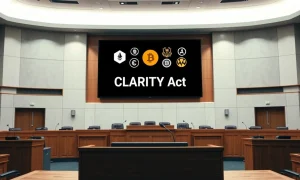
Prominent investor and hedge fund manager Mark Yusko has issued a stark warning regarding the proposed CLARITY Act, arguing that the legislation could effectively transfer control of the cryptocurrency industry from decentralized communities to established Wall Street institutions. Yusko, CEO of Morgan Creek Capital Management, voiced his concerns during a recent industry discussion, framing the bill as a potential turning point that could undermine the foundational principles of digital assets.
What Is the CLARITY Act?
The CLARITY Act, short for the “Clarity for Digital Assets Act,” is a proposed U.S. federal bill aimed at establishing a clearer regulatory framework for cryptocurrencies and digital assets. Its proponents argue that the legislation would provide much-needed legal certainty for businesses and investors operating in the crypto space. However, critics like Yusko contend that the bill’s structure may inadvertently favor large, regulated financial entities over smaller, decentralized projects and individual participants.
Also read: Ripple Partners With Water.org to Expand Clean Water Access Using RLUSD Stablecoin
At its core, the bill seeks to define which digital assets are securities and which are commodities, a long-standing debate that has created regulatory ambiguity. By potentially classifying a broad swath of tokens under securities law, the CLARITY Act could place significant compliance burdens on projects, making it difficult for decentralized startups to operate without the backing of major financial firms.
Yusko’s Central Argument: A Shift in Power
Yusko’s primary concern is that the CLARITY Act, as currently drafted, could concentrate crypto market influence within traditional financial centers. He argues that the compliance costs and legal requirements embedded in the bill would be manageable for large Wall Street banks and asset managers but prohibitive for the grassroots, community-driven projects that have defined the crypto ecosystem.
Also read: Galaxy Research Lowers CLARITY Act Approval Odds to 60% on Political Hurdles
“The risk is that we end up with a system where crypto is just another asset class controlled by the same institutions that brought us the 2008 financial crisis,” Yusko stated. He emphasized that the original vision of cryptocurrencies was to create a parallel financial system that operates outside of centralized control. The CLARITY Act, in his view, could reverse that trajectory.
This perspective aligns with a broader debate within the crypto community about the trade-offs between regulatory clarity and decentralization. While many stakeholders agree that some regulation is necessary for mainstream adoption, the specific design of the rules matters greatly.
Potential Market Implications
If Yusko’s assessment proves accurate, the CLARITY Act could accelerate a trend already visible in the market: the increasing dominance of institutional investors. Over the past two years, major financial firms have launched crypto trading desks, custody services, and exchange-traded products. Clearer regulations could further legitimize these offerings, attracting more institutional capital.
However, this could come at the cost of reducing opportunities for retail investors and small-scale innovators. If compliance costs rise, many decentralized finance (DeFi) protocols and token projects may find it difficult to operate legally in the United States, potentially driving innovation overseas or into less regulated markets.
Broader Context: The Ongoing Regulatory Debate
The CLARITY Act is just one of several legislative efforts in the U.S. aimed at regulating digital assets. The Biden administration and the Securities and Exchange Commission (SEC) have pursued an enforcement-heavy approach, while some members of Congress have pushed for more comprehensive legislation. The bill’s progress remains uncertain, with debates expected to continue through 2025 and into 2026.
Yusko’s warning adds a significant voice to the discussion, given his track record as an early and vocal advocate for Bitcoin and blockchain technology. His critique highlights the tension between the desire for regulatory clarity and the risk of over-centralization.
Conclusion
Mark Yusko’s warning about the CLARITY Act underscores a critical inflection point for the cryptocurrency industry. While the bill aims to bring much-needed legal structure, its potential to shift power toward Wall Street raises fundamental questions about the future of decentralization. For investors and enthusiasts alike, the outcome of this legislative process will have lasting implications for who controls digital assets and how they are used.
FAQs
Q1: What is the CLARITY Act?
The CLARITY Act is a proposed U.S. federal bill designed to create a clearer regulatory framework for digital assets, particularly regarding whether they are classified as securities or commodities.
Q2: Why does Mark Yusko believe the CLARITY Act could hand control to Wall Street?
Yusko argues that the bill’s compliance requirements would be easier for large, established financial institutions to meet, potentially sidelining smaller decentralized projects and shifting market power to traditional Wall Street firms.
Q3: How might the CLARITY Act affect retail crypto investors?
If the bill increases compliance costs, some smaller crypto projects may struggle to operate in the U.S., potentially reducing investment options for retail investors and concentrating market influence among institutional players.