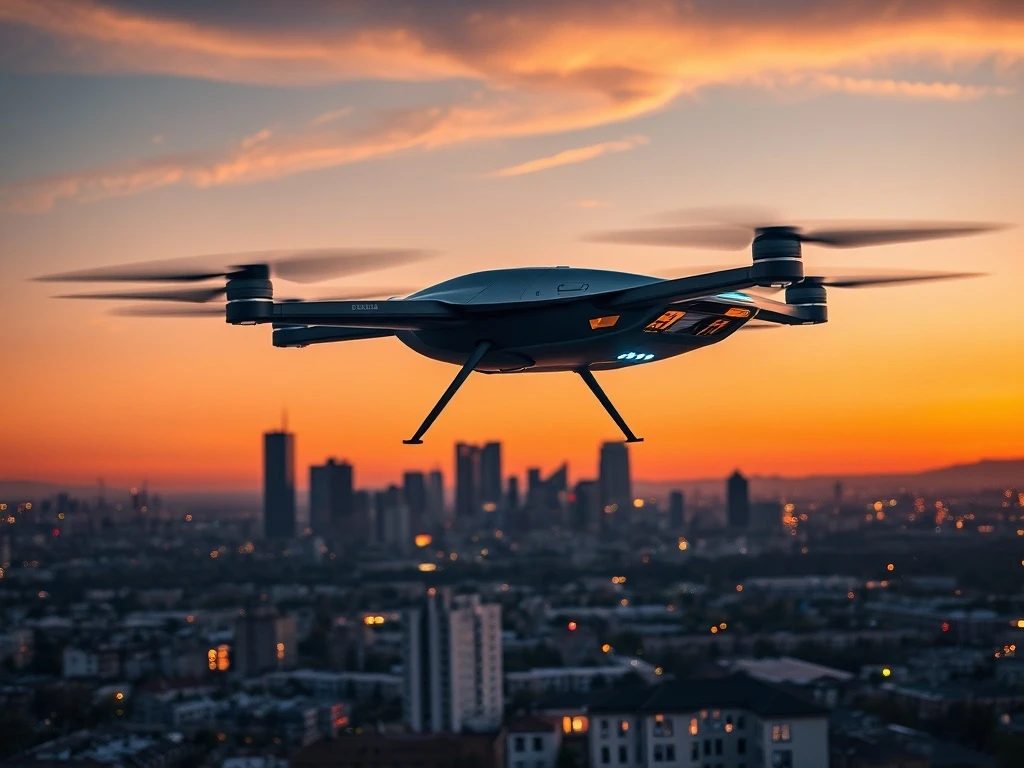
WASHINGTON, D.C., March 15, 2026 — The Federal Aviation Administration has granted an unprecedented, wide-scale authorization for testing flying taxis across 26 states, a landmark decision that accelerates the United States toward a future of urban air mobility. This critical regulatory greenlight, issued late Friday, allows manufacturers like Joby Aviation, Archer Aviation, and Beta Technologies to begin advanced flight operations in designated airspace, moving beyond confined test sites. The FAA’s action directly responds to a concerted push from industry and the White House’s National Advanced Air Mobility Initiative, aiming to establish initial commercial routes by 2028. Consequently, this decision marks the most significant step yet in integrating electric vertical takeoff and landing (eVTOL) aircraft into the national airspace system.
FAA’s Unprecedented Approval for eVTOL Testing
The FAA’s authorization is not a single permit but a coordinated framework of Special Airworthiness Certificates and defined test corridors. Dr. David Kim, the FAA’s Associate Administrator for Aviation Safety, outlined the scope in a briefing. “This framework establishes the operational safety parameters for a new era of aviation,” Kim stated. “We are enabling real-world data collection in diverse environments, from dense urban canyons to suburban landscapes.” The approved states include California, Texas, Florida, Ohio, and North Carolina, chosen for their varying geography, existing aviation infrastructure, and partnership commitments from local governments. Furthermore, the approval mandates rigorous data sharing with the FAA, including noise profiles, detect-and-avoid system performance, and community feedback metrics. This phased approach aims to de-risk the technology before any potential certification for passenger service, which the agency targets for late 2027.
This decision culminates a five-year process that began with the FAA’s “Innovate28” plan. Initially, testing was limited to a handful of remote sites. However, technological maturation and intense lobbying from a coalition of aerospace companies and city planners shifted the timeline. A pivotal 2024 report from the McKinsey Global Institute, projecting a $115 billion annual market for urban air mobility by 2035, added economic pressure. The FAA’s move strategically positions the U.S. in a global race with China and the European Union, both of which have aggressive eVTOL deployment timelines.
Immediate Impacts on Cities and Transportation
The immediate impact of the FAA’s greenlight is logistical and infrastructural. Cities within the 26-state zone must now prepare vertiports—specialized takeoff and landing hubs—and integrate air traffic management for low-altitude operations. “This isn’t just about the aircraft; it’s about building the ground ecosystem,” explained Maria Chen, an urban mobility expert at the Brookings Institution. “We’re looking at a fundamental redesign of urban transit networks, with vertiports atop parking garages, train stations, and even hospital helipads.” The first test corridors will focus on predictable routes: airport-to-downtown shuttles and fixed inter-city links. For instance, a planned test route between Dallas-Fort Worth International Airport and a vertiport in downtown Fort Worth could cut a 50-minute drive to a 12-minute flight. However, significant challenges around noise, privacy, and equitable access remain unresolved.
- Infrastructure Development: An estimated $2-4 billion in private and public investment is now expected to flow into vertiport construction and air traffic control software upgrades over the next 24 months.
- Job Creation: The Advanced Air Mobility industry forecasts creating 15,000 new high-skilled manufacturing and operations jobs by 2028, with many concentrated in the approved test states.
- Regulatory Cascade: Local zoning laws and state transportation policies must now be updated to accommodate this new layer of mobility, a process that will vary widely across jurisdictions.
Expert Analysis and Industry Response
Industry leaders greeted the news with cautious optimism. “This is the watershed moment we’ve been working toward,” said JoeBen Bevirt, founder and CEO of Joby Aviation, in a company statement. “The FAA’s approval validates our safety case and allows us to demonstrate the real-world utility of quiet, electric air travel.” Conversely, external experts urge measured expectations. Dr. Amanda Clark, a professor of aerospace engineering at MIT and author of “The Urban Sky,” provided critical context. “The technical hurdles for safe, scalable, and affordable eVTOL operations are immense,” Clark noted. “Battery energy density, airspace congestion management, and maintenance cost curves are still active areas of development. This testing phase is about confronting those realities, not skipping over them.” Her research, funded in part by NASA, emphasizes that public acceptance will hinge on demonstrated safety and community benefit, not just technological novelty.
Global Context and Competitive Landscape
The U.S. move places it in direct competition with other global powers racing to dominate the advanced air mobility sector. While the FAA’s approach is methodical and safety-first, other regions are pursuing more aggressive, top-down strategies. China’s Civil Aviation Administration, for example, has already certified two eVTOL models for limited commercial use in specific pre-planned “demonstration zones,” such as the Greater Bay Area. The European Union Aviation Safety Agency (EASA) has a certification framework in place and several aircraft in the validation pipeline, with commercial operations expected in cities like Paris and Munich by 2027. The table below highlights key differences in regulatory approaches.
| Region | Regulatory Body | Certification Status | Target Commercial Launch |
|---|---|---|---|
| United States | Federal Aviation Administration (FAA) | Testing authorized; certification underway | 2028 |
| European Union | European Union Aviation Safety Agency (EASA) | Type Certification framework active | 2027 |
| China | Civil Aviation Administration of China (CAAC) | Two models certified for demonstration zones | 2026 (limited) |
The Road Ahead: From Testing to Certification
The path from authorized testing to certified passenger service involves multiple, concurrent validation streams. Next, manufacturers must compile thousands of hours of incident-free flight data across all weather conditions. Simultaneously, the FAA will finalize the new Part 135.XX rule, a novel regulatory category for air taxi operations, expected in draft form by late 2026. “The next 18 months are about proving not just that it flies, but that it fits,” said an FAA official speaking on background. Key milestones include integrating eVTOL flight paths with existing helicopter routes, demonstrating seamless communication with Air Traffic Control, and conducting public demonstration flights in at least three major cities. The ultimate goal is a scalable model where a single operator can manage hundreds of daily flights across a metropolitan area as routinely as an airline manages its schedule.
Community and Environmental Considerations
Public reaction has been mixed. Proponents highlight the potential to decongest roads and reduce carbon emissions from short-haul car trips. Opponents, often organized under community groups like “Silent Skies,” raise concerns about noise pollution, visual clutter, and the “suburban sky-lane” effect, where affluent neighborhoods become primary flight paths. The FAA’s testing mandate requires each operator to establish a community engagement plan and publish noise measurement data. Early data from Joby’s pre-existing test site in Marina, California, shows its aircraft produces 45 decibels at 500 feet—quieter than a typical conversation. However, skeptics argue that cumulative noise from dozens of aircraft in an urban canyon could be disruptive. Environmental reviews will also scrutinize the lifecycle carbon footprint of manufacturing and charging these new vehicles.
Conclusion
The FAA’s authorization for flying taxi tests across 26 states is a definitive turning point, transitioning urban air mobility from concept to tangible reality. This decision unlocks a crucial phase of real-world validation for eVTOL technology, infrastructure, and regulation. While significant technical and societal hurdles remain, the coordinated testing framework provides a clear, data-driven pathway toward potential certification and commercial service by the end of the decade. The success of this endeavor will depend on a triad of factors: flawless safety performance during testing, the development of cost-effective and accessible business models, and the cultivation of genuine public trust. Observers should monitor the first integrated test flights in partnered cities like Orlando and Los Angeles later this year, as they will offer the first true glimpse of a transformed urban transportation layer.
Frequently Asked Questions
Q1: What exactly did the FAA approve for flying taxis?
The FAA granted a coordinated framework of Special Airworthiness Certificates that allow multiple eVTOL manufacturers to conduct advanced flight testing in designated airspace across 26 states. This is not yet approval for commercial passenger service.
Q2: When could I actually take a flying taxi ride?
Manufacturers and the FAA are targeting initial commercial passenger service on specific, pre-approved routes by 2028, pending successful completion of the testing and certification process.
Q3: Which states are included in the testing approval?
The 26 states include major aviation hubs and diverse geographies such as California, Texas, Florida, Ohio, North Carolina, Nevada, Colorado, Tennessee, and Massachusetts, among others.
Q4: Are flying taxis safe?
The core purpose of this testing phase is to prove safety in real-world conditions. eVTOL aircraft are designed with multiple redundant systems (like 6-8 independent rotors) and are electric, eliminating the risk of engine failure common in helicopters.
Q5: How will flying taxis affect current air traffic?
Tests will occur in newly designated “urban corridors” below 4,000 feet, largely separate from traditional airline traffic. A new air traffic management system, often called UTM (Unmanned Traffic Management), is being developed to handle this low-altitude layer.
Q6: How much will a flying taxi ride cost initially?
Early estimates suggest a price point similar to premium ground ride-sharing services—potentially $3-4 per mile—with the goal of reducing costs to be competitive with taxi services over time as operations scale.