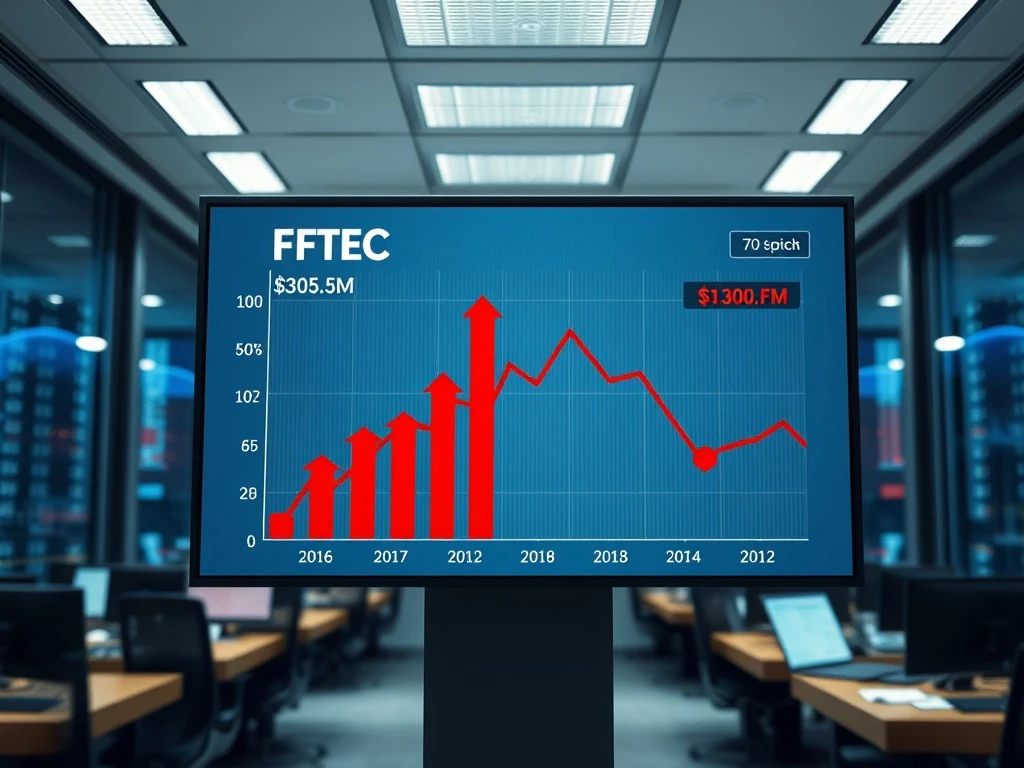
NEW YORK, March 11, 2026 — A significant capital rotation is underway in the technology sector. The Fidelity MSCI Information Technology Index ETF (FTEC) recorded an approximate $305.5 million net outflow for the week ending March 11, 2026, according to data from BNK Invest. This substantial movement, representing a 1.9% decrease in shares outstanding, signals potential investor repositioning ahead of key economic data. The outflow, detected amidst mixed trading for major components like Corning Inc (GLW), Accenture plc (ACN), and Palo Alto Networks, Inc (PANW), raises questions about near-term sentiment toward high-growth tech equities. Market analysts are scrutinizing whether this is an isolated rebalancing or the start of a broader trend.
Anatomy of the $305.5 Million FTEC ETF Outflow
ETF Channel data, monitored by BNK Invest, shows the FTEC ETF’s shares outstanding dropped from 73.7 million to 72.3 million units in a single week. This destruction of units directly translates to the $305.5 million withdrawal. Consequently, the ETF’s sponsor must sell underlying holdings to meet redemptions, creating potential selling pressure on its components. “Weekly flow data is a real-time sentiment gauge,” explains Michael Chen, Senior ETF Strategist at Vanguard. “An outflow of this magnitude from a core tech ETF like FTEC isn’t noise; it requires attention. It often precedes or coincides with sector-specific volatility.” Trading on March 11 reflected this unease, with GLW shares declining about 2.8%, while ACN traded flat and PANW eked out a 0.1% gain, demonstrating divergent performance within the basket.
The FTEC ETF, designed to track the MSCI USA IMI Information Technology Index, holds a concentrated portfolio of giants like Apple, Microsoft, and Nvidia. Therefore, large flows can ripple through the entire tech ecosystem. This week’s activity contrasts sharply with the fund’s strong performance over the past year, where it traded between a 52-week low of $134.11 and a high of $240.25, last trading at $219.06. The current price sits comfortably above its 200-day moving average, a key technical level many investors watch, suggesting the long-term trend remains intact despite short-term flows.
Immediate Market Impact and Component Analysis
The direct impact of an ETF outflow falls disproportionately on its largest holdings due to the mechanics of unit creation and destruction. While the selling is spread across all holdings, the largest weightings feel the greatest effect. For FTEC investors, understanding the performance of its top components provides crucial context for the outflow’s driver.
- Corning Inc (GLW) Downturn: GLW’s 2.8% drop was the most pronounced among the highlighted stocks. As a supplier of specialty glass for electronics and optics, its performance can be sensitive to forecasts for consumer electronics and data center spending. The sharper decline suggests investors may be expressing specific concerns about this segment.
- Accenture plc (ACN) Stability: Trading flat, ACN demonstrated relative resilience. As a global IT services and consulting firm, its business model is often viewed as more defensive within tech, driven by long-term enterprise digital transformation contracts rather than cyclical hardware demand.
- Palo Alto Networks (PANW) Resilience: The marginal 0.1% gain for PANW underscores the persistent demand for cybersecurity solutions. Even during potential sector rotations, security remains a non-discretionary budget item for corporations, insulating stocks like PANW from broader sell-offs.
Expert Insight on ETF Flow Mechanics
Dr. Sarah Jennings, Director of Research at the Investment Company Institute (ICI), clarifies the process. “ETF units are created or destroyed by authorized participants (APs) based on investor demand,” she states. “A net outflow means APs are redeeming units for the underlying basket of securities. The ETF sponsor then sells those securities in the market. This process is mechanical and efficient, but it does introduce a source of selling pressure that is purely flow-based, not fundamentally driven.” This technical selling can sometimes create temporary dislocations between a stock’s ETF-driven price and its intrinsic value, a nuance active traders monitor closely. The ICI provides authoritative data on fund flows, confirming the increased volatility in weekly ETF allocations throughout early 2026.
Broader Context: Tech ETF Flows in Early 2026
This FTEC movement did not occur in a vacuum. The first quarter of 2026 has seen elevated volatility in ETF flows across growth-oriented sectors. Investors are grappling with recalibrated interest rate expectations, geopolitical tensions affecting semiconductor supply chains, and robust earnings that have already lifted valuations. The FTEC outflow may represent profit-taking after a strong run or a tactical shift toward more defensive or value-oriented parts of the market.
| ETF (Symbol) | Flow Direction (Week of Mar 11) | Notable Sector Focus |
|---|---|---|
| Fidelity MSCI IT ETF (FTEC) | -$305.5M (Outflow) | Broad Information Technology |
| Technology Select Sector SPDR (XLK) | Data Pending | Technology (S&P 500 Sector) |
| Vanguard Information Tech ETF (VGT) | Data Pending | Information Technology |
Comparing this event to historical outflows is essential. For instance, similar large-scale redemptions from tech ETFs in late 2025 preceded a period of sector consolidation. However, each event has unique catalysts. The current macroeconomic backdrop includes the Federal Reserve’s data-dependent pause, making investors particularly sensitive to any signs of economic softening that could disproportionately affect high-multiple tech stocks.
What Investors Should Watch Next
The immediate focus shifts to whether this outflow is a one-week anomaly or the beginning of a sustained trend. Market participants will closely monitor the next weekly shares outstanding data from ETF Channel. Furthermore, earnings reports from major FTEC constituents scheduled for the coming weeks will provide fundamental justification or contradiction for the flow-based selling. Any guidance cuts or softening demand signals could validate the outflow as prescient, while strong results could trigger a swift reversal of flows back into the sector.
Institutional and Retail Investor Reactions
Initial reactions from the investment community have been mixed. Some institutional asset managers view the outflow as a healthy correction and a potential entry point, citing unchanged long-term fundamentals for cloud computing, AI, and digital infrastructure. Conversely, quantitative funds that use flow data as a momentum signal may interpret this as a negative short-term indicator, potentially amplifying the move. On retail investor forums, discussion has centered on whether to “buy the dip” in FTEC or rotate into other sectors showing inflow strength, such as healthcare or consumer staples ETFs.
Conclusion
The $305.5 million outflow from the FTEC ETF serves as a critical alert for technology sector investors. While the long-term thesis for tech innovation remains robust, short-term capital movements reflect real-time risk reassessment. The divergent performance of components like GLW, ACN, and PANW highlights the importance of stock-specific fundamentals even during sector-wide flows. Investors should treat this data point as one piece of a larger puzzle, integrating it with upcoming earnings, economic indicators, and Federal Reserve commentary. The week ahead will be crucial in determining if March 11, 2026, marked a temporary blip or a more significant turning point for capital allocation within the high-flying technology sector.
Frequently Asked Questions
Q1: What does a $305.5 million ETF outflow actually mean?
It means investors, on net, redeemed approximately $305.5 million worth of units from the FTEC ETF. To return this cash, the ETF must sell a proportional amount of all the stocks it holds, like Apple, Microsoft, and Nvidia, which can create downward pressure on those share prices.
Q2: How does an outflow directly affect stocks like GLW, ACN, and PANW?
The ETF sells a slice of every holding. Since FTEC owns these stocks, the act of selling to meet redemptions adds sell orders to the market for GLW, ACN, and PANW. This can exacerbate normal trading moves, which is why GLW fell more sharply on a day of broad outflow news.
Q3: Is this a sign the tech bull market is over?
Not necessarily. Single-week ETF flows are often noisy and can reflect short-term profit-taking, portfolio rebalancing, or moves into other sectors. A sustained trend of outflows over several weeks would be a more concerning signal for the sector’s intermediate trend.
Q4: Should I sell my FTEC or tech stock holdings because of this news?
Investment decisions should not be based on one data point. Consider your investment horizon, the fundamentals of the underlying companies, and your overall asset allocation. This outflow is a useful context for market sentiment but not a standalone sell signal.
Q5: Where does the money from an ETF outflow typically go?
It can go to cash, be deployed into other ETFs or sectors, or be used for redemptions in a broader portfolio reallocation. Recent data suggests some rotation into healthcare and consumer staples ETFs, which are often seen as more defensive.
Q6: How can an individual investor track ETF flows like this?
Financial data websites like ETF Channel, Morningstar, and the sponsor sites (e.g., Fidelity.com for FTEC) regularly publish shares outstanding and flow data. Many brokerage platforms also include this information in their ETF research tools.