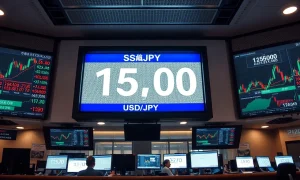
The Japanese yen slipped past the 155 mark against the US dollar on Wednesday, edging closer to levels that last prompted Tokyo to intervene in the currency market in October 2022. Traders are now probing for a defense line the government refuses to name.
The pair traded at 155.80 in early Asian hours, its weakest since June 1990. The move follows a 2.5% decline over the past week, driven by widening interest rate differentials between Japan and the United States. The Federal Reserve’s commitment to holding rates higher for longer has amplified the appeal of dollar-denominated assets, while the Bank of Japan maintains its ultra-loose monetary policy stance.
Also read: PBOC Sets Yuan Reference Rate at 6.7894, Signaling Cautious Stance
An Unspoken Red Line
Japan’s Vice Finance Minister for International Affairs, Masato Kanda, repeated the standard warning on Tuesday: authorities are watching currency moves with a high sense of urgency and will take appropriate action against excessive volatility. He declined to specify what level would trigger intervention.
This ambiguity is deliberate. In 2022, Tokyo spent approximately ¥9.2 trillion ($60 billion) across three intervention rounds, with the first occurring after the yen broke through 151.94. The government never pre-announced those levels either. By keeping the market guessing, officials hope to inject a degree of two-way risk into what has become a one-way bet against the yen.
Also read: Dollar Index Rebounds Above 100.00 After Hitting Lowest Level Since June 17
Yet the strategy has limits. Hedge funds and speculative traders have built record short positions against the yen, according to data from the Commodity Futures Trading Commission. The carry trade — borrowing yen at near-zero rates to invest in higher-yielding dollars — remains highly profitable as long as the BOJ stays dovish.
The Policy Contradiction at the Core
The tension between Japan’s currency policy and its monetary policy is the central contradiction. The Bank of Japan raised interest rates in March for the first time in 17 years, moving its short-term rate target to a range of 0% to 0.1%. But that adjustment has done little to narrow the gap with US rates, which sit above 5%.
BOJ Governor Kazuo Ueda has signaled that further rate hikes depend on data, particularly wage growth and inflation trends. But with Japan’s core inflation running at 2.6% — above the BOJ’s 2% target — the pressure to act is building. Market participants now assign a 40% probability to a rate hike at the BOJ’s July meeting, according to Bloomberg surveys.
“The BOJ is trapped,” said Hiroshi Namioka, chief strategist at T&D Asset Management in Tokyo. “If they hike too fast, they risk crushing domestic demand. If they do nothing, the yen keeps falling and import costs surge. Intervention is a band-aid, not a cure.”
What Happens at 160?
The 160 level holds psychological significance. It represents a 10% decline from the 2022 intervention zone and would mark a fresh 34-year low. Some analysts argue that Tokyo would be forced to act well before that level to maintain credibility.
Others note that the calculus has shifted. Japan’s economy is now emerging from decades of deflation, and a weaker yen supports corporate profits and export competitiveness. Toyota Motor Corp., for instance, benefits from every yen of depreciation against the dollar. The government may tolerate a weaker currency for longer than markets expect.
The Ministry of Finance has also coordinated with the US Treasury and other G7 partners. Any intervention would require tacit approval from Washington, which has historically opposed competitive devaluations. The US Treasury did not label Japan a currency manipulator in its latest semi-annual report, but it kept the country on its monitoring list.
Market Positioning and Risk
The risk of a sudden snap-back is real. When Tokyo intervened in October 2022, the yen surged 5% in a single day. Options markets are pricing in elevated volatility, with one-month implied volatility on USD/JPY at its highest level since March 2023.
For retail traders and institutional investors alike, the question is whether to fade the yen’s weakness or join the trend. The answer depends on whether one believes the BOJ will ultimately blink and tighten policy, or whether the Fed will be forced to cut rates sooner than projected.
For now, the market is daring Tokyo to show its hand. The government, true to form, is keeping its cards close to the chest.
Frequently Asked Questions
At what level will the Bank of Japan intervene to support the yen?
The Bank of Japan has not publicly stated a specific intervention threshold. Historically, it intervened around 151.94 in October 2022 and again near 145. Markets currently speculate the line could be around 160 or beyond, depending on the speed of the move.
How does yen weakness affect the Japanese economy?
A weak yen benefits Japanese exporters by making their goods cheaper abroad, but it hurts consumers and importers by raising the cost of energy, food, and raw materials. The Bank of Japan faces a delicate balance between supporting growth and controlling inflation.
What tools does the Bank of Japan have to defend the yen?
The primary tool is direct intervention in the foreign exchange market, selling US dollars and buying yen. The Bank of Japan can also use rate check operations or signal tighter monetary policy, though it has maintained ultra-low interest rates.
How does the yen carry trade influence USD/JPY?
The yen carry trade involves borrowing yen at low Japanese interest rates to invest in higher-yielding currencies like the US dollar. This puts persistent selling pressure on the yen, especially when the Federal Reserve maintains higher rates.