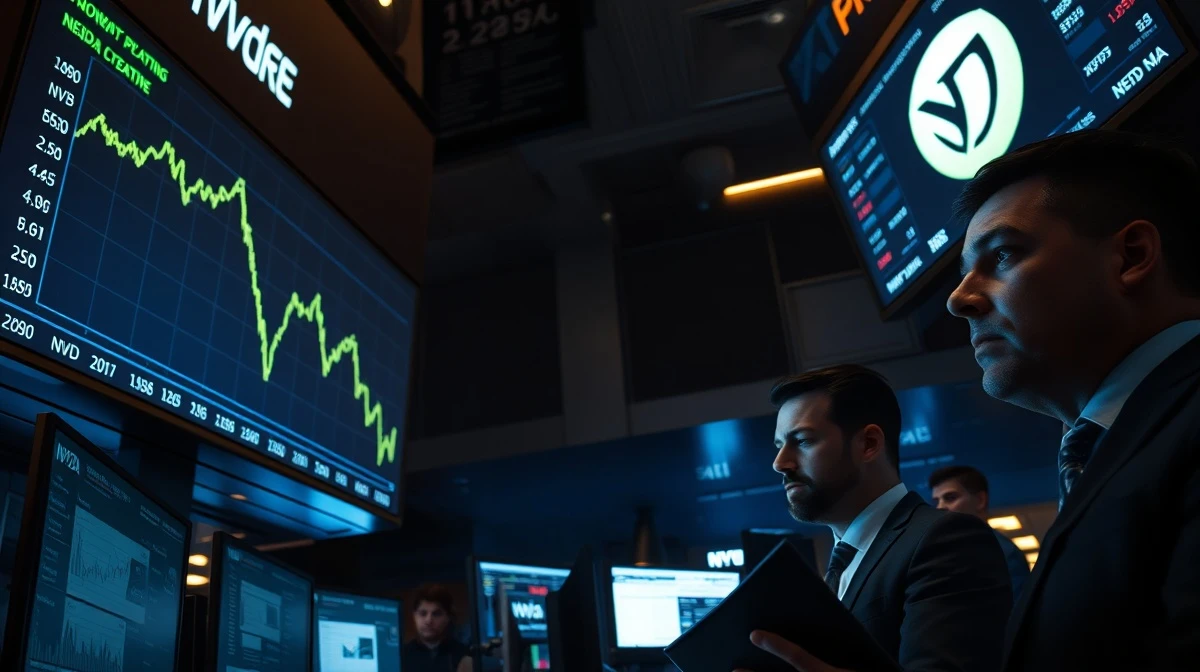
March 21, 2026 — Nvidia Corporation’s stock price declined during CEO Jensen Huang’s keynote address at the company’s annual GTC conference this week, highlighting a growing divergence between Silicon Valley’s enthusiasm for artificial intelligence and Wall Street’s mounting concerns about market uncertainty.
Market Reaction to Grand Vision
As Huang presented his vision for what he called “the next industrial revolution,” Nvidia’s shares traded lower. The company, valued at approximately $4 trillion, saw investor sentiment turn cautious despite the CEO’s characteristically optimistic presentation. Huang spoke for over two hours about new graphics technology, networking infrastructure, autonomous vehicle partnerships, and specialized chips designed for AI inference.
He projected enormous future markets, describing the AI agent ecosystem as worth $35 trillion and the physical AI and robotics industry at $50 trillion. Huang also stated he expects $1 trillion in purchase orders for the company’s Blackwell and Vera Rubin chips by the end of 2027.
The Uncertainty Premium
According to Daniel Neuman, CEO of research firm Futurum, the market’s reaction reflects deeper anxieties. “AI is so good, so transformational, and moving so fast that we don’t actually understand what it’s going to mean for all the societal constructs that we’ve come to understand,” Neuman told TechCrunch. “The markets hate uncertainty. The speed of innovation has actually created a great new uncertainty that I think most people never expected.”
Neuman challenged narratives about slow enterprise AI adoption, suggesting they rely on outdated data. “Enterprise AI adoption is going to hit inflection and scale very quickly,” he said. “I actually think it’s happening. When you say it’s not, I think what you’re probably saying is the [return on investment] and the receipts are still a little bit undefined.”
Strong Fundamentals Amid Skepticism
Nvidia’s financial performance continues to demonstrate remarkable strength. The company’s revenue grew 73% year-over-year last quarter, consistently exceeding market expectations. Recent reporting from Reuters confirmed Amazon plans to purchase 1 million GPUs alongside other AI infrastructure for Amazon Web Services by the end of 2027.
Kevin Cook, senior equity strategist at Zacks Investment Research, noted the company’s central role in the broader economy. “The economy is sort of orbiting around Nvidia,” Cook told TechCrunch. “It’s building this necessary infrastructure. All these different companies in hardware and software and physical AI — even Caterpillar is now physical AI — that are building off of these platforms.”
Diverging Perspectives on AI Future
The tension between Nvidia’s operational success and investor caution underscores a fundamental debate about AI’s economic impact. While Silicon Valley remains overwhelmingly confident in the technology’s transformative potential, financial markets are pricing in what analysts describe as an “uncertainty premium.”
This skepticism exists despite Nvidia’s position as what Huang called a “platform company” with extensive technology, platforms, and ecosystem partnerships. The company’s recent performance suggests it continues to benefit from massive infrastructure investment across multiple industries.
Broader Market Context
Market observers note that concerns about a potential AI bubble have circulated for months, though Nvidia’s consistent execution has thus far defied pessimistic predictions. The company’s role as a foundational provider of AI hardware insulates it somewhat from application-level volatility, but investors appear focused on longer-term sustainability questions.
Nvidia’s recent stock movement suggests that even blockbuster financial results and ambitious technological roadmaps must now contend with heightened scrutiny about AI’s ultimate economic impact. The company’s future performance may depend as much on demonstrating tangible enterprise returns as on announcing technological breakthroughs.
For more information on Nvidia’s financial disclosures, visit the company’s investor relations page.
This article was produced with AI assistance and reviewed by our editorial team for accuracy and quality.