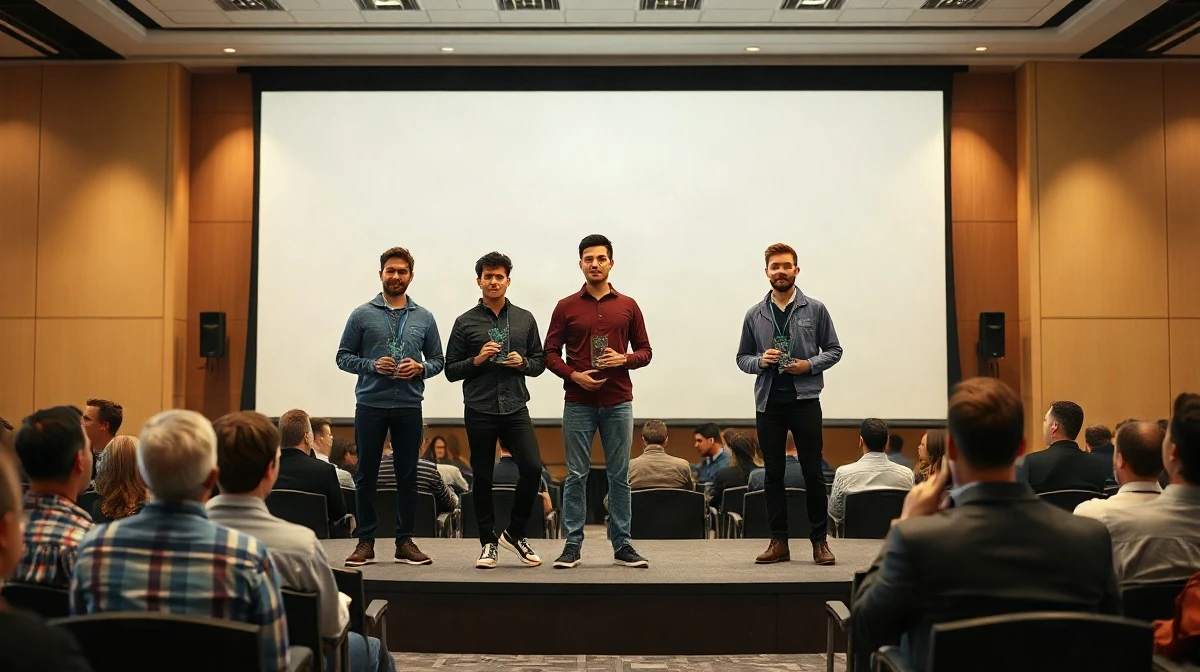
Three startups took the top spots at the regional final of the Road to TechCrunch Startup Battlefield 2026, an event that drew a record 726 applications from 39 countries before narrowing to 22 finalists: Cerberus of Uzbekistan in first place, WeGlobal AI of Kazakhstan in second and LOOQ in third. All three will represent Central Eurasia at Startup Battlefield 200 during TechCrunch Disrupt 2026 in San Francisco on October 13-15, where more than 10,000 technology leaders are expected to attend.
The competition is run by Silkroad Innovation Hub in partnership with TechCrunch, Freedom Holding, Astana Hub and IT Park Uzbekistan. Applications rose nearly 50% from the event’s 2025 debut, when 485 startups from 27 countries applied. National rounds produced the 22 finalists, who pitched live before 47 jurors from eight countries. AI-Dana, an AI judge, served as an independent juror for the second consecutive year.
“Road to Battlefield 2026 had record applications and representation from more countries than ever,” said Isabelle Johannessen, head of the Startup Battlefield program at TechCrunch. “These founders are getting global visibility at TechCrunch Disrupt, and that sends a message to the next generation: You can build locally and scale globally.”
An applicant pool that has gone almost entirely AI
Of the 726 startups that applied this year, 84% were building AI products, and all three winners fit that pattern. The composition of the field says as much about the region’s startup pipeline as it does about global venture funding trends: founders in Central Eurasia and neighboring markets are now shipping AI-native products from the outset rather than adding AI features to existing software later.
“We had a very strong applicant pool this year, which made the final selection genuinely difficult,” said Asset Abdualiyev, founder and CEO of Silkroad Innovation Hub. “The strongest teams made it through to the final, and we are proud to have TechCrunch as a partner in creating this global pathway for founders from Central Eurasia.”
The rest of the top 10 included Suriy (Mongolia), TelAgri (Georgia), SeaDar (Azerbaijan), Kaptın Kaptın (Türkiye), Admyra (United States), MVSxAI (Qatar) and Soup (Kazakhstan) — a spread that reflects how deliberately the competition was built around cross-border participation rather than a single national ecosystem.
What each winner actually builds
- Cerberus (Uzbekistan) — first place. An AI-powered cybersecurity startup whose agents automatically hunt for vulnerabilities in corporate IT systems. The company argues that many current AI security tools lean on general-purpose language models that can hallucinate when given access to production infrastructure. Cerberus has completed 500 Global Eurasia and been accepted into the Alchemist Silkroad — Silicon Valley Residency program.
- WeGlobal AI (Kazakhstan) — second place. An AI platform built around a shortage of school psychologists in Kazakhstan, giving schools tools to monitor student mental health and provide career guidance at a scale hiring alone could not reach.
- LOOQ — third place. Founded by Ayan Sakenov and Yudai Ishida, LOOQ builds camera-based hardware and an “attention API” that measures how many people actually look at billboards and other out-of-home advertising, giving advertisers a clearer read on real-world attention.
“Everyone is writing code with AI now, vulnerabilities are appearing faster than teams can find them, and there’s no established way to let an AI agent test real infrastructure safely,” said Aziz Akhmedkhodjaev, founder and CEO of Cerberus. The win gives Uzbekistan its first Road to TechCrunch Startup Battlefield champion.
The money, and what happens next
The three winners share a $100,000 investment pool funded jointly by Astana Hub Ventures, IT Park Ventures and Silkroad Innovation Hub, invested on standard market terms in exchange for equity: $50,000 for Cerberus, $30,000 for WeGlobal AI and $20,000 for LOOQ. OpenAI provided $280,000 in API credits across the 22 finalists, with $100,000 going to the three winners and $10,000 to each of the other 19.
“Founders across Central Eurasia showed real ambition, a clear focus on solving real problems, and strong technical skill in building with AI,” said Thomas Jeng, Head of Startups APAC at OpenAI.
The financial sums are modest by Silicon Valley standards, and that is the point worth noticing. For early-stage teams in Tashkent or Almaty, the more consequential prize is distribution — a slot on a San Francisco stage in front of investors, customers and press who would otherwise be difficult to reach from the region. Government officials framed the result in exactly those terms. “AI is creating an opportunity for countries like Kazakhstan to compete globally in ways that were not possible a decade ago,” said Zhaslan Madiyev, Deputy Prime Minister and Minister of Artificial Intelligence and Digital Development of Kazakhstan. Uzbekistan’s Minister of Digital Technology, Sherzod Shermatov, called Cerberus’s first-place finish “a strong example of that progress.”
For readers tracking the region, the near-term markers are straightforward: how the three teams perform against the full Startup Battlefield 200 cohort in October, whether the record application volume carries into 2027, and whether regional wins convert into follow-on funding rounds outside Central Eurasia. Disrupt runs October 13-15 in San Francisco.

Warning: Attempt to read property "term_id" on false in /www/wwwroot/stockpil.com/wp-content/themes/flex-mag/functions.php on line 998