
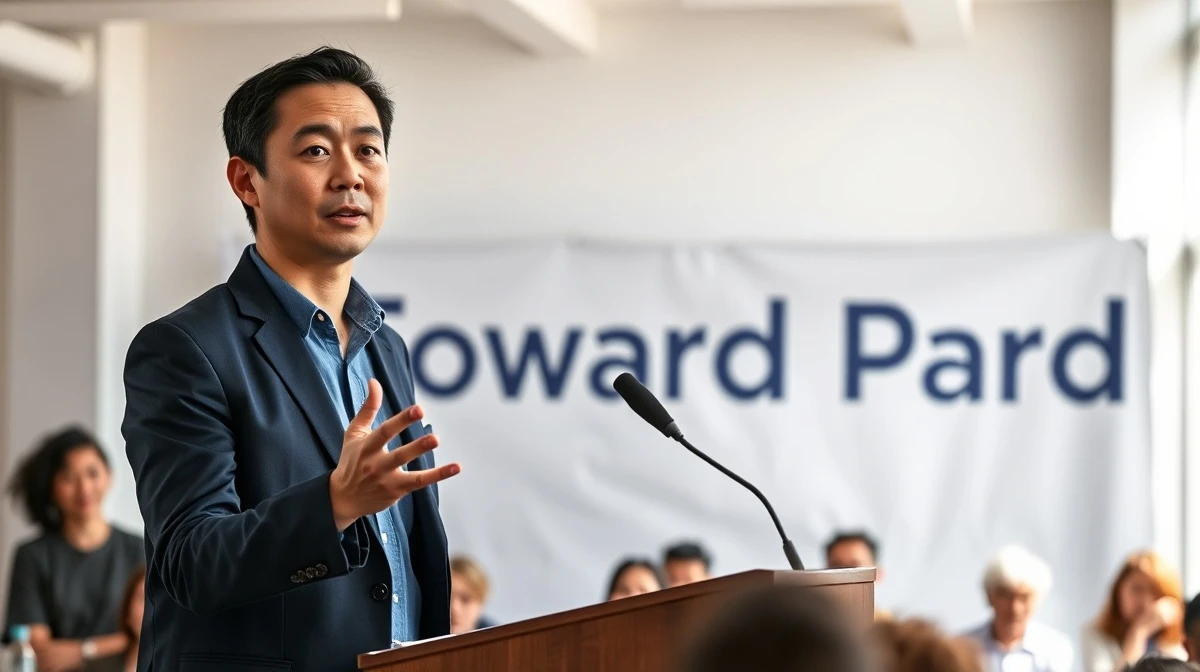
Andrew Yang’s 2020 presidential campaign was built on a specific warning: that automation and artificial intelligence would hollow out the labor market and concentrate wealth in the hands of a few. At the time, his signature policy proposal — a $1,000 monthly Universal Basic Income (UBI) for every American adult — was widely dismissed as a fringe idea.
Four years later, that fringe idea has entered the mainstream. In recent months, Anthropic CEO Dario Amodei has warned that AI could replace a majority of jobs within five to ten years. OpenAI CEO Sam Altman has publicly advocated for some form of UBI. And Senator Bernie Sanders, who once criticized the policy as insufficient, has introduced legislation to study direct cash payments.
Also read: Hey Siri, here’s what I actually want from AI
“It’s surreal, but not surprising,” Yang said in a recent interview. “The math was always clear. The only question was how long it would take for everyone else to see it.”
From candidate to entrepreneur
Rather than waiting for Washington to catch up, Yang has returned to his roots as an entrepreneur. After his 2020 campaign ended, he launched the Forward Party, a political movement aimed at reforming the two-party system and advancing policies like ranked-choice voting and open primaries. He has also invested in and advised several startups focused on economic resilience and workforce transition.
Also read: Waymo buys Apple's former self-driving car proving ground in Arizona for $220M
“Running for president taught me that the system is too slow to respond to a crisis that is already here,” Yang said. “So I’m building things that work now, not hoping for a bill to pass in five years.”
His approach mirrors a broader shift among tech leaders who are increasingly skeptical that government alone can manage the pace of AI-driven change. Altman has argued that companies developing AI must also invest in social safety nets, while Amodei has called for a national conversation about what happens when AI systems outperform humans in most cognitive tasks.
The UBI debate matures
The growing chorus of support for UBI has not translated into federal policy. But several pilot programs are underway. In 2023, the city of Stockton, California, completed a two-year experiment that gave 125 low-income residents $500 per month. Early results showed improved employment outcomes and reduced financial stress. Similar programs have launched in Los Angeles, Chicago, and rural Alaska.
Yang points to these experiments as evidence that the policy works at scale, even if it has not yet reached the national level. “We don’t need to wait for a perfect bill from Congress,” he said. “We can test it, prove it, and build the political will from the ground up.”
Critics argue that UBI is too expensive and disincentivizes work. But Yang counters that the cost of not acting — mass unemployment, social unrest, and deepening inequality — is far higher.
What Yang is building now
Yang’s current focus is on the Forward Party, which has gained traction in several states. The party has endorsed candidates for local and state office, and Yang has been traveling to swing districts to promote ranked-choice voting and nonpartisan primaries.
“The two-party system is not equipped to handle the speed of technological change,” he said. “We need a political system that can adapt as fast as the economy is changing.”
He is also advising a handful of tech startups that are developing AI tools designed to augment human workers rather than replace them. One such company, Workhelix, uses AI to help companies identify tasks that can be automated without eliminating jobs entirely.
“The goal isn’t to stop AI. It’s to make sure the benefits are shared broadly,” Yang said. “That’s a political problem, not just a technical one.”

