
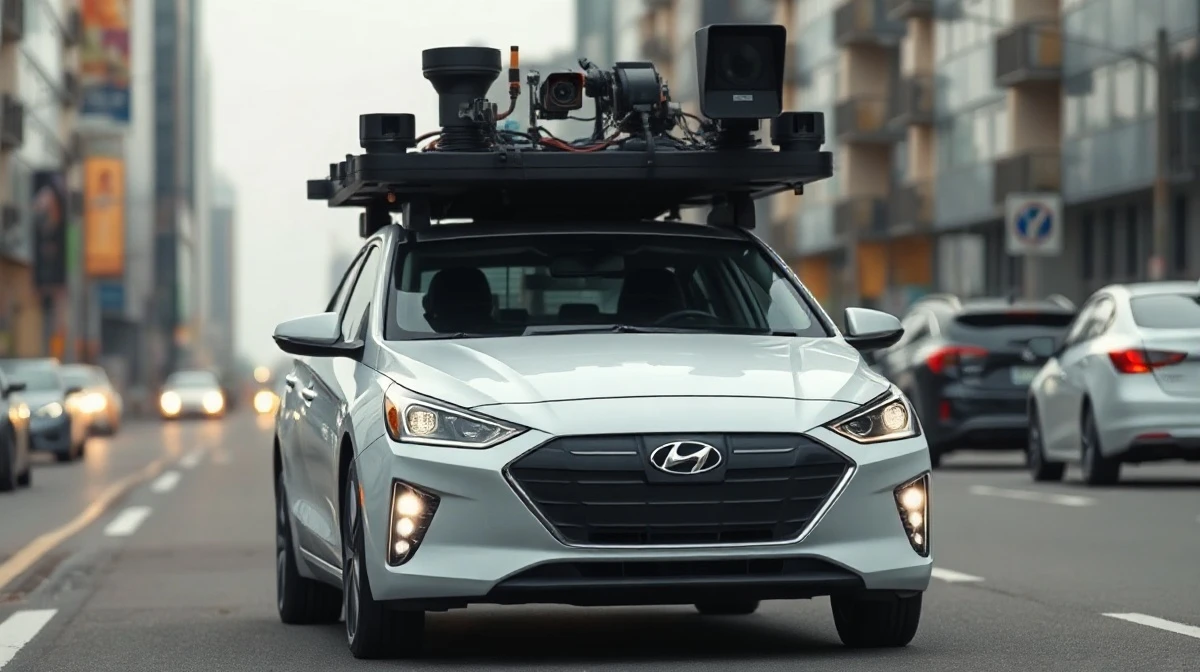
Uber announced Wednesday it will deploy 500 modified Hyundai Ioniq 5 electric vehicles globally this year to collect real-world driving data for its autonomous vehicle partners, including Waymo, Avride, and WeRide. The company expects 50 of these sensor-laden cars to be on the road by summer.
The vehicles, retrofitted by Roush Performance, carry 14 cameras, eight solid-state lidar sensors, and nine radars. All data is processed through Nvidia’s Dual Drive Thor autonomous vehicle computer. Uber first revealed the prototype to TechCrunch in January.
This marks the first time Uber has assembled its own data-collection vehicle since selling its autonomous vehicle division to Aurora in 2020. The effort is part of Uber’s AV Labs division, launched earlier this year, which provides sensor-equipped cars to gather and share data with the company’s 30-plus AV technology partners.
Data collection at scale
Uber says the 500-vehicle fleet will collect roughly 2 million miles per month of high-fidelity data for robotaxi development. The company aims to build what it calls the world’s most geographically diverse training dataset specifically for autonomous driving, offering partners a 360-degree, time-synchronized view to train self-driving software.
Uber already has a head start. The company told TechCrunch it has collected data from thousands of specially equipped vehicles across dozens of cities, plus data from hundreds of Lucid Air vehicles operating in the U.S. and Europe over the past two years. Uber’s AV Labs division is now analyzing those datasets and preparing to add more with the Ioniq 5 fleet.
Evolving sensor suite
Uber said it will continue updating the sensor configuration as partners’ needs evolve. The company is working with a range of autonomous vehicle developers, each of which may require different data inputs for their specific technology stacks.
The announcement signals Uber’s deepening commitment to the autonomous vehicle space without returning to building its own self-driving cars. Instead, the company positions itself as a data infrastructure provider for the broader robotaxi industry.

