
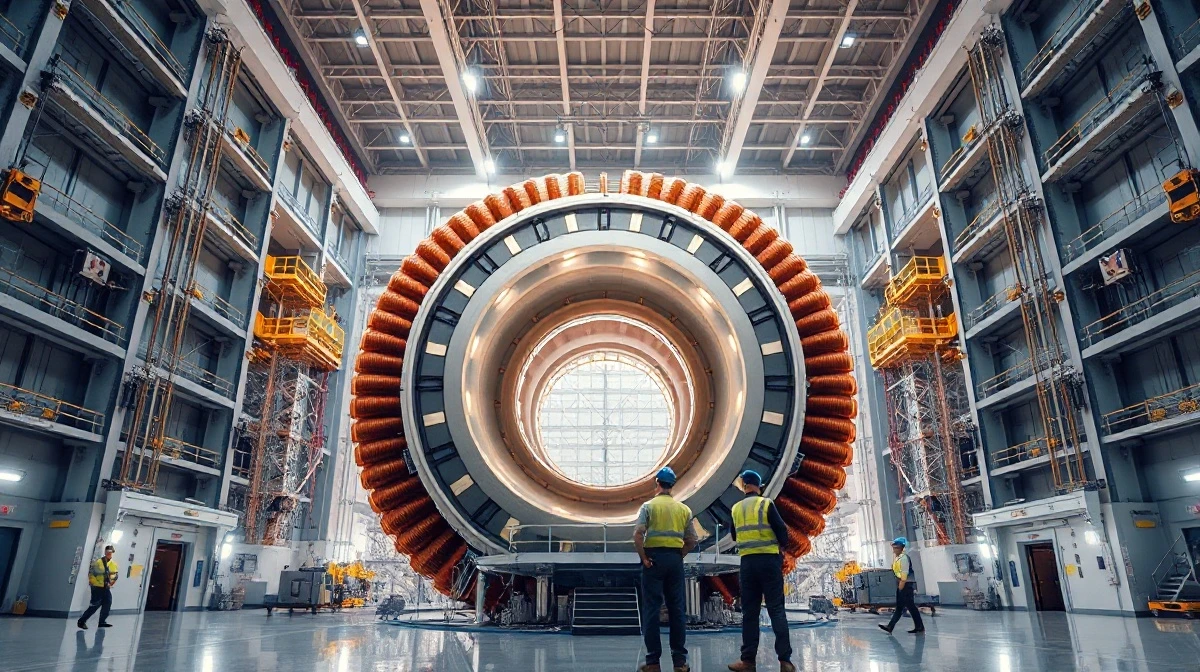
Commonwealth Fusion Systems (CFS), the Massachusetts-based fusion energy startup that has long led the private sector in funding, announced Thursday it has raised an additional $1 billion. The round brings the company’s total capital raised to $4 billion, extending its position as the best-funded fusion power developer in the world.
CFS said the investors in this round include “significant institutional investors, such as pension funds, sovereign wealth funds, and infrastructure and industrial corporate partners.” The company declined to name the specific investors when asked by TechCrunch. The new funding follows a $863 million round announced in August, which included Nvidia, Google, Khosla Ventures, and Breakthrough Energy Ventures.
Also read: US Chip Industry Faces Shortage of Up to 157,000 Workers by 2030, Report Warns
Building toward commercial fusion power
CFS is pursuing magnetic confinement fusion, a method that uses powerful magnetic fields to hold superheated plasma in place long enough for atomic nuclei to fuse, releasing enormous amounts of energy. The company plans to capture the heat from those reactions to drive steam turbines and generate electricity.
The company is currently constructing Sparc, its demonstration reactor, at its Devens, Massachusetts facility. CFS now expects Sparc to achieve scientific breakeven in 2027 — a milestone where the fusion reaction releases more energy than the reactor consumes to ignite it. While scientific breakeven does not mean the reactor can export power to the grid, hitting the mark would be a major validation for CFS’s technology and a signal to investors that the approach is viable.
Also read: ClickFix Scams Spread Through Hijacked HBO Max Reddit Ads, Researchers Say
To date, only one fusion experiment — at the Lawrence Livermore National Laboratory’s National Ignition Facility — has achieved scientific breakeven, and that was in a laser-based inertial confinement system, not the magnetic confinement approach CFS uses.
Alongside Sparc, CFS is finalizing the design of Arc, its first commercial-scale fusion power plant, planned for a site in Virginia. In 2024, Virginia’s former governor Glenn Youngkin described Arc as a “multi-billion-dollar fusion power plant.” CFS has not disclosed the price tag for either reactor.
Revenue commitments and what comes next
CFS has already secured significant offtake agreements. Italian energy company Eni has committed to buying more than $1 billion worth of electricity from Arc. Google has also signed on to purchase 200 megawatts of electricity — half of Arc’s total planned output.
CEO Bob Mumgaard has indicated that the company will continue raising capital as spending ramps up during the construction of Sparc and the final design phase of Arc. This $1 billion round is CFS’s largest since the $1.8 billion it raised in 2021.
The fusion energy sector has attracted billions in private investment over the past decade, but no company has yet demonstrated a reactor capable of producing net energy for the grid. CFS’s progress on Sparc, combined with its deep investor backing, positions it as the frontrunner in the race to commercialize fusion. The 2027 breakeven target will be a critical test of whether the technology can deliver on its long-standing promise of virtually unlimited clean energy.
For readers tracking the industry, the key milestones to watch are Sparc’s first plasma and subsequent breakeven results, the final design review for Arc, and whether CFS discloses the specific institutional investors backing this latest round.

Source: TechCrunch
