
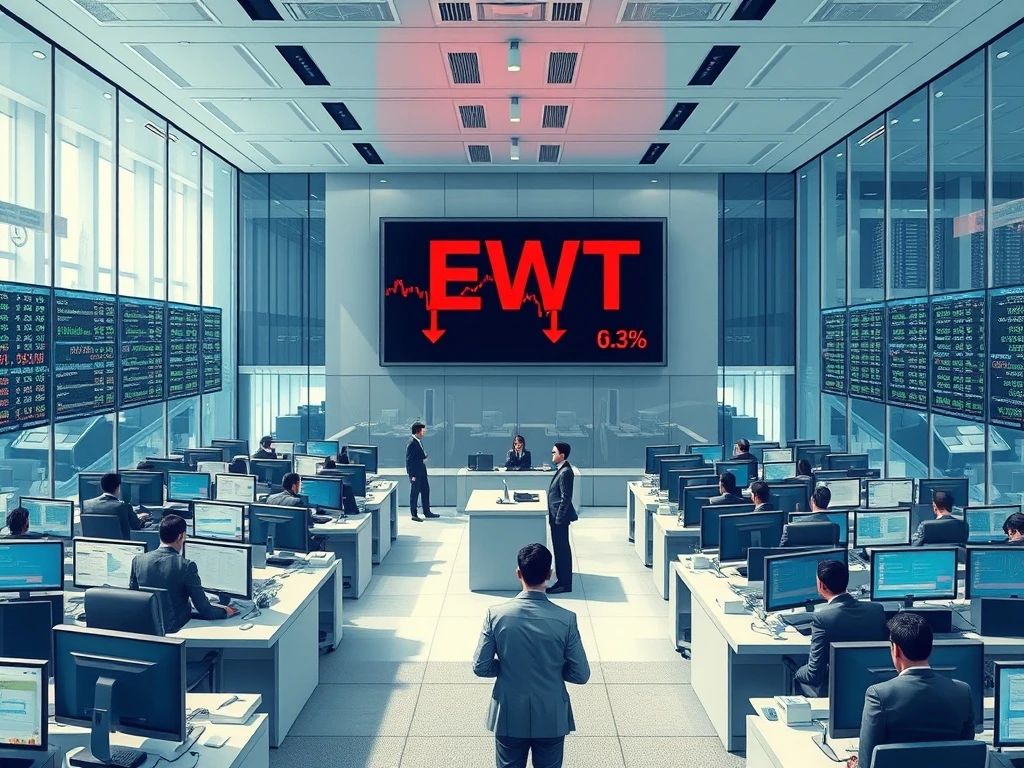
TAIPEI, TAIWAN — March 11, 2026: The iShares MSCI Taiwan ETF (EWT), a key bellwether for foreign investment in Taiwan’s equity market, registered a substantial $183.1 million capital outflow this week. Data from ETF Channel, monitored by BNK Invest, shows the fund’s shares outstanding dropped from 115.7 million to 113.1 million in the week ending March 10, 2026—a notable 2.2% weekly decrease. This EWT ETF outflow represents one of the most significant single-week redemptions for the fund in the past year, triggering close analysis from portfolio managers and market strategists focused on Asian equities. The move comes as the ETF trades at $71.82, navigating a 52-week range between $39.44 and $77.25.
Analyzing the $183.1 Million EWT ETF Outflow
ETF share creation and destruction serve as a direct, real-time gauge of institutional and large-scale investor sentiment. Consequently, a weekly decline of 2.2% in shares outstanding for a fund as large as the iShares MSCI Taiwan ETF signals a pronounced shift. “Weekly flow data is a powerful, albeit sometimes noisy, signal,” explains Dr. Lin Wei, a senior research fellow at the Taipei-based Chung-Hua Institution for Economic Research. “For EWT, which is heavily weighted toward Taiwan Semiconductor Manufacturing Company (TSMC) and other tech giants, outflows of this magnitude often precede or coincide with sector-specific profit-taking or broader geopolitical risk reassessments by global allocators.” The outflow forces the ETF’s authorized participants to sell underlying holdings, potentially creating incremental selling pressure on constituent stocks like TSMC, Hon Hai Precision (Foxconn), and MediaTek.
Technically, EWT’s price action relative to its 200-day moving average provides crucial context. The fund’s last trade at $71.82 sits comfortably above this long-term trend indicator, suggesting the outflow may reflect tactical rebalancing rather than a panic-driven exit. However, the 52-week high of $77.25, reached in late 2025, now acts as a clear resistance level. Market technicians are watching to see if this capital withdrawal undermines the ETF’s ability to retest that peak in the coming quarter.
Impact on Taiwan’s Equity Market and Related Holdings
The immediate impact of an ETF capital flow event of this scale is multifaceted. First, it affects the liquidity and trading dynamics of EWT itself. Second, and more significantly, it transmits to the underlying Taiwan Stock Exchange (TWSE) components. The iShares MSCI Taiwan ETF is a top-tier foreign investment vehicle for the region; its flows are a proxy for international capital movement in and out of Taiwanese equities.
- Direct Portfolio Rebalancing: To accommodate the destruction of ETF units, market makers must sell an estimated $183 million worth of the fund’s underlying holdings. This selling is typically executed across the portfolio in line with its index weights, meaning the largest constituents feel the greatest absolute impact.
- Sentiment Signal for Active Managers: Many active fund managers monitor ETF flows as a contrary or confirmatory indicator. Sustained outflows from a core regional ETF like EWT could lead other investors to reassess their Taiwan exposure, potentially amplifying the initial move.
- Currency and Macro Considerations: Large outflows from Taiwanese assets often involve converting New Taiwan Dollars (TWD) back to USD or other currencies. This can introduce modest volatility into the TWD forex market, which the Central Bank of the Republic of China (Taiwan) monitors closely.
Expert Perspective from BNK Invest and Market Analysts
The data was first highlighted by BNK Invest, a firm providing investment services and operating financial news platforms like ETFChannel. While BNK Invest’s report presented the raw data, independent analysts have expanded on the implications. “We view this as a healthy consolidation after a strong run,” says Michael Chen, Head of Asia-Pacific ETF Strategy at Global Markets Advisors, referencing a research note published to institutional clients on March 10. “Taiwan’s market has outperformed several regional peers over the last six months. This outflow likely represents some institutional profit-taking into strength, particularly in the semiconductor sector, rather than a fundamental repudiation of the Taiwan story.” Chen’s firm points to continued robust export orders and TSMC’s technological leadership as underlying supports. This perspective is crucial for Taiwan stock market investors weighing whether this is a blip or a trend.
Broader Context: EWT Flows Versus Regional Peers
To determine if the EWT outflow is an isolated event or part of a broader regional shift, it’s essential to examine comparable funds. For instance, flows into the iShares MSCI China ETF (MCHI) or the iShares MSCI South Korea ETF (EWY) during the same period provide a relative sentiment gauge. Was capital simply rotating within Asia, or leaving the region altogether? Preliminary data from the week suggests mixed activity, with some Southeast Asia-focused ETFs seeing modest inflows. This indicates the movement may be more country-specific than regional.
| ETF (Symbol) | Region/Focus | Approx. Flow Week of Mar 3-10, 2026 |
|---|---|---|
| iShares MSCI Taiwan (EWT) | Taiwan | -$183.1 Million (Outflow) |
| iShares MSCI China (MCHI) | China | +$45 Million (Inflow) |
| iShares MSCI South Korea (EWY) | South Korea | -$22 Million (Outflow) |
| iShares Asia 50 (AIA) | Pan-Asia | +$15 Million (Inflow) |
What Happens Next: Monitoring for Follow-Through
The critical question for investors is whether this represents a one-week adjustment or the beginning of a sustained withdrawal. Market participants will scrutinize the next two weekly data sets from ETF Channel. A continuation of outflows would strongly suggest a more profound reassessment of Taiwan’s equity risk premium, potentially linked to evolving cross-strait relations, global semiconductor cycle concerns, or shifts in U.S. monetary policy affecting emerging market allocations. Conversely, a quick stabilization or reversal would support the profit-taking thesis. Key dates to watch include Taiwan’s upcoming export data release and TSMC’s monthly revenue report, as fundamental strength could quickly counteract flow-based technical pressure.
Stakeholder Reactions and Market Mechanics
Within Taiwan’s financial community, the reaction has been measured. A spokesperson for the Financial Supervisory Commission (FSC) stated they “monitor all market movements as part of routine oversight” but emphasized the “underlying strength and liquidity of Taiwan’s capital markets.” On trading desks, the outflow has increased focus on the liquidity of EWT’s largest holdings. “When large ETFs see redemptions, we watch the bid-ask spreads in the underlying names, especially during the Taipei market open,” notes a senior trader at a European bank in Hong Kong, speaking on background. “So far, the market has absorbed this without major dislocation, which is a positive sign of depth.”
Conclusion
The detection of a $183.1 million EWT ETF outflow is a significant weekly development for watchers of Taiwanese equities and international ETF flows. While the immediate ETF technical analysis suggests the move has not broken the fund’s primary uptrend, it serves as a clear warning that the rally may be entering a consolidative phase. The divergence between still-strong fundamentals and tactical capital movement defines the current moment. Investors should treat this as a signal to review their Taiwan exposure, assess their risk tolerance regarding regional geopolitics, and monitor the next several weeks of flow data for confirmation of direction. The health of the global tech cycle, as always, will remain the ultimate driver for the iShares MSCI Taiwan ETF and the market it tracks.
Frequently Asked Questions
Q1: What does an ETF outflow like this actually mean?
An ETF outflow occurs when investors redeem more shares (or “units”) of the fund than they create. This forces the ETF’s authorized participants to sell the underlying basket of stocks that back those shares to return cash to investors, effectively pulling capital out of the market.
Q2: How significant is a $183.1 million outflow for the EWT ETF?
It represents a 2.2% weekly reduction in the fund’s total shares outstanding. For a large, established ETF like EWT, this is a notable single-week move that ranks among its larger weekly withdrawals over the past year, warranting attention from market participants.
Q3: Should I sell my EWT holdings because of this news?
Not necessarily. A single week of outflow data is a short-term tactical signal, not a long-term fundamental indicator. Investors should consider their own investment thesis for Taiwan, time horizon, and the fund’s performance relative to its technical supports (like the 200-day moving average) before making decisions.
Q4: Does this outflow predict a downturn for the Taiwan stock market?
While large outflows can precede or accompany market pullbacks, they are not a perfect predictor. The outflow reflects current selling pressure, but future market direction will depend on corporate earnings, economic data, and broader global risk sentiment.
Q5: Where is the money from the EWT outflow likely going?
It’s impossible to know definitively. The capital could be moving to other regions (like China, as the table suggests), shifting to other asset classes like bonds or cash, or being reallocated to actively managed Taiwan funds instead of the passive ETF.
Q6: How can an individual investor monitor ETF flows?
Financial data websites like ETF Channel, Morningstar, and the websites of major ETF issuers like BlackRock (iShares) provide weekly or daily data on shares outstanding and estimated dollar flows, allowing investors to track these trends.



