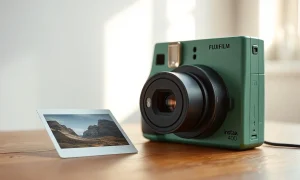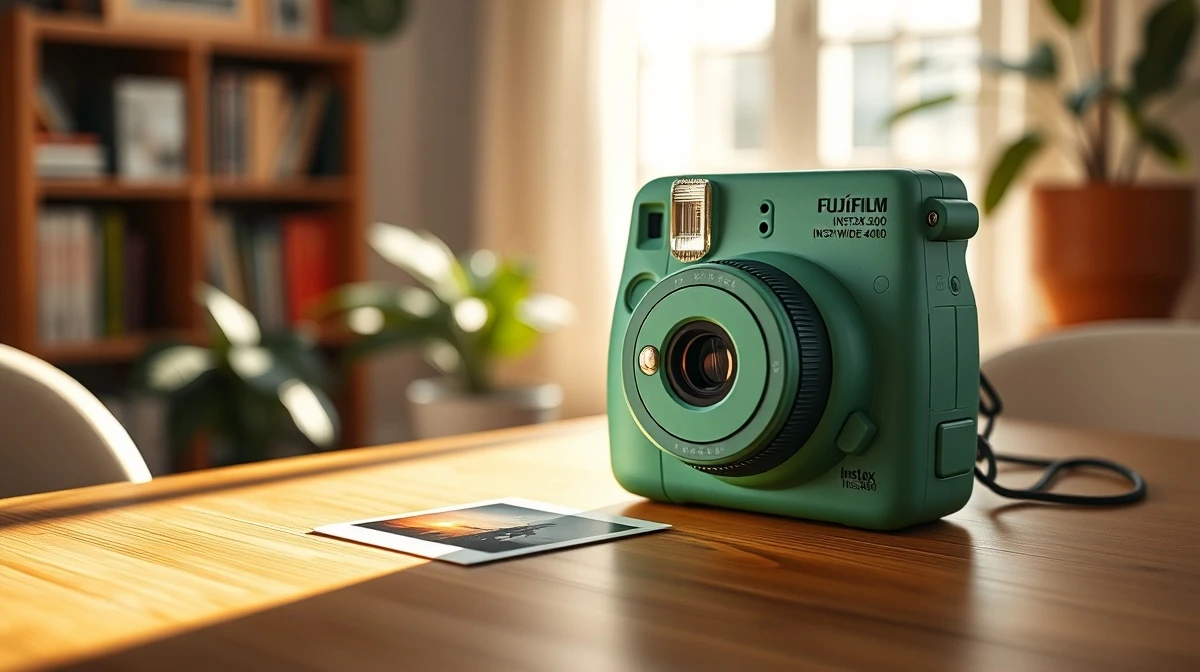
In a world increasingly dominated by AI-generated imagery and smartphone photography, the appeal of analog instant cameras remains strong. Fujifilm’s latest offering, the Instax Wide 400, aims to capture that enduring charm while offering something its Mini and Square siblings cannot: a significantly larger print. Priced at $175, the camera is designed for group shots, landscapes, and anyone who wants more room in the frame without sacrificing the simplicity of point-and-shoot photography.
Larger prints, familiar simplicity
The Instax Wide 400 produces prints measuring 62 × 99 mm, roughly twice the size of standard Instax Mini photos. This extra real estate is immediately noticeable and makes a meaningful difference when framing group portraits or scenic views. The camera operates as a straightforward point-and-shoot, with no manual exposure controls. It automatically handles flash, focus, and other settings, leaving the user to simply compose and shoot. For those accustomed to the Instax Square or Mini, the experience is familiar but the output is noticeably more expansive.
Also read: Tata Electronics, supplier to Apple and Tesla, confirms data breach exposing 630GB of files
Image quality is generally strong under good lighting. Colors appear vibrant with a slight extra saturation, and distant details are rendered with surprising clarity for an instant camera. However, the automatic exposure system struggles in high-contrast scenes. Dark areas against bright skies, for example, tend to lose detail, and there is no way to manually adjust brightness. This is a trade-off inherent to the camera’s design philosophy: simplicity over control.
Design and handling: Bulky but charming
Measuring 162 mm x 98 mm x 123 mm and weighing 1.4 pounds, the Instax Wide 400 is noticeably larger than its Mini and Square counterparts. The size is a logical consequence of the larger film format, but it does make the camera less pocketable. It comes with a shoulder strap, and while that helps with carrying, the camera still feels substantial and requires a bag for comfortable transport. A separate camera case is available but was not included with the review unit.
Also read: New AI-Powered Index Ranks Robotaxi Companies: Baidu Edges Waymo as China Dominates
Despite its bulk, the camera attracted positive attention during testing. Its retro design and green color option (also available in jet black) give it a playful, nostalgic aesthetic that many find appealing. The lens rotates to power the camera on and off, with a first click enabling close-up mode (0.9 to 3 meters) and a second click switching to space mode (beyond 3 meters). A close-up lens attachment snaps onto the front for sharper macro-style shots.
Self-timer and film options
The self-timer is a welcome addition, allowing users to include themselves in group shots. It offers four delay options from 2 to 10 seconds, activated by a lever on the side. The camera emits a ticking sound and red lights flash as a visual countdown. For tripod-free use, the strap includes two angle adjustment accessories that can prop the camera on a flat surface. Film is available in standard white frame, black frame, metallic borders, and monochrome. A 20-sheet box costs between $25 and $28.
Who is this camera for?
The Instax Wide 400 is not for photographers seeking manual controls or advanced features. It is for anyone who values the tactile, social experience of instant photography and wants larger prints without complexity. Families, teens, and casual users will find it easy to use, and the larger format makes it especially suited for group events, parties, and travel snapshots. The camera’s appeal lies in its ability to produce a physical, shareable print in seconds, a process that remains uniquely satisfying in an increasingly digital world.
Conclusion
The Fujifilm Instax Wide 400 successfully expands the instant photography experience by offering larger prints while maintaining the straightforward, fun character that defines the category. It is not a tool for precision photography, but that is not its purpose. For those who want bigger memories without the fuss, it delivers exactly what it promises.
FAQs
Q1: How does the Instax Wide 400 compare to the Instax Mini or Square?
The Wide 400 produces prints roughly twice the size of Mini photos and larger than Square prints. It is bulkier but offers the same point-and-shoot simplicity. The larger format is better for group shots and landscapes.
Q2: Can I adjust exposure or focus manually?
No. The Instax Wide 400 is fully automatic. It manages flash, focus, and exposure. Users can only select close-up or arena mode by rotating the lens.
Q3: How much does film cost, and what options are available?
A 20-sheet pack of Instax Wide film costs between $25 and $28. Options include white frame, black frame, metallic borders, and monochrome.