
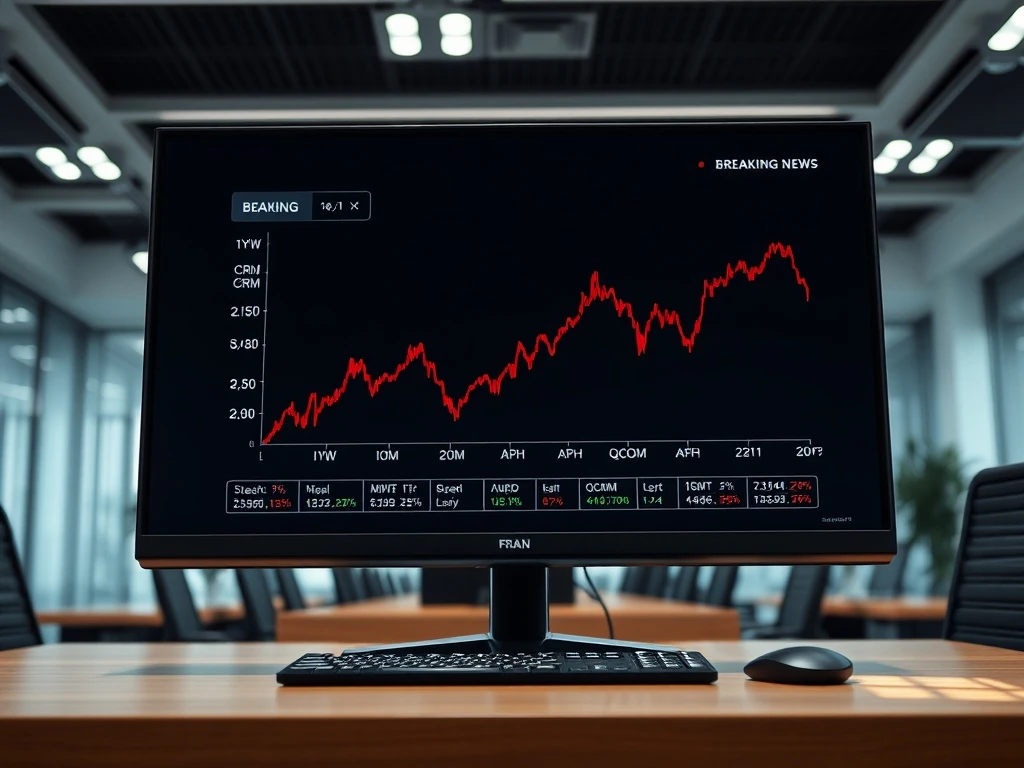
NEW YORK, March 9, 2026 — A significant capital rotation rattled technology markets today as the iShares US Technology ETF (IYW) experienced a massive $282.5 million weekly outflow. This substantial movement, representing a 1.5% decrease in shares outstanding, coincided with notable declines in key holdings including Salesforce Inc (CRM), Amphenol Corp. (APH), and Qualcomm Inc (QCOM). Data from ETF Channel, monitored by BNK Invest, reveals the fund’s shares outstanding dropped from 102.3 million to 100.8 million in the week ending March 9, signaling a potential shift in institutional investor sentiment toward the high-flying tech sector.
Analyzing the IYW ETF’s $282.5 Million Capital Flight
The iShares US Technology ETF (IYW) serves as a core holding for many investors seeking broad exposure to U.S. technology giants. Consequently, a weekly outflow of this magnitude immediately captures analyst attention. According to the latest data, the fund’s net asset value faced pressure not just from the redemption of units but also from simultaneous price declines in its top components. For instance, during today’s session, CRM shares fell approximately 2.2%, APH dropped about 1.2%, and QCOM declined roughly 1.4%. These moves contributed to IYW’s last traded price of $186.85, positioning it between its 52-week low of $117.55 and high of $211.98.
Mechanically, ETF outflows of this scale require the fund’s authorized participants to destroy units. This process forces the sale of the underlying securities within the portfolio to return capital to investors. Therefore, large outflows can create a self-reinforcing cycle of selling pressure on the very stocks the ETF holds. The timing is particularly noteworthy given the sector’s performance relative to its 200-day moving average, a key technical benchmark many traders watch for trend direction.
Immediate Market Impact and Sector-Wide Ripples
The outflow from IYW did not occur in a vacuum. It reflects a broader, albeit nascent, trend of profit-taking and portfolio rebalancing within the technology segment after a prolonged rally. The immediate impact extends beyond the three highlighted stocks to the fund’s other major holdings, which include behemoths like Apple (AAPL), Microsoft (MSFT), and Nvidia (NVDA). While these names saw more muted moves today, sustained outflows could increase their volatility.
- Pressure on Valuation Multiples: Large, liquid ETFs like IYW often act as proxies for the entire sector. Significant selling can prompt questions about stretched valuations, especially for software and semiconductor names.
- Liquidity and Execution Costs: The need to sell hundreds of millions in underlying holdings can test market liquidity, potentially leading to wider bid-ask spreads and higher transaction costs for all market participants.
- Sentiment Shift Among Retail Investors: As ETF flows are widely reported, a major outflow can influence the behavior of retail investors, who may interpret it as a leading indicator and adjust their own positions accordingly.
Expert Perspective from Institutional Analysts
Market strategists are parsing the data for signals. “While a single week’s flow data isn’t a trend, a $282.5 million redemption from a core tech ETF warrants monitoring,” stated Eleanor Vance, Senior ETF Strategist at Clearwater Analytics, in a note to clients. “It could simply be routine portfolio rebalancing at quarter-end, or it might indicate a reassessment of growth expectations ahead of the Q1 earnings season.” She emphasized the need to watch follow-up data in the coming weeks. Meanwhile, the Investment Company Institute’s weekly fund flow data, a broader industry metric, will be scrutinized next week to see if this is an isolated event or part of a larger fixed income or value stock rotation.
Broader Context: ETF Flows as a Market Barometer
Exchange-traded funds have fundamentally changed market structure. Their weekly shares outstanding data provides a near-real-time window into institutional and retail investor sentiment. Large inflows typically signal bullish conviction, as new units are created and the ETF sponsor must buy the underlying basket of stocks. Conversely, large outflows, as seen with IYW, indicate net selling pressure. This event echoes similar episodes in recent market history, such as the rotations out of growth ETFs during the 2024 rate hike cycle.
| ETF (Symbol) | Outflow Week Ending 3/9/2026 | Primary Sector Impact |
|---|---|---|
| iShares US Technology ETF (IYW) | -$282.5 Million | Broad Technology |
| Invesco QQQ Trust (QQQ) | Data Pending | Nasdaq-100 / Technology |
| Technology Select Sector SPDR Fund (XLK) | Data Pending | Technology |
What Happens Next: Monitoring for a Sustained Trend
The critical question for traders and portfolio managers is whether this represents a one-off rebalancing or the beginning of a sustained capital shift. Key dates to watch include the next weekly ETF shares outstanding report and the upcoming Federal Open Market Committee (FOMC) meeting later in March. Any guidance on interest rates could accelerate or halt such sector rotations. Furthermore, analysts will examine whether the outflows are concentrated in technology or if other growth-oriented sectors like consumer discretionary are experiencing similar moves.
Stakeholder Reactions and Trading Desk Commentary
On trading floors, the reaction was measured. A senior equity trader at a major Wall Street bank, who spoke on condition of anonymity, noted, “We saw the prints in CRM, APH, and QCOM and suspected ETF-related activity. The IYW flow data confirms it. The market absorbed it well today, but if we see a repeat next week, it will change the technical picture for the sector.” This sentiment underscores the watchful stance among professional market participants, who view ETF flows as a crucial piece of the liquidity puzzle.
Conclusion
The detection of a $282.5 million outflow from the iShares US Technology ETF (IYW) serves as a notable data point in the evolving 2026 market landscape. While not yet indicative of a broad-based tech exodus, the simultaneous weakness in components like CRM, APH, and QCOM highlights the interconnected nature of modern markets dominated by passive vehicles. Investors should monitor subsequent weekly flow reports and broader macroeconomic signals to determine if this is an isolated rebalancing event or the precursor to a more significant sector rotation. The health of the technology sector remains a key bellwether for the overall market, making the trajectory of funds like IYW a critical story to follow.
Frequently Asked Questions
Q1: What does a $282.5 million outflow from the IYW ETF mean?
It means investors redeemed approximately $282.5 million worth of shares from the iShares US Technology ETF during the week ending March 9, 2026. This forces the fund to sell underlying holdings like CRM, APH, and QCOM to raise cash, potentially creating downward pressure on those stocks.
Q2: How significant is a 1.5% decrease in shares outstanding?
For a large, established ETF like IYW, a weekly decrease of 1.5% is considered a substantial single-week movement. It reflects a meaningful shift in investor appetite for the technology sector as a whole, warranting close attention from market analysts.
Q3: Could this outflow be related to quarterly portfolio rebalancing?
Yes, that is a strong possibility. The end of the first quarter in March is a common time for institutional investors to rebalance their portfolios, which can involve taking profits from outperforming sectors like technology and reallocating to other areas.
Q4: Should individual investors in CRM, APH, or QCOM stock be worried?
Not necessarily based on one week of data. ETF flows are one of many factors affecting stock prices. Individual investors should focus on company fundamentals, earnings reports, and their own long-term investment strategy rather than reacting to short-term flow data alone.
Q5: How does this compare to outflows from other technology ETFs?
As of this report, IYW’s outflow appears prominent. Analysts will compare it to data from other major tech ETFs like the Technology Select Sector SPDR Fund (XLK) and the Invesco QQQ Trust (QQQ) when their weekly figures are released to see if the trend is isolated or broad-based.
Q6: Where can investors find this ETF flow data?
Data on ETF shares outstanding and weekly flows is published by several financial data firms, including ETF Channel (cited in this report), Bloomberg, and the fund sponsors themselves, such as BlackRock for iShares ETFs.



