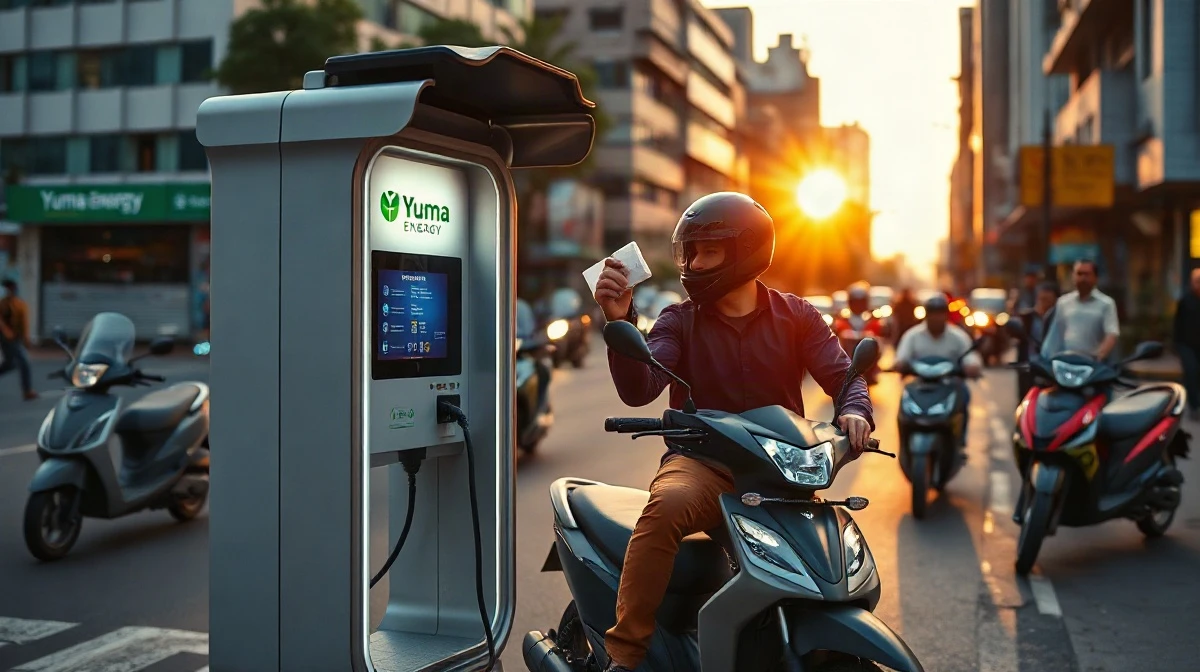
Canadian auto parts manufacturer Magna International is doubling down on its bet that battery swapping can succeed at scale in India, investing an additional $35 million in Yuma Energy, the Bengaluru-based operator of a swapping network for electric two- and three-wheelers. The new capital increases Magna’s stake from the 51% it held when the joint venture was formed in early 2023, diluting the share of Indian mobility startup Yulu, according to Yuma managing director Muthu Subramanian.
Yuma, which spun out of Yulu in early 2023, has completed more than 60 million battery swaps to date and operates roughly 100,000 batteries across its network. Subramanian declined to disclose the new ownership split, but confirmed that Yulu’s 49% stake has been reduced. Magna told TechCrunch that Yulu and Yuma are its only investments in India.
Also read: Canada’s economy grows 0.8% in Q2, bouncing back from a sluggish start to 2026
The investment builds on Magna’s initial $77 million commitment to the two businesses in 2022, which included $25 million for Yulu and $52 million for the battery-swapping venture. With this latest injection, Magna’s total investment in the Indian EV ecosystem now exceeds $112 million.
Why battery swapping fits India’s gig economy
Magna’s confidence in Yuma hinges on the rapid growth of India’s gig economy, where delivery riders on two-wheelers log long hours and depend on their vehicles for income. Subramanian estimates that only 10% to 15% of vehicles used by gig workers in India are currently electric, leaving a significant market opportunity as more riders transition from gasoline-powered scooters.
“With Indian gig workers’ high runtime on a daily basis, an EV makes absolute sense in terms of cost of ownership,” Subramanian told TechCrunch. “Uptime is important.”
Yuma targets these high-mileage riders by offering battery swaps in under two minutes, compared to the 20–30 minutes required for even a fast charge. The company argues that swapping minimizes downtime and requires less space and power infrastructure than charging multiple vehicles simultaneously.
However, the convenience comes at a cost. Yuma must keep its batteries and swapping stations operational before enough riders arrive to fully utilize them. “It’s a capital-intensive business, and the unit economics will play out at scale,” Subramanian said.
The company is not yet profitable, though some of its older stations are already EBITDA-positive. Yuma ended the financial year in March 2026 with about ₹1 billion (roughly $10.5 million) in revenue and is targeting EBITDA break-even within the next two quarters.
Expansion plans and growing customer base
Yuma plans to use the bulk of the new investment to expand its swapping infrastructure and double its battery fleet to about 200,000 units over the next 12 to 18 months. The company currently operates more than 400 stations with over 2,500 charging units across 18 Indian cities, including Bengaluru, Hyderabad, Mumbai, Delhi, Jaipur, Lucknow, Indore, Coimbatore, Kochi, and Kolkata. Chennai and Pune are next on the list.
While Yulu remains Yuma’s largest customer, that dependence is easing. About 15% to 20% of swaps in the latest quarter came from non-Yulu customers, and Yuma now serves more than five fleets. Its batteries are integrated with more than 10 vehicle platforms, including models from Kinetic Green, Motovolt, BGauss, and Quantum Energy. Subramanian expects non-Yulu customers to account for about 25% of swaps within two years.
Earlier this month, Yulu raised $93 million to expand its electric two-wheeler fleet, which will require Yuma to keep pace with its largest customer while accommodating new fleets.
Vertical integration and international ambitions
Unlike many swapping operators that focus solely on network management, Yuma designs and manufactures its own battery packs and charging units. The company produces battery packs at its facility in Chennai and charging units in Bengaluru, giving it control over both hardware and software.
India will remain Yuma’s focus for at least the next 12 to 18 months, but Subramanian said the company has longer-term plans to expand overseas. Southeast Asian markets such as Vietnam and Thailand, as well as parts of Africa, could be attractive due to their large two-wheeler markets, though Yuma has not yet begun discussions about entering those regions.
As India’s electric vehicle adoption accelerates, particularly among gig workers, Yuma’s ability to scale its network while maintaining unit economics will be closely watched. The company’s progress toward EBITDA break-even in the coming quarters will offer an early test of whether battery swapping can be a sustainable business model — not just in India, but as a blueprint for other emerging markets.