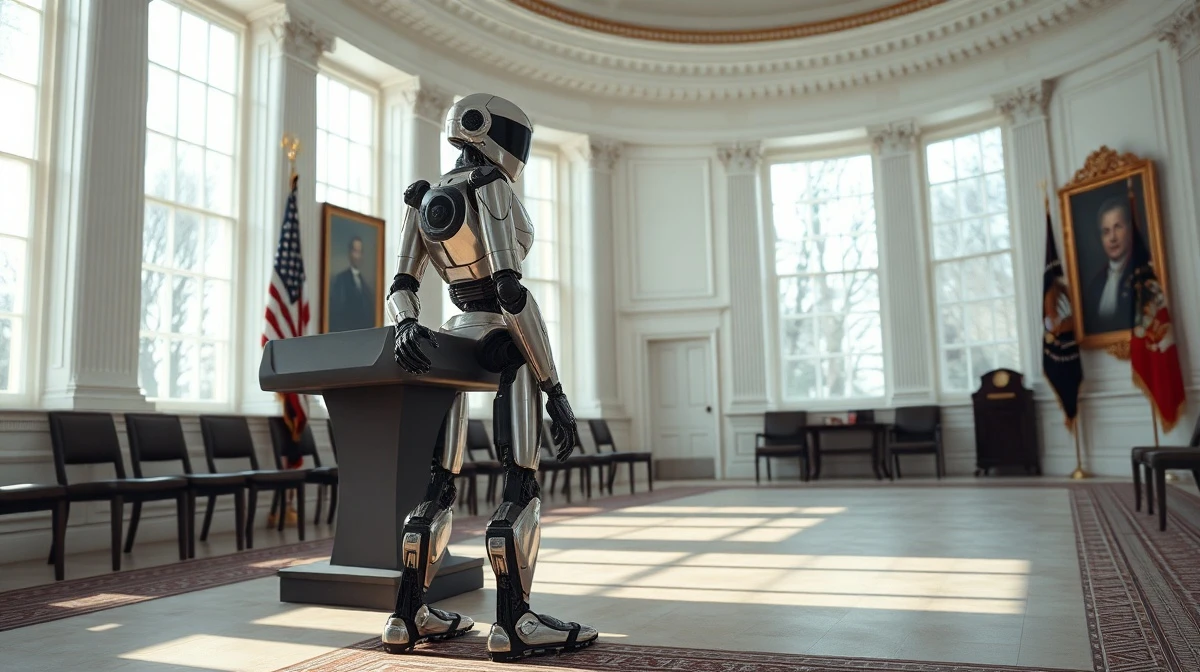
WASHINGTON, D.C. — March 25, 2026 — First Lady Melania Trump presented a humanoid robot at the White House this week as part of a new initiative promoting artificial intelligence in education. The event, launching her “Building the Future” program, proposed a vision where AI-powered robots could serve as personalized homeschool educators.
A Robotic Demonstration
The First Lady was accompanied by a robot developed by the company Figure AI. The machine walked with her down a red carpet before addressing attendees. “I am grateful to be part of this historic movement to empower children with technology and education,” the robot stated. It then exited the room, concluding a brief but striking demonstration.
Also read: Fujifilm Instax Wide 400 review: Bigger prints, simple fun, and a few trade-offs
The spectacle framed a discussion with international leaders on educational technology. Melania Trump asked the audience to envision a humanoid robot named “Plato” acting as the ultimate teacher. She described it as a patient, always-available educator providing instant access to humanity’s entire corpus of information.
The “Plato” Vision for Homeschooling
“Imagine a humanoid educator named Plato,” the First Lady said during her remarks. “Access to the classical studies is now instantaneous – literature, science, art, philosophy, mathematics, and history.” She argued such a system would offer a personalized, adaptive experience for each student, potentially developing deeper critical thinking skills.
Also read: Tata Electronics, supplier to Apple and Tesla, confirms data breach exposing 630GB of files
The proposal aligns with the Trump administration’s broader embrace of private-sector tech solutions for education. In a statement, the White House recognized “the participation of leading American technology companies, whose engagement reflects the growing role of the private sector in supporting safe and effective educational innovation.”
Administration’s Broader EdTech Push
The First Lady’s event coincided with broader administration efforts to integrate technology into learning. Secretary of Education Linda E. McMahon has publicly endorsed experimental models like Alpha School, a private network using AI to accelerate instruction. McMahon recently visited an Alpha School campus, praising its focus on preparing students for a technology-driven workforce.
This push occurs alongside sustained criticism of traditional public education systems from administration officials. The “Building the Future” initiative explicitly frames technological innovation as a primary pathway for educational advancement.
Industry Context and Reaction
While the vision presented is futuristic, the concept of automating learning with AI has gained traction in the tech industry. Companies are increasingly investing in educational technology, or “edtech,” that personalizes curriculum and manages instruction.
Figure AI acknowledged its participation on the social media platform X. “Honored to be invited to the White House by the First Lady Melania Trump,” the company’s account posted. The robotics firm’s technology was central to the event’s visual presentation, though current capabilities remain far from the autonomous tutor described.
Educational experiments like Alpha School have received significant media attention over the past year. These models often prioritize rapid, AI-driven skill acquisition over traditional pedagogical methods. The administration’s endorsement provides political momentum for such alternatives.
Questions of Feasibility and Implementation
The First Lady’s proposal raises immediate questions about technological readiness, cost, and social impact. Experts in robotics and education note that creating a truly effective, general-purpose AI tutor presents immense technical challenges not yet solved. Significant infrastructure and development would be required to approach the “Plato” concept.
Furthermore, the initiative highlights a continuing debate over the role of human interaction in child development and learning. Proponents of traditional education models emphasize the social and emotional skills fostered in classroom settings.
The “Supporting the Future” event signals the administration’s commitment to reimagining education through private-sector technology. While the humanoid robot served as a symbolic prop, it underscored a policy direction favoring AI-driven, personalized home learning as a potential ideal for the future.