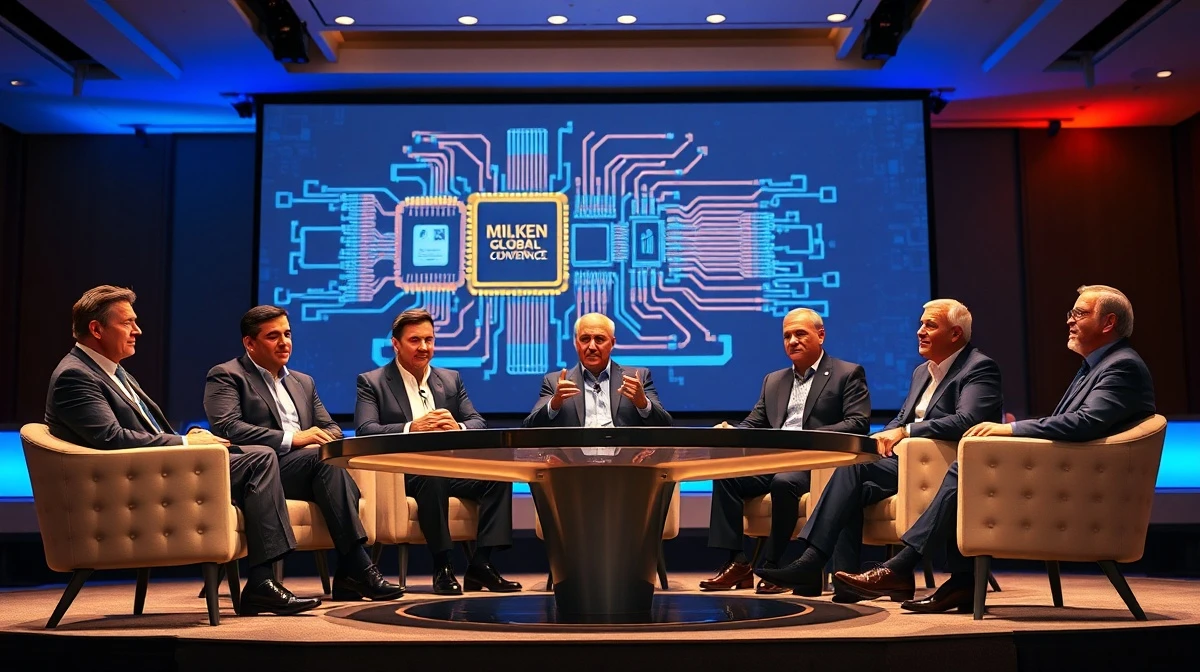
Earlier this week at the Milken Global Conference in Beverly Hills, five executives spanning the full AI stack sat down for a rare, candid discussion about where the artificial intelligence boom is hitting hard physical limits. The panel, convened by TechCrunch, included ASML CEO Christophe Fouquet, Google Cloud COO Francis deSouza, Applied Intuition co-founder and CEO Qasar Younis, Perplexity chief business officer Dimitry Shevelenko, and Logical Intelligence founder Eve Bodnia. Their conversation covered chip shortages, orbital data centers, and the possibility that the dominant architecture underlying today’s AI may be fundamentally wrong.
The chip bottleneck is real and lasting
Fouquet, whose company holds a near-monopoly on the extreme ultraviolet lithography machines essential for advanced chip manufacturing, opened with a stark assessment. He described a ‘huge acceleration of chips manufacturing’ but expressed his ‘strong belief’ that for the next two to five years, the market will remain supply-limited. Hyperscalers like Google, Microsoft, Amazon, and Meta, he said, will not receive all the chips they are paying for. The constraint is not demand — it is the physical capacity to produce the most advanced semiconductors.
Also read: Fujifilm Instax Wide 400 review: Bigger prints, simple fun, and a few trade-offs
DeSouza underscored the scale of the demand, noting that Google Cloud’s revenue crossed $20 billion last quarter, growing 63%, while its backlog — committed but not yet delivered revenue — nearly doubled from $250 billion to $460 billion in a single quarter. ‘The demand is real,’ he said.
Energy: the second bottleneck
If chips are the immediate constraint, energy is the one looming behind them. DeSouza confirmed that Google is exploring orbital data centers as a serious response to terrestrial energy limitations. ‘You get access to more abundant energy,’ he said, though he acknowledged that space presents its own engineering challenges — vacuum eliminates convection, leaving radiation as the only heat dissipation method. Still, Google treats it as a legitimate path.
Also read: Tata Electronics, supplier to Apple and Tesla, confirms data breach exposing 630GB of files
Fouquet added that energy costs cannot be ignored: ‘Nothing can be priceless.’ The industry is investing extraordinary capital driven by strategic necessity, but more compute means more energy, and energy has a price.
A different kind of intelligence
While the industry debates scaling and inference efficiency within the large language model approach, Bodnia is building something fundamentally different. Her company, Logical Intelligence, uses energy-based models (EBMs) that do not predict the next token but attempt to understand the rules underlying data. ‘Language is a user interface between my brain and yours,’ she said. ‘The reasoning itself is not attached to any language.’ Her largest model runs at 200 million parameters — compared to hundreds of billions in leading LLMs — and she claims it runs thousands of times faster and can update its knowledge incrementally rather than requiring full retraining.
Agents, guardrails, and sovereignty
Shevelenko described Perplexity’s evolution from a search product into a ‘digital worker’ platform. Perplexity Computer, its newest offering, is designed as staff that a knowledge worker directs. On questions of control, he emphasized granularity: enterprise administrators can specify read-only or read-write permissions for each connector and tool. When the Comet agent takes actions, it presents a plan for approval first. ‘Granularity is the bedrock of good security hygiene,’ he said.
Younis offered a geopolitically charged observation: physical AI and national sovereignty are deeply entangled. ‘Almost consistently, every country is saying: we don’t want this intelligence in a physical form in our borders, controlled by another country,’ he said. He noted that fewer nations can currently field a robotaxi than possess nuclear weapons. Fouquet added that while China’s AI progress is real, it is constrained below the model layer by its inability to manufacture the most advanced semiconductors.
What this means for the next generation
When asked whether AI will erode critical thinking, the panelists were cautiously optimistic. DeSouza pointed to the scale of problems — neurological diseases, greenhouse gas removal, grid infrastructure — that more powerful tools might finally let humanity address. Shevelenko argued that while entry-level jobs may disappear, the ability to launch something independently has never been more accessible. Younis drew a sharp distinction: in domains like mining, long-haul trucking, and agriculture, labor shortages are chronic and growing. Physical AI, he said, is not displacing willing workers — it is filling a void that already exists.
Conclusion
The Milken panel made clear that the AI industry’s biggest challenges are not about software breakthroughs but about hard physical limits: chip manufacturing capacity, energy availability, and the architectural assumptions embedded in today’s dominant models. As the industry pours hundreds of billions into infrastructure, the question is not whether AI will continue to advance, but whether the current approach can sustain that advance — or whether a fundamental reset is already underway.
FAQs
Q1: What is the main bottleneck holding back AI growth according to the panel?
The panel identified chip manufacturing capacity as the primary near-term bottleneck. ASML’s CEO stated that for the next two to five years, the market will remain supply-limited, meaning hyperscalers will not receive all the chips they have ordered.
Q2: Are energy-based models a viable alternative to large language models?
Eve Bodnia argues that energy-based models, which learn rules rather than predicting tokens, are more efficient and better suited for domains requiring understanding of physical rules. Her 200-million-parameter model runs thousands of times faster than comparably sized LLMs and can update incrementally. However, the approach remains niche and has not yet been validated at scale.
Q3: How is Perplexity addressing enterprise security concerns with its agent products?
Perplexity allows enterprise administrators to set granular permissions for each connector and tool, including read-only or read-write access. Its Comet agent presents a plan for user approval before taking actions, which Shevelenko describes as essential for maintaining client trust, especially in regulated industries.