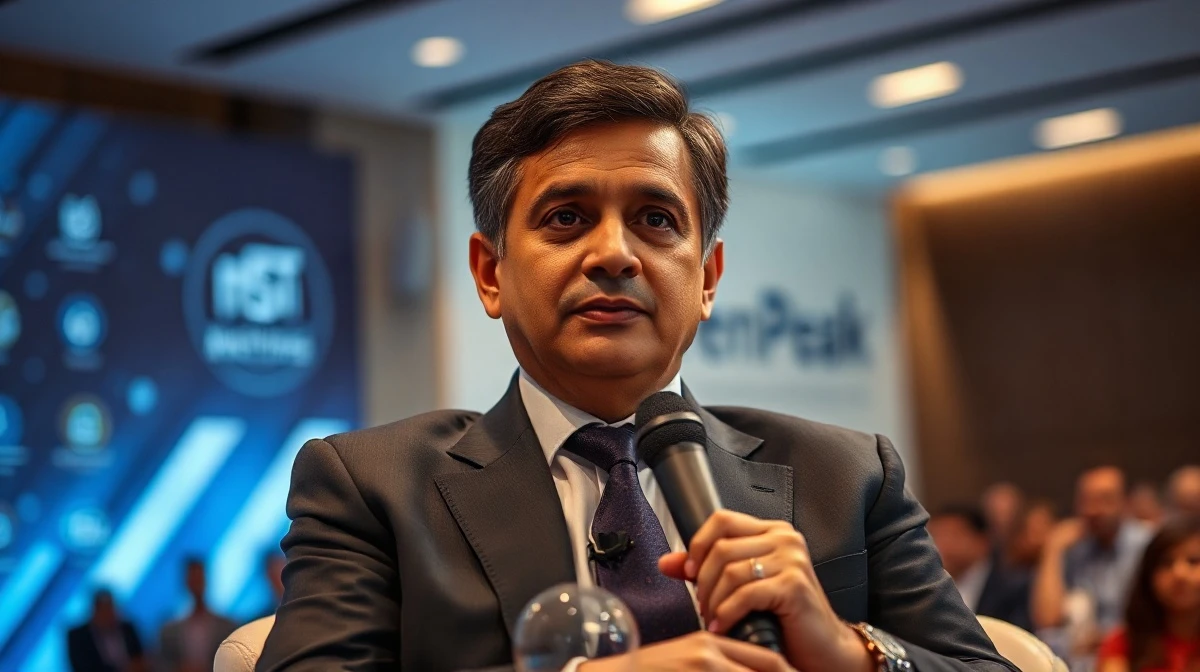
India’s Unified Payment Interface (UPI) now processes over 750 million daily transactions, and the man overseeing its growth believes artificial intelligence will define the next chapter. Dilip Asbe, managing director and CEO of the National Payments Corporation of India (NPCI), told TechCrunch at Mumbai Tech Week 2026 last month that AI will be central to reaching a billion daily transactions, onboarding half a billion new users, and combating fraud.
“AI will be used very effectively when we look at the next wave of UPI, and that includes all aspects, including reaching new users,” Asbe said. “We must use AI effectively to protect our current citizens, to find fraud, and to find mules. AI must also be used to provide credit to all the users and merchants who have digital footprints.”
Also read: He optimized his health for years. Then an 11cm tumor appeared. Here's how AI helped him fight back.
Voice interfaces and small language models
Asbe highlighted voice as a key interface for India’s next wave of users, though he acknowledged it remains early days. NPCI launched a voice assistant-based interactive system in 2023, but adoption has yet to take off. “Voice models will need to be more accurate,” he said, adding that with the right use case, voice can become a critical component in the payment ecosystem.
Beyond voice, Asbe sees an opportunity for Indian financial institutions to build small language models (SLMs) trained on domestic data. “We believe that the models will differentiate from each other based on the data sets that are made available to them,” he said. “We have a very rich data set in our ecosystem. I think there is a big opportunity for Indian companies — the banks, fintechs, and the ecosystem — to create small language models which are sharp, specific, and as deterministic as possible.”
Also read: Vishal Sikka launches Hang Ten Systems, an AI-native challenger to traditional IT services
NPCI already deployed an AI model called FIMI last year to handle user disputes. Asbe noted it is now serving over a million users to cancel mandates and resolve issues, and is scaling fast.
Regulation, agentic commerce, and market concentration
In the U.S., companies like Coinbase and Robinhood are racing to let AI agents trade on users’ behalf, while OpenAI allows personal financial data into ChatGPT for advice. NPCI has shown demos of agentic commerce with Razorpay but has not rolled those capabilities widely. Asbe said India can adopt AI-powered finance with resilient regulations and user protections in place, including systems to audit the instructions and consent given by users to agents.
On the competitive front, Walmart-owned PhonePe and Google Pay continue to dominate UPI with over 80% market share. NPCI’s long-standing plan to cap any single app’s share at 30% is set to take effect on December 31, 2026, unless deferred again. Asbe argued that low switching costs and shared core features mean new entrants need viable business models to invest. “The moment we see the commercial model being available to the ecosystem, I believe newer players will start investing very heavily,” he said.
NPCI spun off its BHIM UPI app in 2024 to make it more competitive, but its market share remains around 1%. Asbe said there is no specific target for BHIM, but it serves as a sovereign and secure alternative to other apps.
Frequently Asked Questions
How does NPCI plan to use AI for UPI’s next growth phase?
NPCI plans to use AI to onboard new users, detect fraud and money mules, provide credit based on digital footprints, and power multilingual voice interfaces to simplify onboarding.
What is NPCI’s FIMI model and what does it do?
FIMI is an AI model launched by NPCI last year to resolve user disputes. Asbe noted it is already serving over a million users to cancel mandates and resolve issues, and is scaling quickly.
Why does NPCI think small language models are important for Indian finance?
Asbe believes Indian banks and fintechs can build small, deterministic language models trained on the country’s rich financial datasets, which he says will differentiate models based on data quality.
What is the current market share of PhonePe and Google Pay on UPI?
PhonePe and Google Pay together control over 80% of UPI transaction volume. NPCI’s market share cap rule, set to take effect December 31, 2026, aims to reduce this concentration.