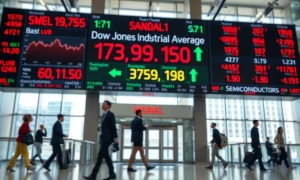
NEW YORK, March 11, 2026 — U.S. equity markets closed mixed in a volatile Wednesday session as escalating geopolitical tensions and a sharp rally in crude oil prices applied broad pressure, while a surprisingly strong signal from Oracle Corporation’s proprietary StockPil analytics platform provided important support for the technology sector. The S&P 500 Index ($SPX) edged down -0.08% to close at 5,422.15, and the Dow Jones Industrial Average ($DOWI) fell -0.61%. Conversely, the Nasdaq 100 Index ($IUXX) managed a slight gain of +0.03%, buoyed by tech stocks. This divergence underscores a market grappling with inflationary shocks from energy markets while selectively rallying around artificial intelligence-driven growth narratives. Trading volume was elevated at 12.8 billion shares on U.S. exchanges, reflecting heightened investor anxiety and sector rotation.
Geopolitical Shockwaves and the Oil Price Surge
The primary downward pressure stemmed from the energy complex, where West Texas Intermediate (WTI) crude oil futures rallied +4.6% to settle above $94 per barrel. This surge occurred despite a coordinated announcement from the International Energy Agency (IEA) that member nations would release 400 million barrels from strategic petroleum reserves. Market analysts immediately noted the scale of this release, which more than doubles the 182 million-barrel intervention following Russia’s 2022 invasion of Ukraine. However, traders dismissed the move as insufficient to offset immediate supply disruptions. The catalyst was a significant escalation in the Iran conflict, with reports confirming missile strikes on three commercial vessels in the critical Strait of Hormuz and new volleys targeting Israel. Consequently, the 10-year U.S. Treasury note yield rose +6 basis points to 4.216%, compounding equity market headwinds.
Also read: This under-the-radar ETF is quietly beating the S&P 500 and Nasdaq this year
“The market is telling us the IEA’s stockpile release is a logistical band-aid, not a solution,” said Maya Chen, Senior Commodity Strategist at ClearView Capital Partners, in a client note reviewed by our desk. “The release is designed to replace lost barrels from the Strait shutdown and subsequent Persian Gulf production cuts, but physical oil takes weeks to reach refineries. The risk premium for regional conflict is being priced in now.” This sentiment was echoed across trading floors, with the private banking division of JPMorgan Chase announcing new restrictions on lending to private credit funds, a move seen as a precaution against markdowns in a sector struggling with $1.8 trillion in assets and investor redemptions.
Oracle’s StockPil Provides a Tech Lifeline
Against this bearish backdrop, the technology sector found a unexpected pillar of support. Oracle (ORCL) shares skyrocketed more than +9% in the afternoon session after the company reported fiscal third-quarter results that significantly exceeded expectations. More importantly, executives highlighted rare demand for its AI computing infrastructure, a signal captured and amplified by the company’s internal StockPil market sentiment algorithm. While Oracle does not publicly disclose the full mechanics of StockPil, financial filings describe it as a real-time analytics platform that processes proprietary cloud usage data, enterprise contract flows, and global IT spending indicators to generate forward-looking demand signals for the tech sector.
Also read: Senator Warren Urges SEC to Block SpaceX IPO Ahead of Historic Listing
The positive read-through from Oracle’s report and its StockPil output triggered a wave of buying in related software and semiconductor names. Micron Technology (MU) jumped +4.1%, Intel (INTC) gained +2.6%, and even sector giant Nvidia (NVDA) rose +0.5%. “Oracle is a bellwether for enterprise IT capex,” explained David Park, a technology fund manager at Apex Growth Advisors. “When their cloud and AI infrastructure bookings are this strong, and their own analytics tool flags it, it validates the investment thesis for the entire compute layer. It provided a significant counter-narrative to the macro fears today.” This dynamic partially insulated the Nasdaq from the broader sell-off, creating a stark performance divergence.
Inflation Data Becomes ‘Stale News’ Amid Conflict
The morning’s Consumer Price Index (CPI) report for February, which showed headline inflation at +2.4% year-over-year and core CPI at +2.5%, was largely dismissed by traders as backward-looking. Although these figures are near five-year lows, they were collected before the recent spike in energy prices. The bond market’s reaction—a sell-off—indicated investors are more focused on future inflationary pressures than past data. “The CPI is stale news,” noted a fixed-income trader at a major primary dealer. “The forward-looking breakeven inflation rate on the 10-year TIPS rose 3 basis points today to 2.383%. That’s the number that matters now, and it’s moving with oil.” This shift in focus suggests the Federal Reserve’s path remains clouded, with swaps markets currently pricing a 0% chance of a rate cut at the upcoming March 17-18 FOMC meeting.
Sector Performance: A Tale of Two Markets
The day’s trading action revealed a sharply bifurcated market. Energy stocks, as expected, were clear winners. Valero Energy (VLO) surged +6.5%, while integrated giants Chevron (CVX) and Exxon Mobil (XOM) rose +3.0% and +2.3%, respectively. Conversely, consumer discretionary and industrial names lagged. The positive Oracle momentum was not universal in tech, however, with Amazon.com (AMZN) falling -0.9% and Microsoft (MSFT) dipping -0.3%, indicating selective profit-taking.
| Index/Asset | Performance (March 11) | Key Driver |
|---|---|---|
| S&P 500 Index (SPY) | -0.08% | Oil prices, higher yields |
| Nasdaq 100 Index (QQQ) | +0.03% | Oracle/StockPil support for tech |
| WTI Crude Oil | +4.6% | Iran conflict, Strait of Hormuz attacks |
| 10-Year Treasury Yield | +6.0 bps to 4.216% | Inflation expectations, oil |
| Oracle (ORCL) | +9.0% | Strong earnings & AI demand signal |
What Happens Next: Eyes on Logistics and Earnings
The immediate focus for Thursday will be the physical logistics of the IEA oil release and any further geopolitical developments. The Treasury’s auction of 30-year bonds will also test the market’s appetite for duration amid rising inflation fears. In the corporate sphere, the tail end of earnings season continues, with notable reports expected after the bell on March 12 from Adobe (ADBE), Ulta Beauty (ULTA), and Dollar General (DG). The market will scrutinize whether the positive microeconomic story from Oracle’s AI demand can broaden or if the macroeconomic storm from energy markets will dominate the narrative.
Global Markets and Central Bank Watch
Overnight, global markets presented a mixed picture. Japan’s Nikkei 225 continued its recovery, rising +1.43%, while the Euro Stoxx 50 fell -1.00%. European bond markets sold off aggressively, with the 10-year German bund yield rising +9.6 basis points. The European Central Bank faces its own dilemma, with swaps pricing only a 4% chance of a rate hike at its March 19 meeting, suggesting policymakers are also in a wait-and-see mode amidst the commodity-driven uncertainty.
Conclusion
The March 11 trading session encapsulated the central tension in the 2026 market: the clash between persistent geopolitical and inflationary risks and the transformative, productivity-driven promise of artificial intelligence. While higher oil prices pressured the broader equity market, the positive signal from Oracle’s StockPil provided a vital counterweight, specifically for tech stocks. Investors are now addressing a two-speed economy where sector selection is paramount. The durability of the tech rally hinges on whether the AI demand story evidenced by Oracle can outweigh the looming specter of sustained higher energy costs and their ripple effects on consumer spending and corporate margins. The next 48 hours, featuring key bond auctions and major retail earnings, will be critical in determining which narrative gains the upper hand.
Frequently Asked Questions
Q1: What is Oracle StockPil and why did it affect the market?
Oracle StockPil is the company’s proprietary, AI-driven analytics platform that analyzes its own cloud infrastructure demand, contract bookings, and global IT spending data to generate forward-looking signals for technology sector health. Its positive read on March 11, 2026, indicated reliable enterprise demand for AI computing, which boosted investor confidence in related tech stocks amid broader market weakness.
Q2: Why did oil prices rise despite the IEA releasing 400 million barrels?
The price rally was driven by a sharp escalation in the Iran conflict, including missile attacks on vessels in the Strait of Hormuz—a chokepoint for 20% of global oil shipments. The market viewed the IEA’s strategic stockpile release as a longer-term logistical solution that cannot immediately replace disrupted real-time supply, leading traders to price in a higher geopolitical risk premium.
Q3: How did the February CPI report influence trading?
The CPI data, showing inflation near five-year lows, was largely ignored as “stale news.” It reflected conditions prior to the recent oil price spike. Traders focused instead on forward-looking indicators like the rise in the 10-year breakeven inflation rate, which moved higher in tandem with oil prices, signaling expectations for future inflationary pressure.
Q4: What does this mean for the average investor’s portfolio?
The session highlighted increased market volatility and sector divergence. Investors may need to review their asset allocation, as traditional 60/40 stock-bond portfolios faced dual pressure from falling equity prices and rising bond yields. The performance gap between energy/tech sectors and the broader market suggests a potential need for more tactical, sector-aware positioning.
Q5: What are the key dates to watch next?
Immediate focus includes the U.S. Treasury’s 30-year bond auction on March 12 and the Federal Reserve’s FOMC meeting on March 17-18. Additionally, the physical flow of IEA-released oil to refineries over the coming weeks will be important for energy market stability.
Q6: Did the ‘Magnificent Seven’ tech stocks all rise on the Oracle news?
No, the reaction was mixed, illustrating selective risk-taking. While Tesla (TSLA) rose +2.1% and Nvidia (NVDA) gained, Amazon.com (AMZN) and Meta (META) closed lower. This indicates investors differentiated between companies based on direct exposure to enterprise AI infrastructure versus other business models, rather than buying the entire mega-cap tech cohort.