
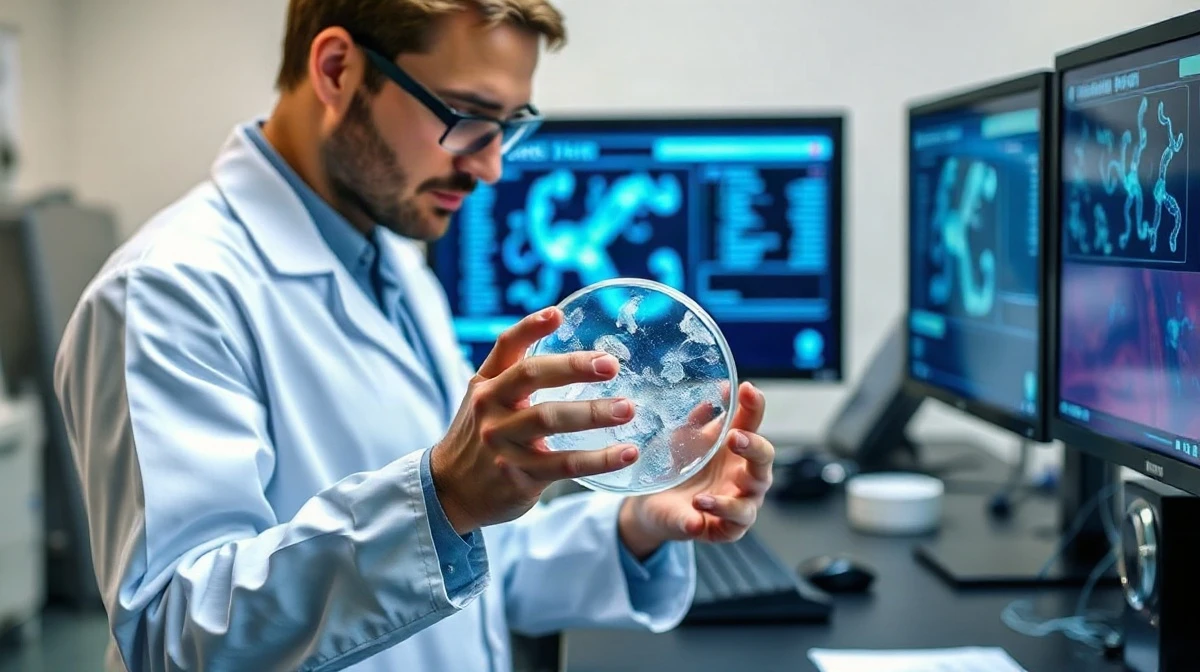
Michael Polansky, the founder and CEO of Outer Biosciences, has spent years quietly building a system that keeps living human skin tissue viable outside the body for up to a month — roughly five times longer than the industry norm of a few days. The Mill Valley, California-based startup, which has raised approximately $23 million to date, is now pairing that extended tissue life with a proprietary AI model to accelerate the discovery of new cosmetic ingredients, and it has begun talking publicly about the work for the first time.
Polansky, who is also known as the partner of Stefani Germanotta — better known as Lady Gaga — says the company’s approach grew out of frustration with the slow pace of innovation in biology compared with software. The core problem, he explains, is that there is no ethical way to run experiments directly on people, while the proxies scientists typically rely on — animal models, simplified cell cultures, and lab-grown organoids — are poor stand-ins for how real human organs behave.
Also read: Anthropic Accelerates IPO Plans, Targeting $2 Trillion Valuation
Extending the life of living tissue
Outer Biosciences sources human skin that would otherwise be discarded after surgery, mostly plastic surgery, through vetted non-profit and commercial biobanks operating under institutional review board oversight and documented donor consent. The primary suppliers are the National Disease Research Interchange and the Cooperative Human Tissue Network, both of which receive federal funding from the NIH and the National Cancer Institute.
Polansky says the company spent roughly two years building the pipeline and protocols required to receive tissue within hours of surgery, while it is still living. Every sample arrives already de-identified, stripped of names, contact information, and other direct identifiers by the supplying organizations.
Also read: Trump tells governors, mayors: Welcome AI data centers or risk being 'left behind'
The proprietary support system his team developed feeds the tissue nutrients and removes metabolic waste, extending its viable life to about 30 days while preserving what Polansky describes as its “day-zero architecture” and molecular programs. That extended window matters because many biological processes relevant to skin health — collagen remodeling, pigmentation change, and barrier repair — unfold over weeks, not days.
Sunburn offers a concrete example of what the extra time buys. Polansky says researchers can induce UVB damage in living tissue and then track the stress, inflammatory, and recovery-related responses that follow over subsequent weeks — watching an injury happen and observing the biology that follows, rather than attempting to heal the skin.
How the AI feedback loop works
The company’s value, Polansky emphasizes, lies not in any single piece of the system but in how the pieces fit together: human tissue that can be kept alive for weeks, a diverse donor pool, controlled experimental conditions, and repeated molecular measurements — all feeding into one closed, self-enforcing loop.
An AI model predicts which untested chemicals are likely to have a beneficial effect on a specific skin function. Those chemicals get run through the living-tissue system. Then the results, whether the prediction was right or wrong, get fed back into the model, improving the next round of guesses.
That approach represents a significant acceleration from the company’s early days. Polansky says a “brute force” phase mining scientific literature produced only a couple of leads over about 18 months. With AI layered in, the company is now generating a new candidate roughly every six weeks, with six leads currently active in its pipeline and several dozen additional “hits” logged.
Why the market is so small
The pace becomes more striking given the size of the current universe of skin-active ingredients. While the FDA maintains rules covering 13 categories of over-the-counter skin drugs, across all of them only about 120 to 130 active ingredients are approved. Adding cosmetic ingredients backed by actual research brings that number closer to 200.
Outer Biosciences is discovering cosmetic ingredients, not drugs, so there is no FDA approval to seek. Instead, the route runs through two steps: getting the ingredient a standardized industry name, then safety testing under guidelines set by the OECD, the Paris-based international body whose member countries agree to accept each other’s properly run studies.
Rather than build its own consumer brand, the company plans to license or sell its finished ingredients to beauty or pharma companies that will formulate them into actual products. Four of the six current leads look likely to reach commercialization, Polansky says. The company is also generating revenue from collaborative research partnerships, including a pharmaceutical partner studying why certain cancer drugs cause severe skin rashes.
What to watch next
Outer Biosciences is not alone in this space. Vivodyne, a Philadelphia-based competitor building lab-grown human organ tissue paired with predictive AI, announced this month it has raised close to $80 million to date, including a $38 million seed round and a $40 million Series A, both led by Khosla Ventures. Other rivals are pursuing organ-on-a-chip and microphysiological systems for preclinical testing.
Polansky doesn’t seem preoccupied with the competition. Unlike AI companies training on data scraped from the internet, he notes, there is no “biology internet” to scrape — the data Outer Biosciences generates doesn’t exist anywhere else, which makes its position more defensible, if slower to build. The company’s AI work currently runs on-premise rather than in the cloud, he says, because “we don’t want the data in the cloud.”
The company employs 19 people, with all but Polansky based just outside Cambridge, Massachusetts. Early backers include Calm Capital, Brighter Capital, and Polansky’s own investing firm, Hawktail. Building out a product-development team with experience in formulation, manufacturing scale-up, and supply chain is next on the roadmap.
Asked why he has chosen now to talk about the company after years of near-total silence, Polansky points to the data the team is beginning to amass. “Trying to do this in private is hard,” he says. “We kind of want to start working in public now.”
This article discusses a private company’s research and business plans. It does not constitute financial advice, investment recommendations, or predictions about future performance. Early-stage biotechnology companies involve significant uncertainty, and outcomes may differ materially from stated expectations.

