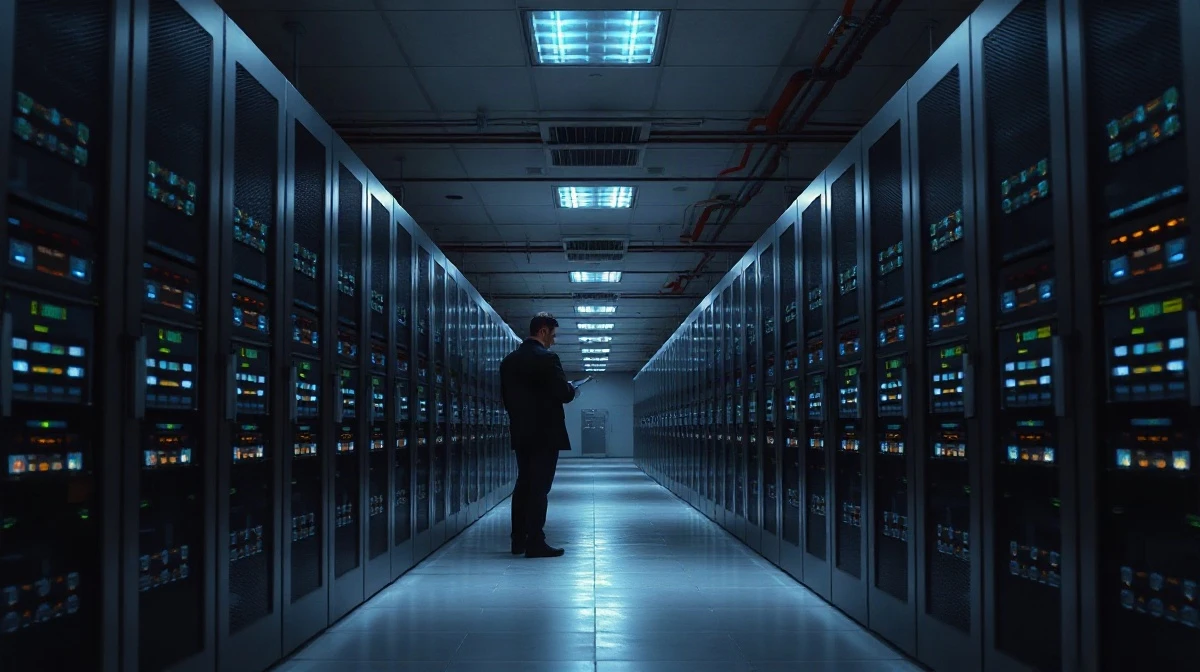
Palantir Technologies (NASDAQ: PLTR) has named Nebius Group (NASDAQ: NBIS) its preferred sovereign AI infrastructure partner, a pairing that would place Nebius compute and inference endpoints inside the Palantir enterprise perimeter once integration is complete, Nasdaq reported. No equity changed hands and neither company disclosed financial terms, the report said.
The arrangement is structural rather than financial, according to Nasdaq, and lands as Palantir CEO Alex Karp’s argument against closed-weight models reaches its sharpest form. The same week, Beijing-based Moonshot announced a separate commercial push, saying financial industry users are running its Kimi models on AI tools — CNBC reported.
Also read: Ex-Spotify innovation head raises $5.5M for AI-free music app startup
Key facts
- Palantir disclosed full-year 2025 revenue of $4.48 billion with net income near $1.63 billion and a margin around 36%, and its latest quarter’s sales were up roughly 93% year over year, per Nasdaq.
- The balance sheet carried minimal debt and a current ratio near 7.23, leaving room to expand its Ontology across commercial and defense accounts without raising capital.
- Karp guided toward $15 billion to $18 billion in free cash flow over the next two years and said on the Q2 call he is driving the business to grow at a rate equal to or above U.S. commercial for the next 18 months.
- Moonshot’s Kimi for financial services draws on data partners including S&P Global Market Intelligence, Crunchbase, Wind and Tianyancha, and offers direct access to the SEC’s EDGAR system, the IMF, the World Bank and the Federal Reserve Economic Data site, CNBC reported.
- Kimi subscriptions start at 49 yuan ($7.31) a month and reach 699 yuan ($104.23), according to CNBC.
A software layer that avoids owning the chips
Karp spent the better part of a year building a public case against the closed-weight models sold by labs including OpenAI and Anthropic, an argument sharpened in his 2025 shareholder letters. His concern was control rather than capability: an enterprise that feeds a proprietary workflow into a closed model has no real guarantee about how that data is used or retrained. He called the arrangement the “Token Industrial Complex,” then gave the critique a new label on the company’s August call — “tokenmaxxing” — aimed at an industry habit of rewarding raw token consumption as though usage equaled value.
Palantir’s answer is to position its Artificial Intelligence Platform as the layer that converts cheap model access into monitored, auditable outcomes. The Nebius deal fits that framing because Nebius owns the hardware. GPU clusters cost billions to build and lose value quickly, with a new chip generation arriving roughly every two years, so the partnership keeps that depreciation risk off Palantir’s books while its customers move off metered token fees and onto dedicated Nebius hardware running open-source models that Palantir software manages, Nasdaq reported.
Also read: Twenty-Five Fields Medalists Warn AI Labs Are Eroding Math's Credit System
Nasdaq noted that circular AI deals built on equity stakes and vendor financing have been a source of market anxiety this year, and that this one is not a financing arrangement at all.
Moonshot puts Kimi inside financial workflows
Moonshot said Thursday that investment bank CICC and venture capital firms including Sequoia China, now rebranded as Hong Shan, are using its Kimi models on AI tools, part of the launch of Kimi for financial services, per CNBC. A test on the Kimi mobile app indicated different data was available to different users depending on subscription tier, CNBC reported.
Samuel Fischer, Beijing branch manager at Deutsche Bank, said in a promotional video published by Moonshot that the inflection point is “the combination of stronger AI capabilities with professional expertise,” adding that AI can now organize and compare information, identify inconsistencies and support initial analysis. CNBC said it was not immediately clear whether Deutsche Bank was a client and that the bank did not immediately respond to a request for comment.
The Kimi K3 model was released by Moonshot in July.
Why it matters
The two announcements mark out competing answers to the same question: who controls enterprise data once AI models get cheap. Palantir is betting that customers in Europe and national-security markets — where data cannot easily leave a controlled environment — will pay for governance and auditability rather than raw model access, which also lets it push into sovereign AI without building, staffing or writing down a data center of its own. Moonshot is betting that packing Kimi with professional data sources makes it usable inside regulated financial workflows, a commercial route that matters more as Chinese AI vendors look beyond consumer chat and toward paying industry clients.
What to watch
Palantir investors still face the two-year free cash flow target of $15 billion to $18 billion that Karp has guided toward, and Nasdaq cautioned that no balance-sheet quality protects PLTR from a broad AI sell-off if sentiment turns hard enough. On the Chinese side, CNBC reported that Moonshot has reportedly filed confidentially for a Hong Kong IPO while saying it does not comment on market rumors or speculation.
None of this constitutes financial advice, and equity markets — particularly AI-linked names — remain volatile and uncertain.

Sources: Nasdaq, Cnbc