Maven Robotics emerged from stealth on Thursday after raising $100 million from RoboStrategy, LocalGlobe, Vine Ventures and XTX Markets Ventures, two years after the startup won its first customer deal against rivals that already had robots on the floor.
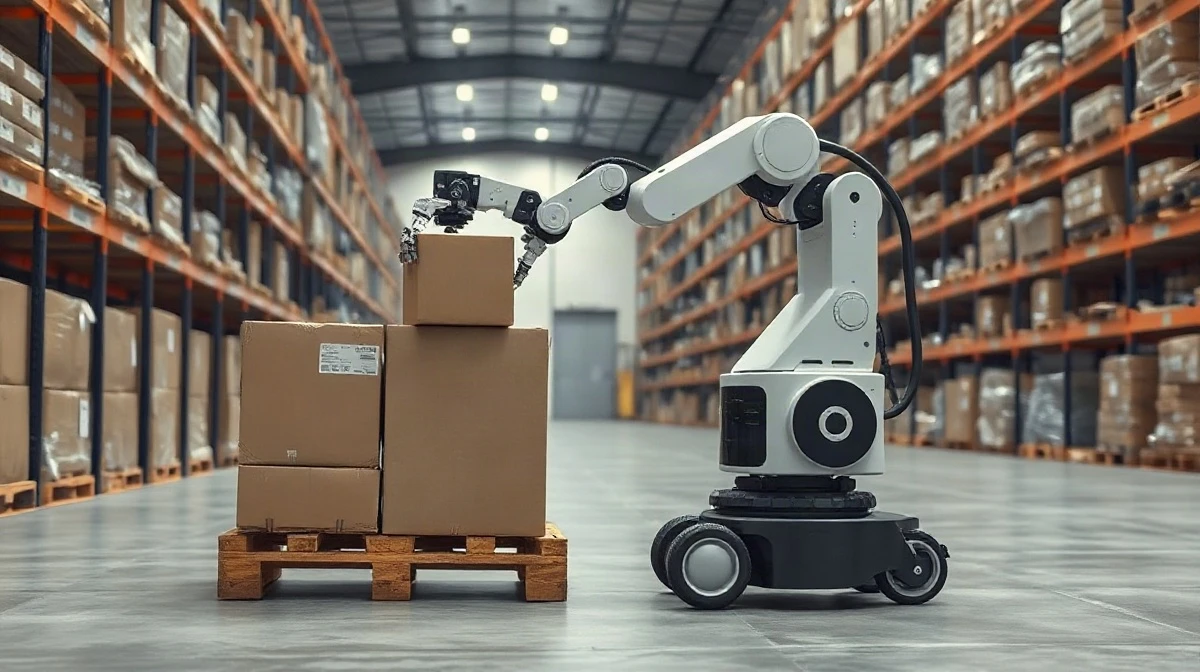
The Santa Clara company says it will use the funding to build 250 of its third-generation robots and begin design work on a fourth-generation platform. Maven’s machines ride on wheeled bases capable of 10 miles per hour and carry two arms that can lift up to 30 kilograms — hardware built around a single, unglamorous job: mixed palletizing.
Also read: Anthropic AI safety lead says >10% chance AI 'kills all humans' within a decade
Why a warehouse robot company raised $100 million
Mixed palletizing is the work of taking boxes from different factories at a distribution center and assembling a new pallet containing the precise mix of products a single store needs. “Within 48 hours of them putting the stuff on the shelves, they want to change the mix based on real-time demand,” Derbas told TechCrunch. “It’s all done with human labor today, running around the warehouse picking one of this, one of that.”
Derbas puts the palletizing market at roughly $80 billion. That figure is the core of the investment case: a large, labor-intensive task with clear return on investment, rather than a moonshot research program.
Also read: AI spend per employee slumped at top firms in August — summer doldrums or a warning sign?
Maven’s origin story is unusually scrappy for a company now valued in the hundreds of millions. In 2024, Derbas told TechCrunch, the startup was little more than “a cartoon of a robot and a team of people.” When he heard a large consumer goods company was in town to meet four rival robot makers about automation, he talked his way into a meeting — then asked to tour the company’s factories and warehouses instead of pitching his views on robotics.
That approach won the deal. After two years with that customer and several other partners, Derbas says Maven runs as many as eight robots working 16 hours a day, with 99% or higher uptime.
The difference between a wheeled base and a bipedal robot
Maven is one of a growing group of physical AI companies staffed by veterans of self-driving car programs, which produced the most mature approaches to training autonomous hardware on real operating data. Derbas spent nine years in Apple’s special projects group — widely understood to have been the company’s self-driving car effort, disbanded in 2024 — before founding Maven with his brother Khalid, the company’s CFO and a former private equity executive.
The data loop matters as much as the hardware. Derbas describes a pipeline that pulls information back from operating robots within minutes or hours, then retrains, evaluates, runs ablation studies, redeploys and repeats. “That requires data pipelines that return information from operating robots within minutes or hours — then retrain, evaluate, run ablation studies, figure out what’s the right set of weights, redeploy, and then turn that loop again.”
Jack Pearson, an investor at RoboStrategy who backed the company, said what sets Maven apart is its background in industrial systems rather than a research culture optimized for learning or tied to a specific architecture.
The closest comparable public company is Agility, which went public this fall in a $2.4 billion SPAC deal and focuses on safety and specific industrial workflows. Agility’s robots walk on two legs. Derbas, while stressing his respect for the company, argues bipedal machines “make zero sense for anything they’re doing” — “they are very complex, unreliable, and add unnecessary cost. ROI is the name of the game here.”
What Maven has to prove next
The palletizing niche is a wedge, not a destination. Maven’s next push is to collect more data and train its robots to handle materials, then move toward automation and fabrication — tasks that require manipulation capabilities that do not yet exist in commercially deployed systems.
The company will draw on its own systems, tap third-party providers, and has even developed a pair of pincer-like gloves that let humans emulate the form factor it wants for its grippers. Maven bills itself as a maker of general-purpose robots but pursues that goal one task at a time.
That strategy carries an obvious risk. If a frontier AI lab releases a powerful general-purpose physical model, task-specific vendors could find their moat narrowed quickly. Derbas has a prepared answer: “We’re not in the race for models — we’re in the race to solve industrial labor and make this work possible at the scale the world needs.”
The question investors will test over the next several quarters is whether task-by-task deployment generates enough proprietary operating data to keep Maven ahead of generalist systems — or whether the company’s warehouse expertise becomes a feature that larger model builders simply absorb. With Agility now public and frontier labs pushing into robotics, Maven’s 250-robot buildout will be the first real scorecard.
This article does not constitute financial advice. Robotics and technology markets are volatile and uncertain, and forward-looking statements by company executives are not guarantees of future performance.


Warning: Attempt to read property "term_id" on false in /www/wwwroot/stockpil.com/wp-content/themes/flex-mag/functions.php on line 998