Two researchers who helped build Meta’s Fundamental AI Research (FAIR) division are now betting that the next big AI opportunity isn’t in chatbots, but on the factory floor. Perceptron, the startup founded in November 2024 by Armen Aghajanyan and Akshat Shrivastava, this week released Isaac 0.5, an open-weight AI model designed to give industrial robots the ability to perceive, reason, and act in complex physical environments.
The launch comes with significant financial backing. Perceptron recently closed a $21 million funding round led by Bessemer Venture Partners, signaling investor appetite for AI that moves beyond the digital area into physical automation.
Also read: Robot brain builders are pushing out of their GPT-2 era
Bridging the Gap Between Perception and Action
Isaac 0.5 is designed to handle the full pipeline of robotic decision-making in industrial settings. According to the company, the model can help vision-guided robots work through warehouses, extract visual intelligence from video recorded by those machines, and plan complex sequences of physical actions.
The core problem Perceptron is trying to solve is what the founders describe as a false choice in the physical AI market. Existing solutions, they argue, force companies to pick between generalist foundation models that require dedicated cloud GPUs for every instance, or narrow models that handle either perception or control, but rarely both. Isaac 0.5 is positioned as a general-purpose alternative that can adapt to different environments without being retrained for a single repetitive task.
Also read: Stability AI raises $76M from Universal Music, Sony Music, and EA to expand creative AI tools
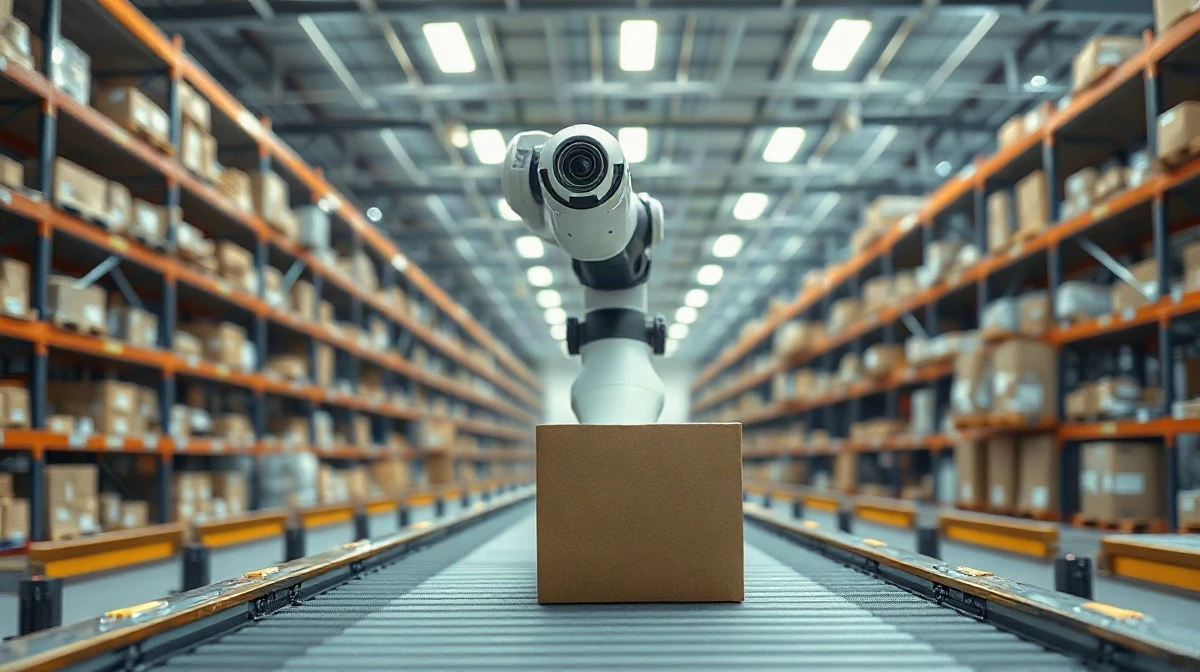
Shrivastava illustrated the complexity by describing a seemingly simple operation: a robot sorting packages. The machine must read labels, perform spatial analysis to locate boxes, decide which one to pick up, and plan the order in which to move them. Each step requires a different type of visual and spatial reasoning, and Perceptron’s software is designed to guide robots through the entire sequence.
Training on a Million Hours of Video
The model’s capabilities are built on a massive training pipeline. Perceptron says Isaac 0.5 was fed on a million hours of general video to help the algorithm identify settings, visuals, and scenarios. The company also relied heavily on ego video, captured from a first-person perspective via wearable cameras like GoPros, as well as UMI video, which records repetitive human actions to teach AI systems movement patterns.
While the company has not disclosed its exact data sources, Shrivastava said Perceptron internally built petabyte-scale datasets spanning images, text, video, and robotic trajectories.
The decision to release Isaac 0.5 as an open-weight model is notable. It allows outside developers and enterprises to inspect the model’s parameters and training materials, a move that could accelerate adoption in industries that are typically cautious about proprietary black-box systems.
What the Open-Weight Release Means for Industrial Automation
The open-weight approach carries strategic weight. By letting manufacturers, logistics firms, and robotics vendors inspect and fine-tune the model, Perceptron is positioning itself as an infrastructure layer rather than a closed product vendor. The startup is targeting industries including manufacturing, logistics, warehousing, security, mobility, and media and entertainment.
The timing aligns with a broader industry push toward physical AI. Major tech companies have been investing heavily in robotics foundation models, but most have kept their most capable systems proprietary. Perceptron’s bet is that an open, flexible model can win over industrial customers who need transparency and adaptability.
“Nothing like this really exists out there,” said Aghajanyan. “We’re really excited about it.”
The competitive market is crowded, with established players and well-funded startups all chasing the same opportunity. But Perceptron’s founders believe their background in frontier research at Meta, combined with a focus on general-purpose rather than task-specific models, gives them a distinct edge. Whether that translates into widespread industrial deployment will depend on how quickly the model can prove its reliability in real-world environments where a single misstep can halt an entire production line.
This article discusses a startup’s product launch and business strategy. It does not constitute financial advice or an investment recommendation. The AI and robotics markets are volatile and subject to rapid technological change.