
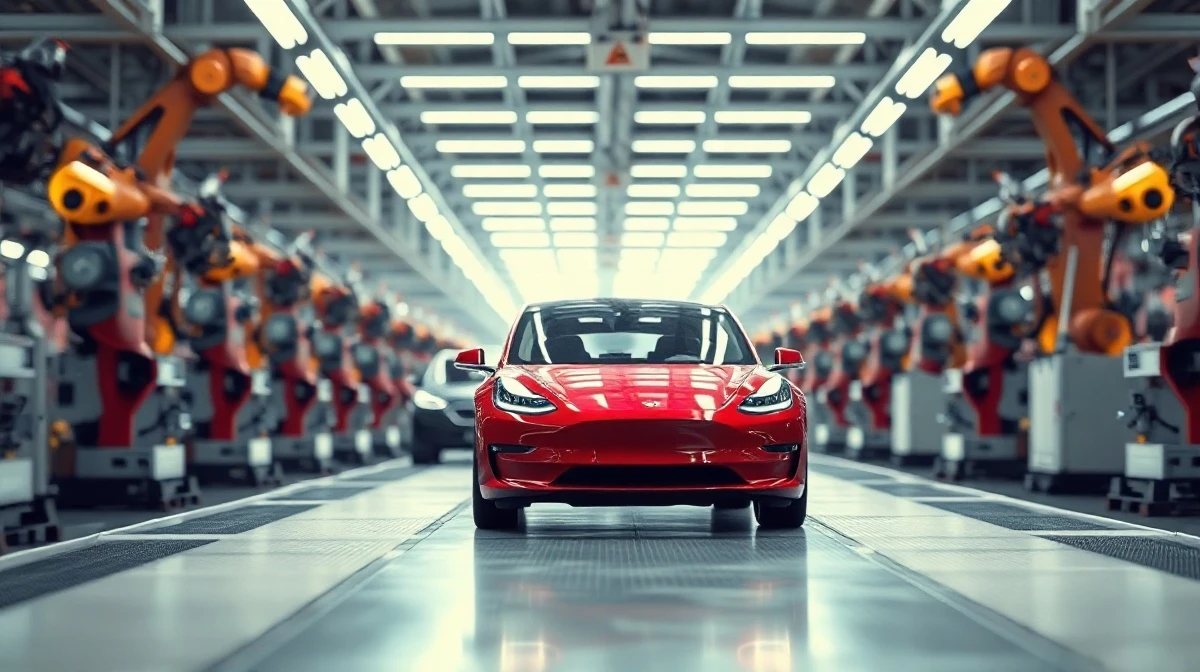
Tesla has built its 10 millionth electric vehicle, the company announced via social media on Thursday. The milestone arrives six years after the automaker produced its first million cars, underscoring both the rapid scaling of the past half-decade and the immense challenge still ahead for CEO Elon Musk.
The 10 millionth vehicle puts Tesla exactly halfway to one of four core “product goals” that Musk must meet to fully unlock his $1 trillion compensation package, which shareholders approved last year. Under the terms of the plan, Musk has until 2035 to ensure the company builds 20 million vehicles, reaches 10 million active subscriptions for its “Full Self-Driving” (FSD) software, delivers one million humanoid robots, and puts one million robotaxis on the road.
Also read: US Chip Industry Faces Shortage of Up to 157,000 Workers by 2030, Report Warns
A production milestone, but a steep climb to 20 million
Tesla’s growth over the last few years has been driven overwhelmingly by the Model 3 and Model Y. Yet even at its peak, the company has never sold 2 million vehicles in a single year. If it maintains its current production pace — or if demand slows further — reaching 20 million vehicles will likely take until the early 2030s, leaving little margin for error on the remaining goals.
Musk himself once promised Tesla would produce 20 million cars per year by 2030, but he abandoned that projection several years ago as sales growth began to decelerate. The company’s U.S. sales fell 13% year-over-year in the second quarter of 2024, forcing Tesla to seek buyers in newer markets such as Japan, Australia, and Lithuania.
Also read: ClickFix Scams Spread Through Hijacked HBO Max Reddit Ads, Researchers Say
Still, of the four product goals, vehicle production is the one Tesla is closest to achieving. The other three remain far more speculative.
FSD subscriptions, robots, and robotaxis remain distant targets
Tesla recently reported just shy of 1.5 million FSD subscribers, though it is unclear whether that figure includes free trial users — which would not count toward the official goal laid out by the board. Reaching 10 million paying subscribers would require roughly a sevenfold increase, a daunting target given the software’s regulatory and technical hurdles.
The robot and robotaxi goals are in even earlier stages. Tesla has shown prototypes of its Optimus humanoid robot but has not begun mass production. The robotaxi, which Musk has promised for years, has yet to enter commercial service. Regulatory approval for autonomous vehicles without human supervision remains uncertain in most major markets.
Musk also faces a separate financial threshold: Tesla’s adjusted EBITDA must reach $400 billion by 2035 for him to access the full share package. The company’s current adjusted EBITDA is roughly $3.27 billion and has been shrinking, weighed down by aggressive price discounts, the loss of saleable regulatory credits, and rising spending on AI and robotics initiatives.
Competition thins in the U.S., but BYD looms globally
Tesla faces less competition in the United States than it did a few years ago. Major automakers including Ford and General Motors have pulled back from aggressive EV expansion plans, while startups like Rivian and Lucid Motors continue to struggle with production scale.
Globally, however, Tesla’s lead is under pressure. China’s BYD recently crossed 17 million “new energy vehicles” built and sold, roughly half of which were hybrids. BYD’s vertically integrated supply chain and aggressive pricing have made it the dominant EV manufacturer in China, the world’s largest auto market.
The 10 millionth vehicle is a genuine achievement, but it also marks the moment when the easy part of Musk’s compensation plan is over. The next 10 million — along with the software, robots, and robotaxis — will determine whether the pay package ever pays out in full.

Source: TechCrunch
