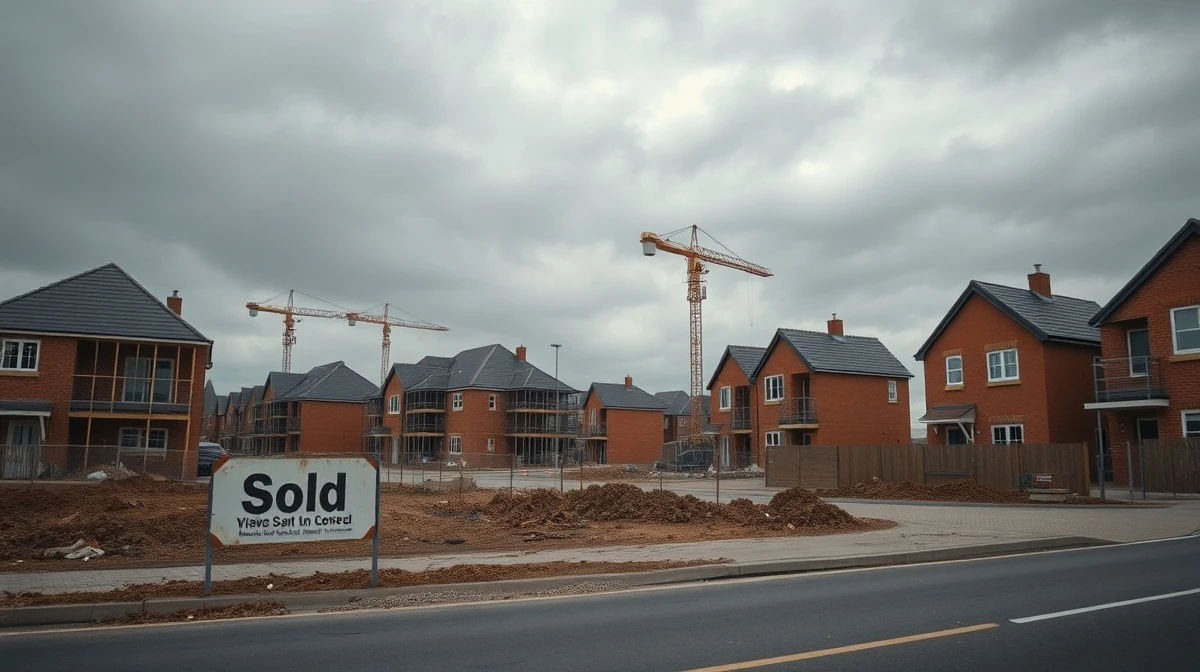
Major UK housebuilders are scaling back operations, cutting earnings guidance, and reducing land purchases as the combined pressures of geopolitical instability from the Iran conflict and persistently high interest rates dampen buyer demand. The pullback casts serious doubt on the government’s ambitious pledge to deliver 1.5 million new homes over the next five years.
Industry Retreat Signals Broader Slowdown
Several of the UK’s largest listed homebuilders have revised profit forecasts downward in recent weeks, citing a sharp decline in new home reservations and rising cancellation rates. The companies are also significantly reducing their land acquisition budgets, a move that typically signals a prolonged period of lower construction output. Industry analysts note that the current retrenchment mirrors patterns seen during the 2008 financial crisis, though the drivers are different.
Also read: Gold edges lower to near $4,150 as US–Iran peace uncertainty and hawkish Fed signals weigh
The Iran conflict has introduced a new layer of uncertainty, driving up energy costs and stoking inflation fears. This, in turn, has kept the Bank of England cautious about cutting interest rates, leaving mortgage rates elevated and squeezing household affordability. For prospective buyers, the combination of high borrowing costs and economic anxiety has led to a sharp pullback in demand, particularly in the first-time buyer segment.
Government Housing Target Under Threat
The government’s target of 1.5 million new homes by 2030 was already considered ambitious. With housebuilders now actively reducing output, many experts believe the goal is increasingly unattainable. The construction sector typically requires stable economic conditions and accessible financing to maintain production levels. Both conditions are now absent.
Also read: Gold Answers to the Fed, Not the Fear: Rate Cut Bets Drive Rally
Local authorities, who are also under pressure to approve planning applications faster, may find that even approved projects struggle to secure financing. The pullback in land purchases means that future supply pipelines are being cut now, with effects likely to be felt two to three years down the line.
Impact on Homebuyers and the Rental Market
The immediate consequence for consumers is a tighter housing market. Fewer new homes being built means less choice for buyers and continued upward pressure on rents, as the supply of available housing fails to keep pace with demand. First-time buyers, already struggling with high deposits and mortgage rates, face an even more constrained market.
Existing homeowners may also feel the effects, as reduced construction activity can slow the overall housing market, making it harder to sell properties at desired prices. The broader economic ripple effects include job losses in construction and related industries, which could further dampen consumer confidence.
Conclusion
The combination of geopolitical risk from the Iran conflict and sustained high interest rates has forced UK housebuilders into a defensive posture. While the government maintains its housing target rhetoric, the industry’s actions suggest a far more cautious outlook. The coming months will be critical in determining whether policy interventions can revive builder confidence and buyer demand, or whether the UK housing market faces a prolonged period of stagnation.
FAQs
Q1: Why are UK housebuilders cutting back on construction?
Housebuilders are responding to falling demand caused by high mortgage rates and economic uncertainty linked to the Iran conflict. This has led to lower sales volumes and reduced profitability, prompting them to scale back land purchases and new project starts.
Q2: How does the Iran war affect the UK housing market?
The conflict has contributed to global energy price volatility and inflationary pressure, making the Bank of England more cautious about cutting interest rates. This keeps mortgage costs high, reducing buyer affordability and confidence.
Q3: Can the government still meet its 1.5 million homes target?
Most analysts consider the target highly unlikely under current conditions. The industry’s retreat from land acquisition and construction suggests that the pipeline for new homes is shrinking, not growing, making the goal increasingly unattainable.