
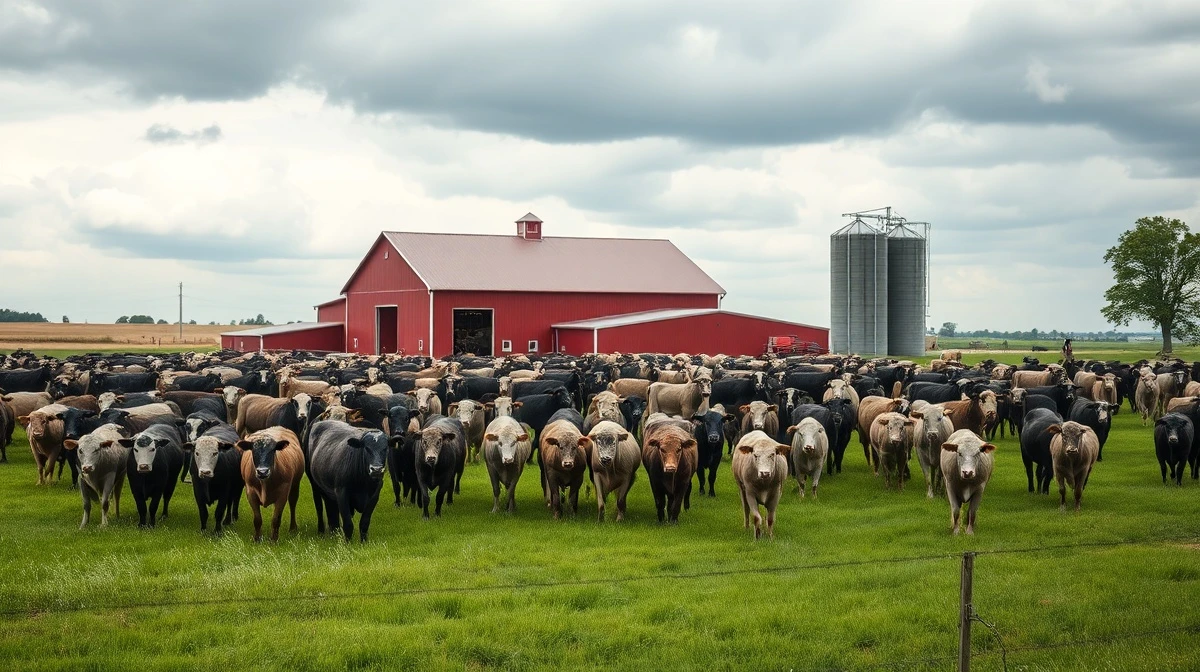
Live cattle futures ended Thursday’s trading session in negative territory, with contracts falling $2.80 to $3.92, despite a failed midday rally attempt. The decline came even as cash trade activity picked up, with southern deals reported at $256–$258 per hundredweight and northern trade at $258–$260, signaling underlying physical market strength.
Cash Market Resilience vs. Futures Weakness
The divergence between cash and futures markets is notable. Cash cattle trade, which had been slow to develop earlier in the week, gained momentum on Thursday with prices holding firm in the $256–$260 range. Analysts suggest the futures sell-off may reflect broader macroeconomic concerns or technical positioning rather than a deterioration in actual livestock demand.
Also read: SpaceX, OpenAI, and Anthropic: The AI IPO Wave That Could Reshape Public Markets
Feeder cattle futures suffered steeper losses, declining $6.07 to $6.87 on the day. The CME Feeder Cattle Index dropped $2.90 to $372.29 as of May 5, underscoring ongoing pressure in the feeder market.
Trade and Tariff Developments
Brazilian President Luiz Inácio Lula da Silva met with President Donald Trump in Washington, D.C., on Thursday to discuss trade and tariff policies. While few specific details were released, the meeting underscores the importance of U.S.-Brazil agricultural trade relations. Brazil is a major beef exporter, and any shifts in trade policy could affect global cattle prices.
Also read: SpaceX IPO Allocation Leaves Binance, Kraken Users Empty-Handed Despite Massive Demand
New World Screwworm and Export Data
The USDA’s Animal and Plant Health Inspection Service (APHIS) reported 1,702 active cases of New World screwworm in Mexico as of Wednesday, including 133 cases in the border state of Tamaulipas and 44 in Nuevo León. Three cases in Tamaulipas were within 96–97 miles of the U.S. border, keeping biosecurity concerns on the radar for cattle producers.
The weekly Export Sales report, covering the week ending April 30, showed 10,005 metric tons of beef sold for 2026 — the second-lowest weekly total this calendar year. Japan purchased 3,000 MT and Taiwan bought 2,500 MT. Shipments totaled 14,207 MT, a six-week high, with South Korea (4,400 MT) and Japan (3,600 MT) as top destinations.
Wholesale and Slaughter Data
Wholesale boxed beef prices declined in Thursday’s afternoon report. Choice boxes fell $2.68 to $386.94, while Select dropped $5.21 to $384.42. The Choice-Select spread narrowed to $2.52, reflecting slightly tighter demand for higher-grade product.
USDA estimated Thursday’s federally inspected cattle slaughter at 109,000 head, bringing the weekly total to 422,000 head — down 12,000 head from the prior week and 46,428 head below the same week last year.
Contract Settlements
- Jun 26 Live Cattle: $250.050, down $3.425
- Aug 26 Live Cattle: $245.900, down $3.000
- Oct 26 Live Cattle: $239.975, down $3.750
- May 26 Feeder Cattle: $366.325, down $6.075
- Aug 26 Feeder Cattle: $366.175, down $6.875
- Sep 26 Feeder Cattle: $364.650, down $6.650
Why This Matters
Thursday’s price action highlights a persistent disconnect between physical cash markets and futures sentiment. For cattle producers and feedlot operators, the ability to lock in favorable cash prices remains critical, especially as feeder cattle costs stay elevated and export demand shows signs of unevenness. The combination of biosecurity risks, trade policy uncertainty, and declining slaughter numbers suggests the cattle market is handling a complex arena.
FAQs
Q1: Why did live cattle futures fall when cash prices were strong?
The decline likely reflects technical selling, macroeconomic headwinds, or concerns about future demand rather than a weakening of the physical cash market. Cash trade at $256–$260 remains supportive for producers.
Q2: How does the New World screwworm situation affect U.S. cattle?
Active cases near the U.S.-Mexico border raise the risk of cross-border transmission. APHIS monitoring and containment measures are in place, but any escalation could disrupt cattle movements and increase costs for producers.
Q3: What does the drop in beef exports mean for the market?
Weekly export sales of 10,005 MT were the second-lowest of the year, suggesting softer international demand. However, shipments rose to a six-week high, indicating that previously booked orders are being fulfilled. Traders will watch for sustained export trends in coming weeks.

