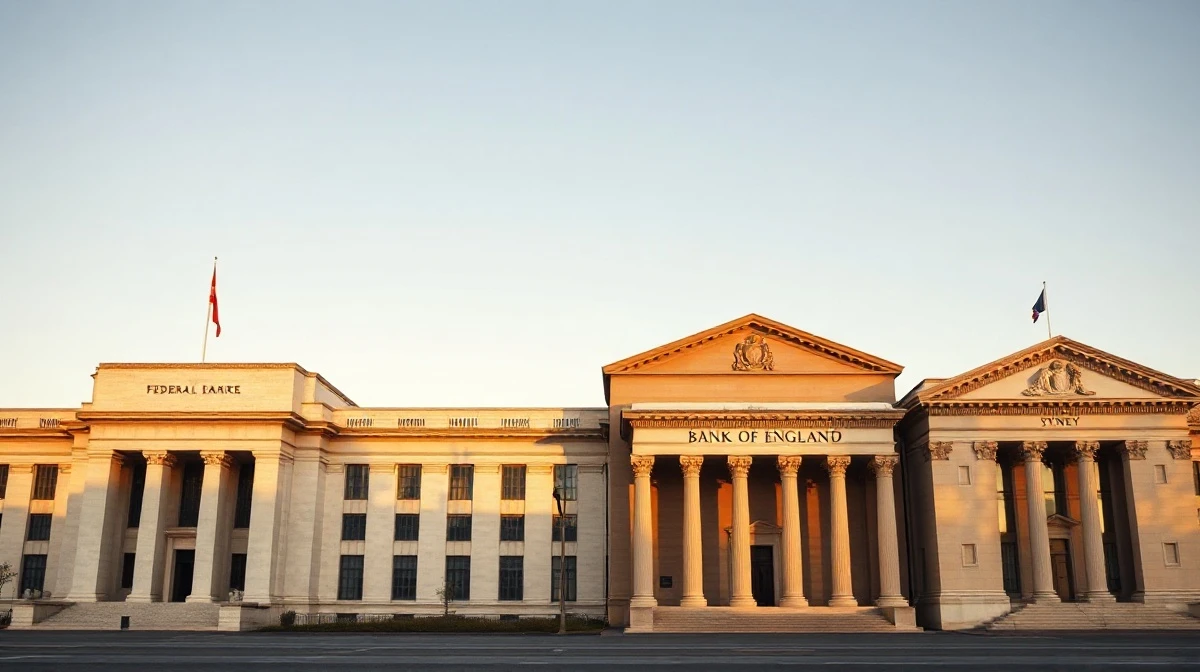
Investors face a packed week starting Monday, September 16, as four of the world’s most influential central banks — the U.S. Federal Reserve, the Bank of Japan, the Bank of England, and the Reserve Bank of Australia — all deliver monetary policy decisions within a 72-hour window. The cluster of meetings comes at a time when global inflation trends are diverging and growth signals are mixed, making each announcement potentially market-moving.
Federal Reserve: Rate Cut Expectations Firm
The Federal Open Market Committee (FOMC) concludes its two-day meeting on Wednesday, September 18. Markets are pricing in a high probability of a 25-basis-point cut, which would bring the federal funds rate to a range of 5.00%-5.25%. This would mark the first rate reduction since March 2020, when the Fed slashed rates to near zero at the onset of the pandemic.
Also read: Japanese Yen Surges Without Official Intervention as Markets Reprice Rate Bets
Recent data shows headline inflation cooling to 2.5% year-over-year in August, down from 2.9% in July, according to the Bureau of Labor Statistics. However, core inflation remains sticky at 3.2%, keeping some FOMC hawks cautious. The labor market has softened gradually, with nonfarm payrolls adding 142,000 jobs in August, below the six-month average of 202,000.
Fed Chair Jerome Powell’s press conference will be scrutinized for clues on the pace of further cuts. The dot plot — the FOMC’s quarterly summary of individual rate projections — will also be updated and is likely to show a median expectation for additional easing before year-end.
Also read: Silver slides toward two-month low as hawkish Fed bets strengthen dollar
Bank of Japan: A Potential Rate Hike Looms
The Bank of Japan announces its decision on Friday, September 20, and the outcome is far less certain. The BoJ raised its policy rate to 0.25% in July, its highest level since 2008, and markets are split on whether Governor Kazuo Ueda will deliver another hike this month.
Japan’s core CPI rose 2.7% year-over-year in July, above the BoJ’s 2% target, and wage growth has shown signs of broadening. The yen has strengthened sharply since July, moving from around 161 per dollar to the 140 area, which complicates the outlook for exporters and import prices. A stronger yen reduces import costs but also weighs on corporate profits for Japan’s large manufacturers.
A rate increase of 15-25 basis points is seen as a live possibility, but the BoJ may opt to hold steady and wait for more data, particularly given global growth uncertainty. Any hawkish surprise would likely trigger yen strength and pressure Japanese equities.
Bank of England: Hold Expected, But Divided Views
The Bank of England’s Monetary Policy Committee (MPC) announces its decision on Thursday, September 19. The MPC cut rates by 25 basis points in August to 5.00%, and the consensus is for a hold this month as policymakers assess the impact of that easing.
UK CPI inflation was 2.2% in August, slightly above the BoE’s 2% target but well below the double-digit peaks of late 2022. Services inflation, a key gauge of domestic price pressures, remains elevated at 5.2%. The labor market is showing signs of cooling, with the unemployment rate edging up to 4.1%.
The vote split will be important. In August, the decision was 5-4 in favor of cutting, with four MPC members preferring to hold. If more members shift toward another cut, that would signal a more dovish tilt. Governor Andrew Bailey has emphasized a data-dependent approach, leaving the door open for further easing if inflation continues to moderate.
Reserve Bank of Australia: Cash Rate Likely Unchanged
The Reserve Bank of Australia announces its decision on Tuesday, September 17. The RBA has held the cash rate at 4.35% since November 2023, and no change is expected this month. Inflation in Australia was 3.8% year-over-year in the second quarter, above the RBA’s 2-3% target band, but has been trending lower.
Governor Michele Bullock has maintained a hawkish tone, warning that the board is not ruling out further hikes if inflation proves persistent. However, the economy is slowing — GDP grew just 0.2% in the second quarter, the weakest pace since the pandemic-era contraction. The labor market remains tight, with the unemployment rate at 4.2%, but forward indicators point to softening.
The RBA’s updated economic forecasts, released alongside the decision, will be the key focus. Any downgrade to growth projections would reinforce expectations that the next move will be a cut, likely in early 2025.
Market Implications and What to Watch
The four decisions will affect currency markets, bond yields, and equity sectors differently. The dollar-yen pair is particularly sensitive to the Fed-BoJ policy divergence. If the Fed cuts and the BoJ holds or hikes, the yen could strengthen further, potentially breaking below 140. Conversely, a hawkish Fed hold and a dovish BoJ would likely reverse recent yen gains.
Global bond markets are also watching the Bank of England closely, as UK gilt yields serve as a benchmark for European fixed-income markets. A surprise BoE cut would likely push yields lower across the region.
For equity investors, the Fed’s decision carries the most weight. A rate cut would be broadly positive for U.S. stocks, particularly rate-sensitive sectors like real estate and utilities. However, if the cut is accompanied by a hawkish dot plot — signaling fewer cuts ahead — the initial relief rally could fade quickly.
This week’s central bank marathon will test the resilience of current market pricing. With inflation still above targets in several economies and growth slowing, the path forward for monetary policy remains uncertain. Investors should brace for volatility, especially around the Fed and BoJ announcements.