
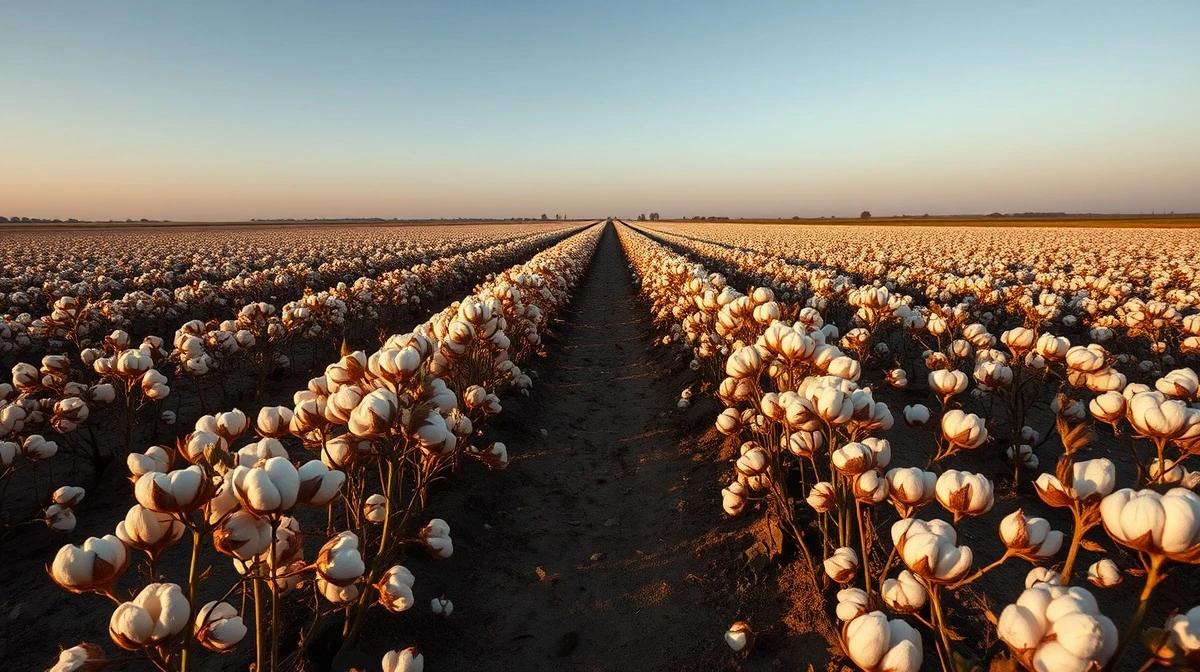
Cotton futures managed to trim early-session losses on Wednesday but still ended the day in negative territory, weighed down by a steep drop in crude oil prices and ongoing macroeconomic uncertainty. Contracts across the board fell between 31 and 75 points, with the most-active July 2026 contract settling at 84.05 cents per pound, down 75 points.
Crude Oil Decline Pressures Cotton
The primary driver of Wednesday’s weakness was a sharp selloff in crude oil, which fell by $6.06 per barrel. The decline followed reports that the United States and Iran are nearing a memorandum of understanding that could ease tensions in the Middle East, including provisions for safe passage through the Strait of Hormuz. Lower crude oil prices reduce the cost of polyester, a synthetic substitute for cotton, and can also signal weaker global demand, both of which weigh on cotton sentiment.
Also read: SpaceX, OpenAI, and Anthropic: The AI IPO Wave That Could Reshape Public Markets
Market Data and Fundamentals
Despite the bearish close, the market showed resilience by recovering from its worst levels of the session. The U.S. dollar index slipped 0.420 points to 97.890, providing some support for dollar-denominated commodities. Meanwhile, the Cotlook A Index, a key benchmark for world cotton prices, rose 75 points to 92.80 cents per pound on Tuesday, indicating firmness in international physical trade.
On the domestic front, The Seam reported sales of 7,483 bales on May 5 at an average price of 79.55 cents per pound. ICE certified cotton stocks increased by 1,760 bales to 181,952 bales, reflecting adequate near-term supply. The Adjusted World Price (AWP) was raised by 40 points to 65.66 cents per pound, effective through Thursday, which could influence farmer selling decisions.
Also read: SpaceX IPO Allocation Leaves Binance, Kraken Users Empty-Handed Despite Massive Demand
Why This Matters for Traders and Producers
The interplay between geopolitical developments and commodity markets remains a key theme. While a potential US-Iran deal could reduce energy costs and inflationary pressures, it also introduces uncertainty about global trade flows. For cotton producers, the lower AWP means reduced loan deficiency payments, potentially encouraging more cash sales. For textile mills, lower cotton prices could improve margins if demand holds steady.
Conclusion
Wednesday’s session highlighted cotton’s sensitivity to external markets, particularly crude oil. The ability to recover from early lows suggests underlying support, but the market remains vulnerable to further volatility as geopolitical and macroeconomic events unfold. Traders will watch for weekly export sales data and weather developments in key growing regions for further direction.
FAQs
Q1: Why did crude oil prices fall so sharply on Wednesday?
Crude oil dropped over $6 per barrel amid reports that the US and Iran are close to a memorandum of understanding that could include safe passage through the Strait of Hormuz and a path to ending conflict, potentially increasing global oil supply.
Q2: What is the Adjusted World Price (AWP) and why does it matter?
The AWP is a USDA-calculated benchmark price used to determine loan deficiency payments and marketing loan gains for US cotton producers. A higher AWP reduces government subsidies, which can influence farmer selling behavior.
Q3: How do ICE certified cotton stocks affect prices?
ICE certified stocks represent cotton stored in exchange-approved warehouses that can be delivered against futures contracts. Rising stocks indicate ample near-term supply, which can put downward pressure on futures prices.

