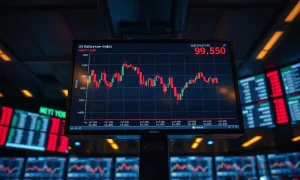
The highest long-dated US Treasury yields in nearly two decades delivered almost no lift to the Dollar Index on Tuesday, with the currency benchmark closing a session range of just 17 pips to hold above 99.50. The index remains pinned beneath its flat 200-day Exponential Moving Average (EMA) near 99.75, a level that has capped every upside attempt for a fortnight.
The disconnect between the bond market and the currency is turning heads in forex circles. Historically, a move of this magnitude in long-end yields — driven by term premium repricing and sticky inflation expectations — would typically provide a solid bid for the greenback. That it has failed to do so suggests the dollar’s yield advantage is no longer the dominant force it once was in setting the currency’s direction.
Also read: Swiss Franc Gains Favor as Funding Currency as Yen Intervention Risk Looms, ING Says
Why the Dollar Is Ignoring Higher Yields
The muted price action points to a market that had already positioned for this exact scenario. The move in yields has been gradual and well-telegraphed, allowing investors to price it in ahead of time. More importantly, the driver behind the yield spike matters. When yields rise on strong growth expectations, the dollar tends to benefit. When they rise on supply concerns or fiscal worries — as is the case now, with the US Treasury’s increased issuance schedule — the currency’s reaction is far more ambiguous.
Adding to the pressure is the global dimension. While US yields are climbing, so are yields in other major economies. The European Central Bank and the Bank of Japan have both signaled a slower pace of easing than previously anticipated, narrowing the interest rate differential that has been a key pillar of dollar strength since 2022. The Dollar Index, which measures the greenback against a basket of six major currencies, is therefore finding little traction even as the US bond market moves.
Also read: Dollar Index Fails at 200-Day EMA as Washington's Fiscal Pressures Weigh
Technical Picture: A Ceiling at 99.75
From a chart perspective, the story is one of compression. The 200-day EMA near 99.75 has acted as a hard ceiling, and the index has been grinding sideways below it for two weeks. Spot is hovering just above 99.50, with immediate support emerging at the 99.40 area, a level that has held firm in recent sessions.
A break above the 200-day EMA would open the door to a test of the 100.00 psychological level, but momentum indicators remain mixed. The Relative Strength Index is hovering near the neutral 50 mark, suggesting neither buyers nor sellers are in full control. For now, the market is waiting for a catalyst — likely in the form of the next Federal Reserve policy signal or a shift in global risk sentiment.
What This Means for Forex Traders
For traders, the takeaway is that yield-driven dollar trades are losing their reliability. The correlation between the 10-year Treasury yield and the Dollar Index has weakened measurably over the past quarter, and relying on that relationship alone could lead to repeated whipsaws. Currency markets are increasingly trading on relative growth outlooks and carry considerations rather than on the absolute level of US yields.
The Federal Reserve’s upcoming meeting will be the next major test. If the central bank pushes back against market pricing for rate cuts, the dollar could finally find its footing. But if it signals tolerance for higher long-end yields, the current disconnect may persist, leaving the Dollar Index stuck in its narrow range. With the 200-day EMA flat and volatility compressed, the path of least resistance remains sideways until a decisive break occurs.