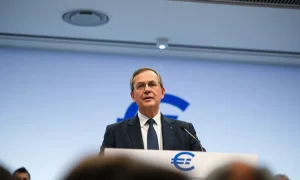
The European Central Bank’s outgoing Vice-President, Luis de Guindos, has publicly criticized the German government’s resistance to UniCredit’s takeover bid for Commerzbank, warning that political intervention in cross-border banking mergers undermines the European Union’s single market. Speaking in an interview, de Guindos stated that Berlin’s stance goes “against the spirit of the single market,” adding that such interference could discourage much-needed consolidation in Europe’s fragmented banking sector.
Background of the Bid and Political Pushback
Italy’s UniCredit, one of Europe’s largest banking groups, has been pursuing a strategic acquisition of Commerzbank, Germany’s second-largest private lender, in what would be one of the most significant cross-border banking mergers in the eurozone. The German government, which still holds a 12% stake in Commerzbank following its post-financial crisis bailout, has expressed strong reservations about the deal, citing concerns over national economic interests, job security, and the potential loss of control over a key domestic financial institution.
Also read: How to Surf Turbulent Markets: A Guide for Investors
Chancellor Olaf Scholz’s administration has signaled it would prefer a German-led solution, potentially involving domestic consolidation, rather than allowing a foreign takeover. This position has drawn sharp criticism from de Guindos, who argued that political interference in such transactions sets a dangerous precedent for the EU’s financial integration project.
De Guindos’ Intervention and Its Implications
De Guindos, a former Spanish economy minister who has served as ECB vice-president since 2018, made his remarks during a farewell interview before stepping down from his role. His comments carry weight because the ECB is the primary banking supervisor for the eurozone, and its leadership has long advocated for deeper cross-border integration to create a more resilient and competitive European banking market.
Also read: Gold edges lower to near $4,150 as US–Iran peace uncertainty and hawkish Fed signals weigh
“If we want a true banking union, we cannot have member states picking and choosing which cross-border mergers they accept based on national preferences,” de Guindos said. He emphasized that the single market rules are designed to allow capital and services to flow freely across borders, and that political opposition to legitimate commercial transactions undermines the credibility of the entire framework.
Why This Matters for European Banking
The dispute highlights a fundamental tension within the EU’s banking union project. While regulators and central bankers in Frankfurt and Brussels have pushed for consolidation to create larger, more diversified banks capable of competing globally, national governments in countries like Germany, France, and Italy have often resisted foreign takeovers of domestic lenders. This has left Europe with a banking sector that remains heavily fragmented along national lines, with many small and mid-sized banks that are less efficient and more vulnerable to economic shocks.
For investors and market analysts, the outcome of the UniCredit-Commerzbank saga will be seen as a bellwether for the future of cross-border M&A in European banking. If Berlin successfully blocks or significantly alters the deal, it could deter other potential acquirers and reinforce the perception that national interests still trump EU integration when it comes to banking.
Reactions and Next Steps
The German Finance Ministry has not issued a direct response to de Guindos’ comments, but officials have privately reiterated that the government’s role as a shareholder gives it legitimate grounds to evaluate the deal’s impact on German economic stability and employment. UniCredit has so far maintained a public stance of seeking a constructive dialogue with German authorities, though the bank’s CEO, Andrea Orcel, has made clear that the strategic rationale for the acquisition remains strong.
The ECB is expected to review the deal as part of its supervisory responsibilities, while the European Commission may also examine it for compliance with EU competition and single market rules. Political analysts suggest that the standoff could ultimately require mediation at the highest levels of EU leadership to resolve.
Conclusion
Luis de Guindos’ intervention has brought the simmering conflict between EU integration ambitions and national economic sovereignty into sharp focus. As the eurozone grapples with slow growth, rising interest rates, and global competitive pressures from U.S. and Chinese banks, the ability to execute cross-border mergers may prove critical to the long-term health of the European banking system. Whether Berlin will relent or double down on its opposition remains uncertain, but the debate has clearly moved from boardrooms to the highest levels of European policymaking.
FAQs
Q1: Why is the German government opposing UniCredit’s bid for Commerzbank?
The German government holds a 12% stake in Commerzbank from its post-2008 bailout and has expressed concerns about losing control over a major domestic lender, potential job losses, and the impact on national economic interests. Berlin has indicated a preference for a German-led consolidation solution.
Q2: What did ECB Vice-President Luis de Guindos say about the situation?
De Guindos stated that the German government’s opposition goes “against the spirit of the single market,” arguing that political interference in cross-border banking mergers undermines the EU’s banking union project and discourages necessary consolidation in the sector.
Q3: What could happen next in the UniCredit-Commerzbank takeover process?
The ECB will review the deal under its supervisory mandate, and the European Commission may examine it for compliance with EU rules. Political negotiations between Berlin, Rome, and EU institutions are likely, and the outcome could set a precedent for future cross-border bank mergers in Europe.