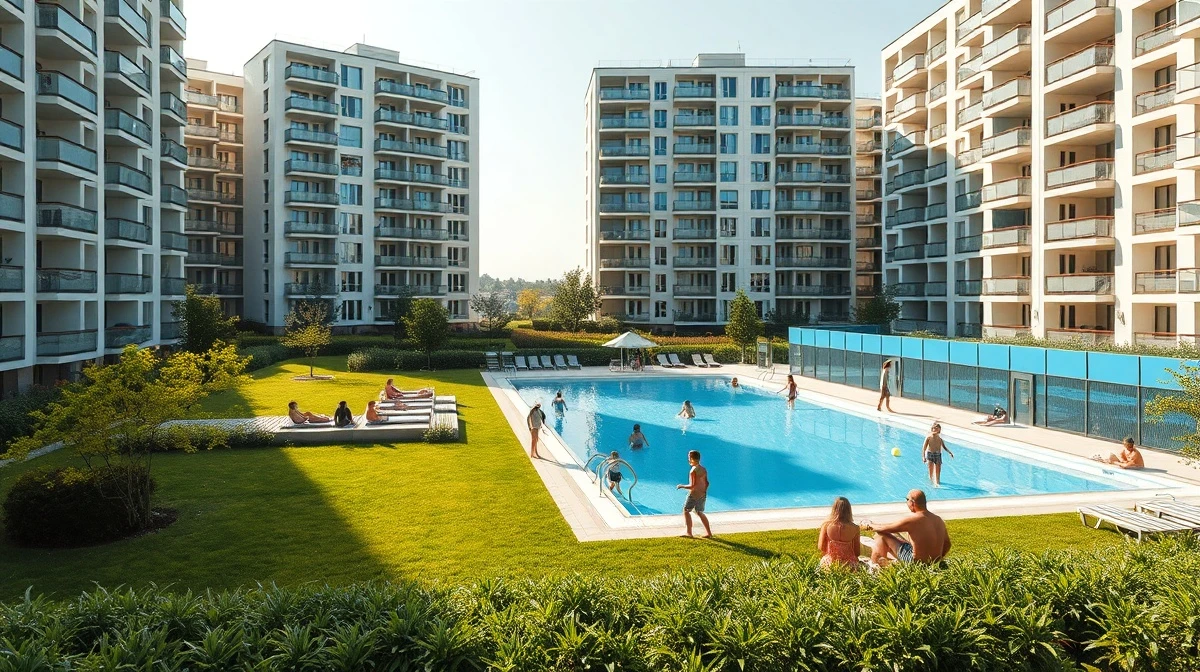
Vienna’s Alterlaa social housing development has become a global benchmark for affordable living, offering residents not just low rents but also access to 20 saunas and 14 swimming pools. With a five-year waiting list for apartments, the scheme challenges assumptions about public housing and provides a compelling case study for the UK Labour Party as it considers its own housing reforms.
How Alterlaa redefined social housing
Completed in the 1980s, Alterlaa is a large-scale residential complex in Vienna’s 23rd district. It houses thousands of residents in high-rise towers surrounded by extensive green spaces. What sets it apart is the inclusion of premium amenities—pools, saunas, gardens, and communal areas—funded through a non-profit housing model that keeps costs low. Rents are set at cost-recovery levels, not market rates, making high-quality living accessible to a broad income range.
Also read: How to Surf Turbulent Markets: A Guide for Investors
Why Labour is looking at Vienna
The UK faces a chronic housing shortage, with rising rents and declining homeownership. Labour has pledged to build 1.5 million homes and reform planning rules. Alterlaa offers a proven alternative: publicly-led, non-profit development that prioritizes long-term affordability over speculative profit. The model shows that high-density housing can be desirable when paired with generous communal amenities and strong management.
What the numbers reveal
Alterlaa’s waiting list runs five years long, reflecting demand that far exceeds supply. Residents pay around €6 per square meter monthly—roughly half the Vienna private market average. The complex also includes shops, doctors’ offices, and a kindergarten, creating a self-contained community. For UK policymakers, the lesson is clear: quality and scale can coexist in public housing if the funding structure is designed for social benefit rather than developer returns.
Also read: Gold edges lower to near $4,150 as US–Iran peace uncertainty and hawkish Fed signals weigh
Conclusion
Vienna’s Alterlaa demonstrates that social housing need not be synonymous with austerity. Its combination of affordability, density, and high-quality amenities offers a replicable template. For Labour, the challenge lies not in vision but in execution—securing land, reforming finance, and committing to long-term stewardship. If the UK can adapt even parts of this model, it could transform the housing debate.
FAQs
Q1: What makes Alterlaa different from typical UK social housing?
A: Alterlaa includes extensive amenities like pools and saunas, is managed by a non-profit cooperative, and sets rents at cost-recovery levels rather than market rates.
Q2: Could this model work in the UK?
A: Yes, but it requires public land, patient capital, and a shift away from developer-led profit models. Some London boroughs are already experimenting with similar approaches.
Q3: How long is the waiting list for Alterlaa?
A: Approximately five years, reflecting high demand and limited turnover. This underscores the need for more such developments.