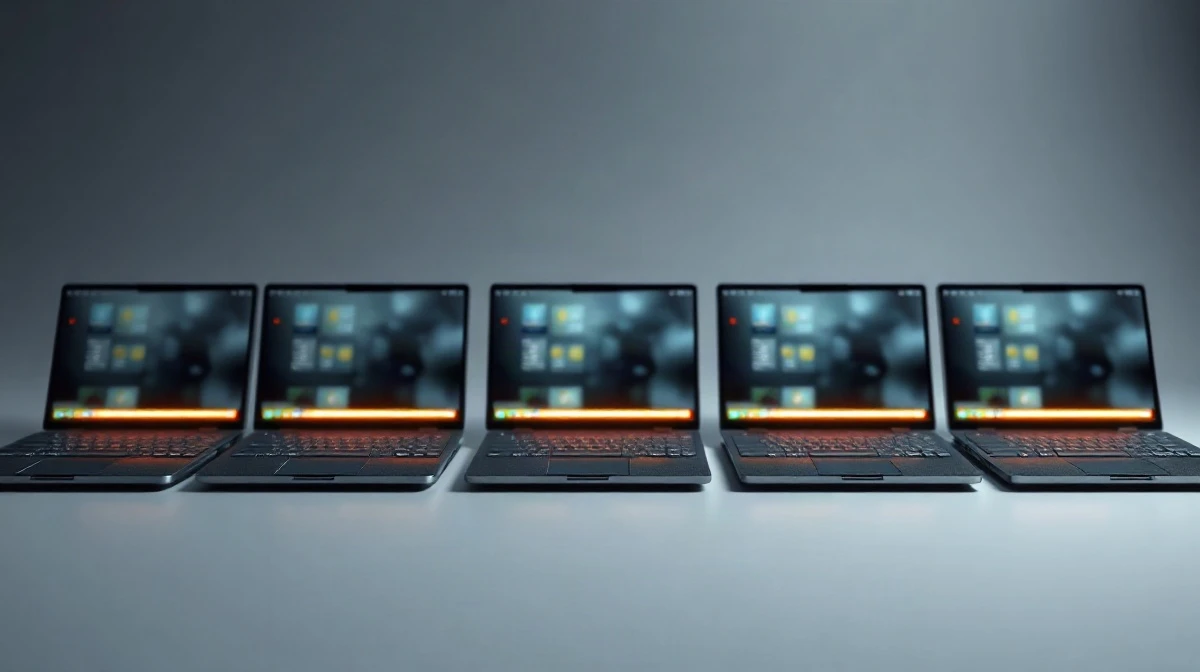
Google opened preorders on Monday for five Googlebook laptops priced from $899, the first machines built to the company’s new Googlebooks standard, Wired reported. The lineup comes from HP, Dell, Lenovo, Acer and Asus, and the computers reach store shelves on October 4.
The launch follows a first tease in May and a media-only event in New York City last week where Google detailed the operating system. The machines start at $899 and every purchase includes a full year of Google AI Pro with 5 terabytes of storage. According to Techcrunch, preorders are open on the Google Store, Best Buy and other retailers.
Also read: US Chip Industry Faces Shortage of Up to 157,000 Workers by 2030, Report Warns
Key facts
- Five Googlebooks launched on September 21, 2026: the Acer Googlebook 14 at $899, the Dell XPS Googlebook at $1,199, and the HP Googlebook 14, Lenovo Googlebook 15 and Asus Googlebook 14 at $1,299 each.
- All are clamshells except the Acer, which is a 2-in-1. Preorders opened the same day, with US shelves on October 4 and Canada, the UK, Ireland, France, Germany and Australia on October 5, per Techcrunch.
- Machines run Qualcomm’s Snapdragon X Elite or Intel’s Core Ultra 3; MediaTek supports the platform with its Dimensity CX C10 Max chip, but no launch laptop uses it.
- Google’s hardware standards require at least 16 GB of RAM, more than 45 TOPS, a touchscreen, a backlit keyboard, a haptic trackpad, Dolby Atmos speakers and at least 14 hours of battery life, plus 10 years of software updates.
- Every Googlebook carries the Glowbar, the signature LED strip Google previously used on its original Chromebook Pixel.
Android phone continuity comes to the laptop
The pitch mirrors what Apple has long offered iPhone and Mac owners: link an Android phone and Wi-Fi networks, passwords, settings, messages, contacts and photos move to the laptop. Apps are sorted into three tiers on the Play Store, “Made for Desktop,” “Optimized for Desktop” and “Better on the Website,” with Facebook cited as an example of the last group. Wired reported that roughly 20 apps are already optimized or made for desktop, including CapCut, Adobe Photoshop, Notability and Fantastical.
Google says more than 20,000 Play Store titles are available, with about 50 of the top 100 optimized for keyboard, trackpad and touchscreen. Because AAA games cannot be downloaded to a Googlebook yet, especially without a discrete GPU, buyers get a year of Nvidia’s GeForce Now streaming. Features include “Continue on” task handoffs, app casting for phone-only services like DoorDash, and a “Link to iOS” app for iPhone owners that Wired notes offers less breadth than the Android path.
Also read: ClickFix Scams Spread Through Hijacked HBO Max Reddit Ads, Researchers Say
Sameer Samat, president of the Android ecosystem, said at the event that laptops were largely designed decades ago, before mobile devices existed, and that reinventing them is a multi-year effort starting with the Android community. Google merged Android’s mobile-first system with ChromeOS; Chromebooks continue for schools and budget buyers, and a distinct OS is optimized for x86 and ARM chips.
Gemini sits at the cursor
The headline AI feature is Magic Pointer, which summons Gemini actions by wiggling the cursor over on-screen content, such as turning an invitation into a calendar event or checking an email for phishing. Rambler, Google’s voice dictation engine that strips filler words and restates, is built in and reachable through the Quick Insert key. Users can also generate desktop widgets by prompt, and the keyboard carries a dedicated G key for Gemini.
Techcrunch questioned how much these features will drive purchases, comparing Magic Cursor to Android’s Circle to Search, which did not trigger a mass shift to Android, and calling Rambler useful but not essential. Techcrunch reported that Gemini Spark and Gemini Live do not require new hardware, and framed the device as part of a longer effort to move the roughly 50 million Chromebooks in schools toward Gemini. Google has said 10 years of updates are planned for the new devices.
Why it matters
Googlebooks give Google a hardware route into the AI-assistant race at the desktop, a space where Apple’s Mac ecosystem and Microsoft’s Windows laptops already compete. For buyers, the practical question is whether tighter Android phone pairing and Gemini features justify replacing a Chromebook or an older Windows machine. The three app tiers also put pressure on developers: Google is asking them to rebuild mobile apps for a desktop layout, and the size of that catalog will shape how useful these laptops feel beyond the browser.
What to watch
The October 4 US retail date and October 5 overseas launches will show whether preorders convert into sales, and whether Google says more about a laptop of its own under the Made by Google Pixel division, which it has not confirmed. Developer uptake of the “Made for Desktop” tier and any shift of Chromebooks toward the Googlebook experience are the next markers to track. This is not financial advice, and markets and product roadmaps remain uncertain.

Sources: Wired, Techcrunch