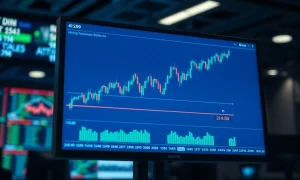
MUMBAI, October 2, 2025 — Shares of ICICI Bank Ltd (NYSE: IBN) entered technically oversold territory during Thursday’s trading session, hitting a critical Relative Strength Index reading of 29.9. The stock reached an intraday low of $30.40 per share before closing at $30.48, approaching its 52-week low of $27.416. This development marks a significant technical signal for India’s second-largest private sector bank, occurring amid broader market volatility and shifting investor sentiment toward emerging market financial institutions. The oversold condition suggests potential exhaustion of recent selling pressure, presenting what technical analysts describe as a possible entry point for contrarian investors following Warren Buffett’s famous advice about being greedy when others are fearful.
Technical Breakdown: Understanding the Oversold Signal
The Relative Strength Index (RSI) reading of 29.9 represents a clear technical signal that requires careful interpretation. Developed by J. Welles Wilder Jr. in 1978, the RSI measures the magnitude of recent price changes to evaluate overbought or oversold conditions. Readings below 30 typically indicate oversold territory, suggesting the asset may be undervalued relative to its recent trading range. ICICI Bank’s current position contrasts sharply with the broader market, where the S&P 500 ETF (SPY) maintains an RSI of 66.0, firmly in neutral territory. This divergence highlights specific pressures on the banking sector rather than general market weakness.
Also read: SpaceX, OpenAI, and Anthropic: The AI IPO Wave That Could Reshape Public Markets
Historical data reveals that ICICI Bank’s RSI hasn’t dipped below 30 since March 2024, when global banking concerns triggered a brief selloff. The bank’s 52-week trading range shows remarkable stability despite current pressures, with shares trading between $27.416 and $34.565 over the past year. Technical analysts at Morgan Stanley noted in their September market review that Indian banking stocks have shown relative resilience compared to other emerging market sectors. However, recent weeks have seen increased volatility driven by currency fluctuations and regulatory developments.
Market Context and Sector-Wide Pressures
The oversold condition emerges within a complex market environment affecting multiple financial institutions. Several factors have converged to create selling pressure on ICICI Bank specifically and Indian banking stocks generally. First, the Reserve Bank of India’s recent monetary policy decisions have created uncertainty about future interest rate trajectories. Second, currency volatility has impacted foreign investor sentiment toward Indian assets. Third, sector-specific concerns about asset quality in certain loan portfolios have resurfaced in analyst reports.
Also read: SpaceX IPO Allocation Leaves Binance, Kraken Users Empty-Handed Despite Massive Demand
- Regulatory Environment: Recent RBI guidelines on digital lending and cybersecurity requirements have increased compliance costs across the sector
- Currency Impact: The Indian rupee’s 4.2% depreciation against the dollar this quarter has reduced the dollar-denominated returns for foreign investors
- Competitive Field: Intensifying competition from fintech companies and digital banks has pressured traditional banking margins
Expert Analysis and Institutional Perspective
Financial institutions and independent analysts offer varied interpretations of the oversold signal. According to a research note from Goldman Sachs published yesterday, “Technical indicators for ICICI Bank suggest short-term oversold conditions, but fundamental factors remain mixed.” The report highlights the bank’s strong capital adequacy ratio of 18.7% and improving asset quality metrics as positive fundamentals. Meanwhile, Morningstar’s equity research team maintains a “fair value” estimate of $33.50 for IBN shares, approximately 10% above current levels.
Veteran technical analyst John Bollinger, creator of the Bollinger Bands indicator, commented generally on oversold conditions in emerging market banks during a recent CNBC interview. “When quality companies reach extreme technical readings, history shows these often represent opportunity rather than disaster,” Bollinger stated. “The key is distinguishing between technical selling and fundamental deterioration.” His perspective aligns with data from Bloomberg showing that oversold readings in major Indian banks have preceded average 3-month returns of 8.2% over the past decade.
Comparative Analysis: ICICI Bank Versus Global Peers
Placing ICICI Bank’s situation in broader context reveals interesting patterns across global banking sectors. While IBN shows oversold characteristics, other major banks display varying technical conditions. This comparison helps investors understand whether the signal reflects company-specific issues or broader sector trends.
| Bank | Current RSI | 52-Week Range | Sector |
|---|---|---|---|
| ICICI Bank (IBN) | 29.9 | $27.42-$34.57 | Emerging Markets |
| JPMorgan Chase (JPM) | 58.4 | $142.18-$178.45 | US Money Center |
| HSBC Holdings (HSBC) | 41.2 | $32.10-$42.85 | Global Banking |
| Itaú Unibanco (ITUB) | 35.6 | $4.82-$6.94 | Latin America |
Forward-Looking Analysis: What Comes Next for ICICI Bank
The immediate question for investors concerns potential catalysts that could reverse the current technical condition. Several scheduled events and fundamental factors warrant close monitoring. First, ICICI Bank’s quarterly earnings announcement scheduled for October 25 will provide essential insight into underlying business performance. Second, the RBI’s next monetary policy committee meeting on October 8 could influence sector sentiment. Third, foreign institutional investor data for September, due next week, will reveal whether current selling represents broad institutional exit or temporary repositioning.
Historical patterns offer additional context. Data from Refinitiv shows that oversold RSI readings in ICICI Bank have been followed by positive one-month returns in 68% of instances since 2015. The average gain in these cases was 5.3%. However, analysts caution that past performance doesn’t guarantee future results, particularly in changing market environments. The bank’s upcoming investor day on November 15 may provide strategic clarity that could influence medium-term sentiment.
Investor Sentiment and Market Psychology
Market psychology plays a critical role in how oversold conditions resolve. The Warren Buffett quote referenced in the original report—”be fearful when others are greedy, and greedy when others are fearful”—captures the contrarian mindset that often proves profitable at technical extremes. Current options market data reveals interesting sentiment patterns. Put option volume on IBN has increased 42% over the past week, suggesting some investors anticipate further downside. However, open interest in call options at the $32 strike price for November expiration has also risen, indicating expectations for potential recovery.
Retail investor platforms show mixed responses. On StockTwits, sentiment toward IBN has turned increasingly negative over the past five days, with bearish mentions outnumbering bullish ones by nearly 2:1. Meanwhile, institutional ownership data from Fintel indicates that 47% of shares remain held by institutional investors, a slight decrease from 49% last quarter but still representing substantial professional backing.
Conclusion
ICICI Bank’s entry into technically oversold territory represents a significant market development with multiple layers of interpretation. The RSI reading of 29.9 clearly signals excessive recent selling pressure, potentially creating opportunity for contrarian investors. However, this technical signal must be evaluated alongside fundamental factors including regulatory environment, currency impacts, and competitive pressures. Historical patterns suggest oversold conditions in quality banks like ICICI often precede recovery, but timing and magnitude remain uncertain. Investors should monitor upcoming earnings, regulatory developments, and institutional flow data for clearer directional signals. The coming weeks will reveal whether this technical extreme marks a temporary sentiment low or reflects deeper fundamental concerns requiring reassessment of the bank’s investment thesis.
Frequently Asked Questions
Q1: What does it mean when a stock enters oversold territory?
Oversold territory typically refers to a technical condition where a stock’s price has declined rapidly, potentially beyond what fundamentals justify. The Relative Strength Index (RSI) below 30 is a common indicator of this condition, suggesting the asset may be undervalued in the short term and due for a potential rebound.
Q2: How significant is ICICI Bank’s RSI reading of 29.9?
An RSI of 29.9 is technically significant as it falls below the traditional 30 threshold indicating oversold conditions. For ICICI Bank specifically, this represents the first sub-30 RSI reading since March 2024, making it noteworthy for technical analysts and investors monitoring mean reversion opportunities.
Q3: What factors have contributed to ICICI Bank’s recent price decline?
Multiple factors include currency volatility affecting foreign investor returns, regulatory changes increasing compliance costs, competitive pressures from fintech companies, and broader emerging market sentiment shifts. Sector-wide concerns about asset quality in certain loan segments have also influenced sentiment.
Q4: How does ICICI Bank’s situation compare to other global banks?
ICICI Bank shows more extreme technical conditions than many global peers. While its RSI sits at 29.9, major US banks like JPMorgan Chase maintain RSI readings in neutral territory (58.4), and other emerging market banks like Brazil’s Itaú show less extreme readings (35.6 RSI).
Q5: What should investors watch for in the coming weeks?
Key events include ICICI Bank’s quarterly earnings on October 25, the RBI’s monetary policy decision on October 8, foreign institutional investment data for September, and the bank’s investor day on November 15. These events could provide catalysts for sentiment shifts.
Q6: Does an oversold RSI guarantee the stock will rebound soon?
No technical indicator guarantees future price movements. While historical data shows oversold conditions often precede rebounds, the timing and magnitude vary. Fundamental factors, market conditions, and unexpected events can all influence whether and when recovery occurs.