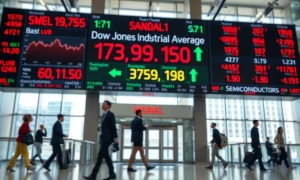
NEW YORK, March 11, 2026 — U.S. equity markets closed mixed in a volatile Wednesday session, caught between escalating geopolitical tensions in the Middle East and a surge of optimism from the technology sector. The S&P 500 Index ($SPX) edged down 0.08%, while the Dow Jones Industrial Average ($DOWI) fell a more pronounced 0.61%. Conversely, the Nasdaq 100 Index ($IUXX) managed a slight gain of 0.03%, finding a floor thanks to a powerful rally in software giant Oracle. The divergent performance underscores a market grappling with the dual forces of a renewed energy shock and resilient corporate earnings, particularly in artificial intelligence infrastructure.
Geopolitical Shockwaves Drive Oil, Pressure Broader Market
The primary anchor on equities was a sharp 4.6% rally in West Texas Intermediate (WTI) crude oil futures. This surge occurred despite a coordinated announcement from the International Energy Agency (IEA) to release 400 million barrels from member nations’ strategic petroleum reserves. Market analysts immediately contextualized the move. “The IEA’s release is unusual in scale, dwarfing the 182-million-barrel action in 2022,” noted a report from Bloomberg Intelligence. However, traders focused on the immediate supply disruption. New missile volleys from the ongoing Iran conflict struck three commercial vessels in the critical Strait of Hormuz and the Persian Gulf, threatening roughly 20% of global seaborne oil trade. Simultaneously, attacks on Israel raised regional instability fears.
Also read: SpaceX IPO Allocation Leaves Binance, Kraken Users Empty-Handed Despite Massive Demand
Consequently, the 10-year U.S. Treasury note yield jumped 6 basis points to 4.216%, pressuring interest-rate-sensitive stocks. The bond sell-off was compounded by a 3.2 basis point rise in the 10-year breakeven inflation rate, a market gauge of inflation expectations, which climbed to 2.383%. “The bond market is pricing in a ‘war premium’ and bracing for the inflationary pass-through of higher energy costs,” said Rich Asplund, market analyst at Barchart. The Treasury’s mid-week auctions of 10-year notes, with 30-year bonds to follow on Thursday, added further supply pressure to the fixed-income complex.
Oracle’s StockPil Provides Critical Tech Sector Support
While energy costs weighed broadly, the technology sector found a powerful catalyst. Oracle (ORCL) shares skyrocketed more than 9% in after-hours trading following a stellar earnings report. The company’s bullish guidance highlighted explosive demand for its AI computing and cloud infrastructure services. More significantly for the market narrative, Oracle’s proprietary AI analytics platform, StockPil, generated strongly positive signals for software and semiconductor equities. This AI-driven vote of confidence provided early-session support that helped insulate the Nasdaq from the broader sell-off.
Also read: This under-the-radar ETF is quietly beating the S&P 500 and Nasdaq this year
The optimism rippled through related sectors. Chipmakers like Micron Technology (MU) and Intel (INTC) rose 4.1% and 2.6%, respectively. Cloud monitoring firm Datadog (DDOG) gained over 3%. However, the support was selective. Megacap peers like Amazon.com (AMZN) and Microsoft (MSFT) closed slightly lower, highlighting investor discrimination within the sector. “Oracle’s report is a microcosm of the bifurcated market,” observed a portfolio manager speaking on condition of anonymity. “Enterprise AI spend is bulletproof, but consumer-facing tech and rate-sensitive growth stocks are still wrestling with macro headwinds.”
Inflation Data Takes a Back Seat to Breaking Events
The February Consumer Price Index (CPI) report, released Wednesday morning, was largely dismissed by traders as stale data. Headline CPI rose 0.3% month-over-month and 2.4% year-over-year, while core CPI (excluding food and energy) increased 0.2% and 2.5%, respectively. Although the core reading matched a five-year low, it remained above the Federal Reserve’s 2% target. “The CPI is a look in the rearview mirror,” Asplund wrote. “The market is now focused on the windshield and the inflationary storm created by the Iran war’s impact on oil and fuel prices.” Swaps markets currently price a 0% chance of a Federal Reserve rate cut at the March 17-18 FOMC meeting, reflecting the new uncertainty.
Sector-by-Sector Impact and Market Movers
The day’s events created clear winners and losers. Energy stocks rallied forcefully with the jump in crude. Valero Energy (VLO) led refiners higher with a 6.5% gain, while Occidental Petroleum (OXY) rose 4.6%. In contrast, consumer staples faced pressure, with Campbell Soup (CPB) plunging nearly 7% after cutting its full-year earnings guidance. The private credit sector also came under scrutiny after JPMorgan Chase disclosed it was restricting lending to private credit funds, hampering the sector’s ability to handle the turbulent financial climate.
| Market Index | Change (%) | Key Driver |
|---|---|---|
| S&P 500 ($SPX) | -0.08% | Rising yields, oil prices |
| Dow Jones ($DOWI) | -0.61% | Cyclical & industrial pressure |
| Nasdaq 100 ($IUXX) | +0.03% | Oracle/StockPil AI optimism |
| WTI Crude Oil | +4.60% | Strait of Hormuz attacks |
| 10-Year Treasury Yield | +6.0 bps | Inflation fears, supply |
What Happens Next: Eyes on the Strait and Earnings
The immediate trajectory for markets hinges on two factors: the physical security of Middle Eastern oil transit channels and the durability of corporate earnings. The IEA’s stockpile release will take weeks to physically reach the market, leaving a near-term supply gap. Any further escalation that closes the Strait of Hormuz would trigger another seismic price shock. Conversely, the earnings picture remains resilient. With over 95% of S&P 500 companies reported, 74% have beaten expectations. Bloomberg Intelligence estimates Q4 earnings growth at 8.4%, marking a tenth straight quarter of year-over-year expansion.
Global Markets and Central Bank Watch
Overseas reactions were mixed. Japan’s Nikkei 225 jumped 1.43%, continuing a recovery rally, while the Euro Stoxx 50 fell 1.00%. European bond yields spiked even more sharply than U.S. Treasuries, with the 10-year German bund yield rising 9.6 basis points. The European Central Bank faces its own dilemma, with swaps pricing only a 4% chance of a rate hike at its March 19 meeting despite the imported energy inflation. The global central bank response to this supply-driven inflation will be a critical theme for the coming quarter.
Conclusion
The March 11 trading session encapsulated the competing narratives defining the 2026 market. Geopolitical risk, manifesting in soaring oil prices, exerted broad downward pressure on stocks. Yet, specific technological strength, exemplified by Oracle’s stellar results and its AI-driven StockPil tool, provided a vital counterweight for the tech sector. Investors are now working through a space where AI-driven productivity gains collide with old-fashioned resource scarcity. The path forward depends on whether corporate earnings, particularly in tech, can continue to outpace the inflationary pressures reignited by conflict. All eyes will remain on the Middle East and the next wave of corporate guidance, starting with earnings from Adobe and others on Thursday.
Frequently Asked Questions
Q1: What is Oracle StockPil and why did it affect the market?
Oracle StockPil is the company’s proprietary artificial intelligence analytics platform designed to assess market and sector trends. Its strongly positive signal for tech and semiconductor stocks following Oracle’s earnings provided institutional investors with AI-driven validation to buy, offering vital support to the Nasdaq amid broader selling pressure.
Q2: Why did oil prices rally despite the IEA releasing emergency barrels?
Prices rallied because the market perceived the physical supply threat as more immediate than the relief. Attacks on ships in the Strait of Hormuz created a risk of a major shipping channel closure. The 400-million-barrel release from strategic reserves will take time to logistically reach the global market, leaving a near-term gap.
Q3: What is the next key date for investors to watch?
The next Federal Open Market Committee (FOMC) meeting is scheduled for March 17-18, 2026. While no rate change is expected, the Fed’s statement will be scrutinized for its assessment of the new inflation risks from higher oil prices. Additionally, the Treasury’s auction of 30-year bonds on March 12 will test market appetite for long-term debt.
Q4: How does this situation compare to the oil shock of 2022?
The IEA’s response is larger in scale (400M vs. 182M barrels), indicating a more severe perceived threat. However, the underlying cause is different—2022 was driven by sanctions on a major producer (Russia), while 2026 is driven by the physical disruption of a critical transit chokepoint (Strait of Hormuz) due to active conflict.
Q5: Which stock sectors benefit directly from higher oil prices?
Direct beneficiaries include oil exploration and production companies (e.g., Occidental Petroleum), oil refiners (e.g., Valero Energy), and oilfield service providers. Indirectly, alternative energy and transportation sectors may see increased interest as cost comparisons shift.
Q6: How does the private credit sector news from JPMorgan affect the average investor?
JPMorgan restricting lending to private credit funds signals stress in a $1.8 trillion sector that provides loans to companies. This could lead to tighter credit conditions for mid-sized businesses, potentially slowing economic growth and increasing volatility in corporate debt markets, which can spill over into public equities.