
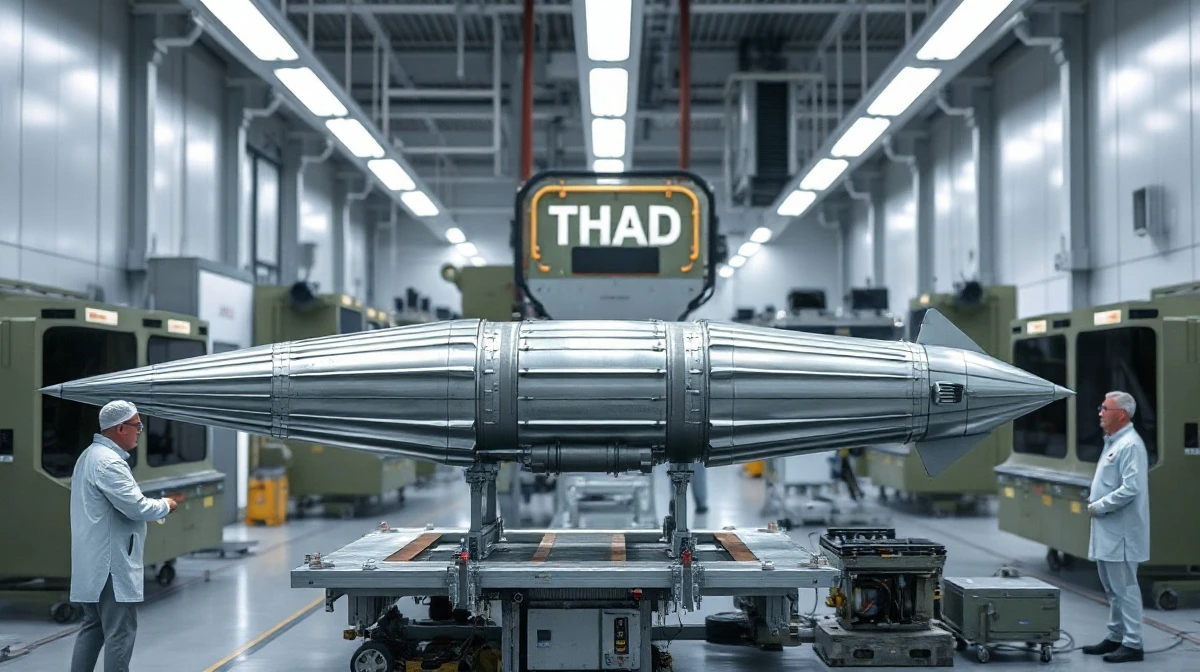
The Pentagon on Monday signed framework agreements with Northrop Grumman and Lockheed Martin aimed at dramatically expanding production of missile-defense interceptors, part of a broader push to rebuild the U.S. defense industrial base. The deals are designed to quadruple output of Terminal High Altitude Area Defense (THAAD) interceptor structural components and support a threefold increase in Patriot Advanced Capability-3 (PAC-3) production, according to a War Department release.
Northrop Grumman said its portion of the agreements is worth a combined $3 billion, including a $2 billion deal to supply rocket motors and safety devices and a $1 billion agreement to increase deliveries of THAAD components. Lockheed Martin separately announced a seven-year contract modification for up to $53.86 billion for PAC-3s, bringing the total multiyear contract value to $58.62 billion following a $4.7 billion award in April.
Also read: Bailey Signals BOE Ready to Adjust Stance as Economic Data Evolves
Why the Pentagon is surging missile-defense output
The agreements give suppliers longer-term demand commitments needed to invest in tooling, facility upgrades, and workforce development, the War Department said. Michael Duffey, undersecretary for acquisition and sustainment, framed the deals as central to the administration’s defense strategy.
“Building the Arsenal of Freedom requires solid, dynamic supply chains at every level of the industrial base,” Duffey said in a statement. “Framework agreements with munitions components suppliers like Northrop Grumman are vital to accelerating the tripling of PAC-3 and quadrupling of THAAD interceptor production.”
Also read: Foxtons cuts costs as buyer caution drives 13% drop in sales revenue
The push comes amid heightened global demand for missile-defense systems, particularly in Europe and the Indo-Pacific, where allies have sought to replenish inventories drawn down by ongoing conflicts. The U.S. Army has been working to increase annual PAC-3 MSE missile production from about 600 units to thousands for both American forces and allied countries.
Northrop Grumman said it plans to raise PAC-3 solid rocket motor production at its Allegany Ballistics Laboratory in West Virginia, where the company has doubled tactical motor capacity since 2021 and expects to triple production capability by 2027. The company is also doubling solid rocket motor capacity at its Utah facilities and increasing capacity by 25% at its Elkton, Maryland, plant.
Second-source strategy and supply-chain resilience
The deal establishes a second source for solid rocket motors and increases production of ignition safety devices. The Pentagon said adding another rocket-motor supplier would increase competition and reduce supply-chain risks — a priority after years of supply bottlenecks in the munitions sector.
Under the THAAD agreement, Northrop will increase monthly deliveries of structural components, including interceptor shell cores, aft bulkheads, and heat-shield assemblies. The company has supplied components for the missile-defense system since 2002.
Ben Davies, Northrop Grumman vice president, said the company’s long-term investments in manufacturing technology positioned it to scale quickly. “Our long-term investments in breakthrough manufacturing technologies and resilient supply chains let us pivot from steady production to a production surge in record time,” Davies said. “As one of America’s leading producers of solid rocket motors, we’re supporting the administration’s push to accelerate munitions output.”
Northrop said it has invested more than $2 billion in munitions-related technologies and facilities since 2019, including more than $1 billion for solid rocket motor production.
What it means for the defense industry and taxpayers
The agreements signal a sustained shift toward multiyear procurement and industrial-base expansion, a departure from the annual contracting cycles that have historically limited suppliers’ ability to invest in capacity. For investors, the deals provide clearer revenue visibility for both Northrop Grumman and Lockheed Martin over the next several years.
For taxpayers, the scale of the investment raises questions about cost oversight. The Lockheed PAC-3 modification alone brings the total contract value to nearly $59 billion, and the Pentagon has not disclosed financial terms for the framework agreements beyond Northrop’s $3 billion figure.
The agreements were developed with the Munitions Acceleration Council, the Economic Defense Unit, the Missile Defense Agency, and the Office of the Under Secretary for Acquisition and Sustainment, the War Department said.
As the U.S. continues to supply missile-defense systems to allies and replenish its own stockpiles, the industrial-base expansion is likely to remain a focal point for defense policymakers. The next milestone to watch will be whether Northrop meets its 2027 production-capability target at Allegany and how quickly the second-source rocket motor supply chain matures.
This article is for informational purposes only and does not constitute financial advice. Defense contracting involves risks, and market conditions can be volatile.

