
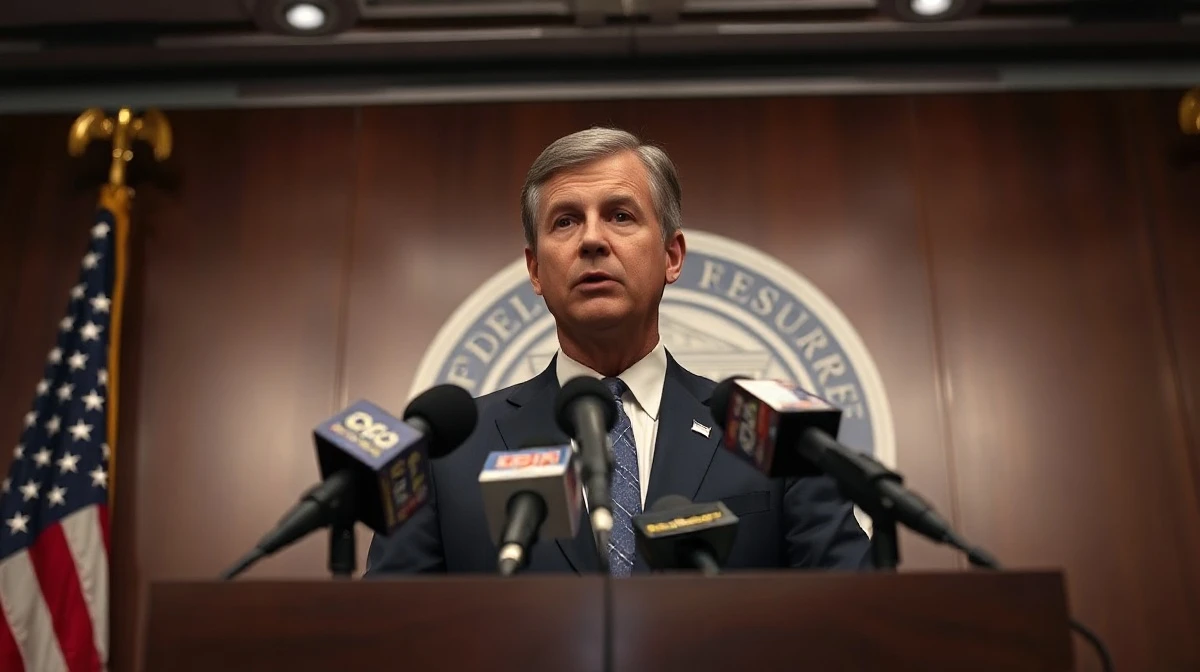
New Federal Reserve Chair Kevin Warsh delivered his first major policy address on Wednesday, striking a decidedly hawkish tone that signaled a shift toward tighter monetary policy and a sweeping promise to reform the central bank’s internal communication practices. Speaking at the Economic Club of New York, Warsh said the Fed must ‘restore its credibility on inflation’ and pledged to ‘fundamentally overhaul how we communicate our policy intentions to the public and to markets.’
Warsh, who succeeded Jerome Powell in January, used the speech to distance himself from the previous regime’s dovish leanings. He emphasized that the Fed’s primary focus must remain on price stability, even if that means keeping interest rates higher for longer than markets currently anticipate. ‘We cannot afford to declare victory prematurely,’ Warsh said, referencing recent inflation data that remains above the Fed’s 2% target.
Also read: OpenAI to pay $3.2 million to settle DOJ allegations it favored foreign workers over Americans
A promise to overhaul Fed communication
Beyond the hawkish policy stance, Warsh’s most concrete announcement was a pledge to reform the Fed’s communication strategy. He criticized the current framework as ‘opaque and prone to market misinterpretation,’ promising a new system that would provide clearer forward guidance and more timely explanations of policy decisions. Warsh said he would task a newly formed internal committee with delivering a proposal within six months.
Analysts noted that Warsh’s critique of the Fed’s communication echoes long-standing complaints from market participants, who have often struggled to parse the meaning of the Fed’s post-meeting statements and minutes. ‘This is a genuine attempt to reduce noise and improve predictability,’ said Reuters chief Fed correspondent Howard Schneider in a note to clients.
Also read: eBay doubles down on live shopping after Q2 GMV jumps 8x year-over-year
Market reaction and implications
Financial markets reacted swiftly to the speech. The S&P 500 fell 1.2% in afternoon trading, while the yield on the 10-year Treasury note rose 8 basis points to 4.37%. The U.S. dollar strengthened against a basket of major currencies, gaining 0.6% on the day. The moves reflected a repricing of rate expectations, with futures markets now pricing a lower probability of a rate cut at the Fed’s next meeting in March.
Warsh’s hawkish message comes at a delicate time for the U.S. economy. The labor market remains tight, with the unemployment rate at 3.7%, while consumer price inflation has ticked up to 3.1% year-over-year, above the Fed’s target. Some economists worry that keeping rates too high for too long could tip the economy into a recession, but Warsh made clear he views the risk of entrenched inflation as the greater threat.
What comes next
The next Federal Open Market Committee meeting is scheduled for March 18-19. Investors will be watching closely for any follow-through on Warsh’s reform promises, as well as the tone of the accompanying statement. Warsh’s speech suggests the new Fed chief is willing to tolerate short-term market turbulence in pursuit of long-term credibility. Whether that approach will be sustained depends on the economic data in the months ahead.
Frequently Asked Questions
What does a ‘hawkish’ Fed mean for interest rates?
A hawkish Fed is more concerned with controlling inflation than with promoting maximum employment, which typically leads to higher interest rates or a slower pace of rate cuts.
What reforms did Chair Warsh promise?
Warsh promised to reform the Fed’s communication strategy, including more transparent forward guidance and a potential review of the Fed’s dual mandate framework.
When did Kevin Warsh become Fed Chair?
Kevin Warsh was sworn in as Chair of the Federal Reserve on January 20, 2025, succeeding Jerome Powell.
How did markets react to Warsh’s speech?
Markets initially sold off on the hawkish tone, with the S&P 500 falling 1.2% and the 10-year Treasury yield rising 8 basis points before stabilizing.

