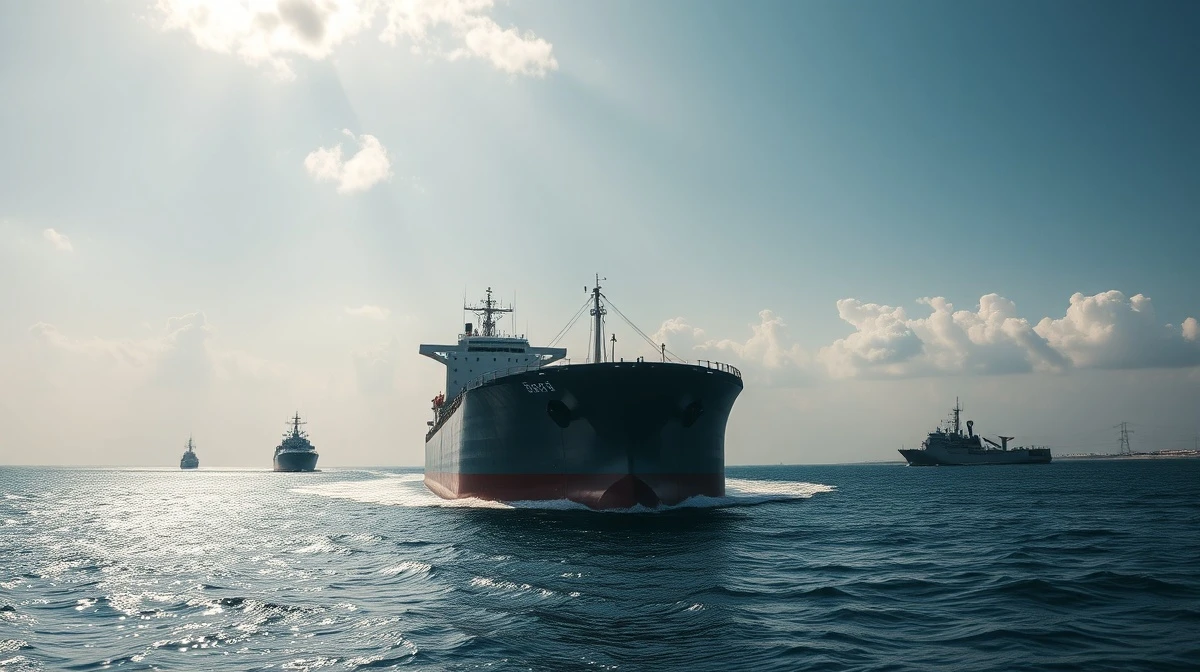
Crude oil prices staged a partial recovery on Thursday after reports emerged that the United States is considering restarting naval operations to guide commercial ships through the Strait of Hormuz, following a brief pause amid pushback from Gulf allies. The development comes as markets closely watch diplomatic signals between Washington and Tehran over a potential deal to ease the blockade of Iranian ports and reopen the strategic waterway.
Market Moves and Diplomatic Signals
June West Texas Intermediate crude oil futures (CLM26) settled at a modest loss of 0.28% on Thursday, while June RBOB gasoline futures (RBM26) declined 0.10%. Prices had fallen earlier in the session after Al Arabiya, a Saudi-affiliated news outlet, reported that agreements had been reached to ease the US naval blockade of Iran in exchange for a gradual reopening of the Strait of Hormuz. However, crude recovered much of those losses following a report that the US is looking to restart the escort operation as soon as next week, providing naval and air support to commercial vessels transiting the strait.
Also read: SpaceX, OpenAI, and Anthropic: The AI IPO Wave That Could Reshape Public Markets
The Wall Street Journal reported that Saudi Arabia and Kuwait have lifted restrictions on the US military’s use of their bases and airspace, after Iran launched missiles and drones at the United Arab Emirates in response to the earlier US effort to reopen the strait. Those restrictions had been imposed after senior US officials downplayed Iranian attacks on the Persian Gulf.
Supply Disruption and Global Energy Crisis
The continued closure of the Strait of Hormuz threatens to deepen an already severe global energy crisis. Approximately one-fifth of the world’s oil and liquefied natural gas transits through the strait, making it one of the most critical chokepoints for global energy supplies. Goldman Sachs estimates that crude output in the Persian Gulf has been curtailed by about 14.5 million barrels per day, and that the disruption has drawn down nearly 500 million barrels from global crude stockpiles. The investment bank warns that stockpiles could fall by another 500 million barrels by June if the blockade persists.
Also read: SpaceX IPO Allocation Leaves Binance, Kraken Users Empty-Handed Despite Massive Demand
Persian Gulf oil producers have been forced to cut production by roughly 6% as local storage facilities reach capacity. The International Energy Agency reported on April 13 that about 13 million barrels per day of global oil supply has been shuttered by the Iran war and the closure of the strait, and that more than 80 energy facilities have been damaged during the conflict, with recovery potentially taking up to two years.
Broader Geopolitical and Market Context
The situation is further complicated by the ongoing Russia-Ukraine war, which continues to restrict Russian crude exports. Ukrainian drone and missile attacks have targeted at least 30 Russian refineries over the past ten months, limiting Russia’s crude oil export capabilities. Meanwhile, OPEC+ announced a production increase of 188,000 barrels per day for June, though such hikes appear unlikely given that Middle East producers are being forced to cut output due to the conflict.
In a potentially bearish development for crude prices, the United Arab Emirates announced on April 13 that it will leave OPEC effective May 1. As the third-largest producer in the cartel, the UAE’s exit allows it to boost production without being constrained by OPEC’s output quotas.
Conclusion
The crude oil market remains highly sensitive to developments in the Strait of Hormuz and broader Middle East geopolitics. While diplomatic signals suggest progress toward easing the blockade, the situation remains fluid, and any resolution could take days or weeks to materialize. Traders and energy consumers alike should prepare for continued volatility as the world watches for concrete steps toward reopening the strait and restoring global oil flows.
FAQs
Q1: Why is the Strait of Hormuz so important for global oil markets?
The Strait of Hormuz is a narrow waterway between Iran and Oman through which about 20% of the world’s oil and liquefied natural gas passes. Its closure disrupts global supply chains and can cause significant price spikes.
Q2: What is the current status of US-Iran negotiations?
The US has presented a proposal to Iran that would gradually reopen the Strait of Hormuz and lift the US naval blockade on Iranian ports. Iran is expected to respond via Pakistan in the coming days. President Trump has stated that the blockade will remain in full force until a deal is fully agreed.
Q3: How much oil supply has been lost due to the conflict?
Goldman Sachs estimates that crude output in the Persian Gulf has been curtailed by about 14.5 million barrels per day. The International Energy Agency reported that about 13 million barrels per day of global oil supply has been shuttered by the Iran war and the closure of the Strait of Hormuz.